Before moving on, I want to review a few things we discussed previously, because they are important. We talked about the covenant God made with Noah. That covenant was unconditional. God promised that He would watch over Noah’s descendants and that there would never again be a flood that would destroy the earth. We also talked about the new covenant that God has made with His people. Jesus referred to it when He said, “This is the new covenant in my blood.” Every time we observe communion, we are reminded of that covenant.
When you stop and think about it, it is amazing that the God of the universe would make covenants with people at all. He made a covenant with Adam. Adam failed that covenant because it was conditional. God said, in effect, “I will do this if you do that.” God made a covenant with Noah. Later He made a covenant with Abraham. He made a covenant with David. And He promised the new covenant.
The primary passages describing the new covenant are Jeremiah 31:31–34 and Ezekiel 36:26–27. When we put those passages together, several promises stand out.
First, God promises a new heart. He removes the old stony heart and replaces it with a heart that is soft, pliable, and able to be faithful.
Second, He promises that He will cause His people to walk in His ways. That is a remarkable statement. To cause something means to make it happen. God causes the recipients of the new covenant to walk in His judgments and His ways.
Third, there is complete forgiveness of sins. In addition to those promises, God gives a new spirit. He also places His own Spirit within His people. We know Him as the Holy Spirit.
Finally, He promises to put His law in our minds and upon our hearts.
So the new covenant includes a new heart, a new spirit, the presence of the Holy Spirit, forgiveness of sins, God causing His people to walk in His ways, and His law written on their hearts.
Is that covenant conditional or unconditional? In one sense it is unconditional because God says, “This is what I am going to do.” Yet a person becomes a recipient of those blessings by believing God’s promise. Not everyone in the world is presently enjoying those covenant blessings. A person receives them as a gift. We trust Christ. We receive what we call salvation.
But Christianity is more than simply being convinced that certain facts are true. People can be argued into political positions or persuaded of various viewpoints. Christianity is different. A person trusts Christ. He believes Him. Abraham believed God, and it was counted to him for righteousness. In the same way, we believe what God has said. God says that if we believe on His Son, He will save us. We receive that promise and trust Him.
Some people say they are trying to believe. But trying to believe is not the same thing as believing. Believing means actually trusting that God’s promises are true and that He means what He says. When a person trusts Christ, God does what He promised. He replaces the old heart with a new heart. He gives a new spirit. He gives the Holy Spirit. He causes that person to grow and to walk in His ways through His Word and through a relationship with Him in prayer. He writes His law upon the heart.
That is transformation. As 2 Corinthians 5:17 says, “If any man be in Christ, he is a new creation.” A Christian has a new heart. He has new motivations. He loves God. He loves God’s people. He loves the church. He loves prayer. He loves fellowship with God because his heart has been changed. That is what God promises in the New Covenant.
Noah’s Sons and the Spread of the Nations
Genesis 9:18 introduces us again to Noah’s sons: Shem, Ham, and Japheth. We are also told that Ham was the father of Canaan. The name Canaan immediately reminds us of the land that Israel later entered and of the Canaanites who became such a significant part of Israel’s history.
The text says that from Noah’s three sons the whole earth was populated and scattered abroad.
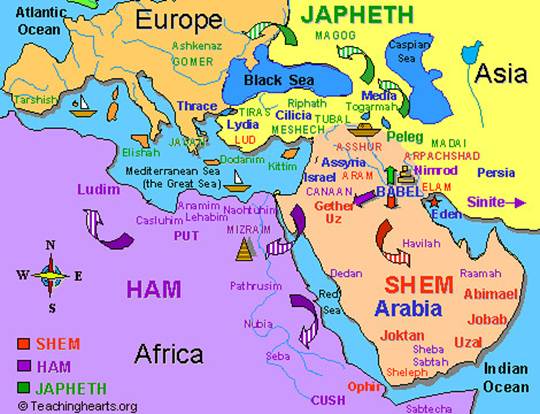
When you look at the map showing the descendants of Noah, it becomes easier to visualize what happened. Generally speaking, Ham’s descendants settled throughout much of Africa. Shem’s descendants occupied areas including the Arabian Peninsula, Israel, and Assyria. Japheth’s descendants spread into parts of Asia and eventually into Europe as well.
This also helps explain the word “Semite.” When people speak of antisemitism today, they are speaking about hostility toward Jewish people. The word comes from Shem. Over time the spelling shifted, and descendants of Shem became known as Semites.
The Jewish people are not the only Semites, however. There are many other peoples in the Middle East who also descend from Shem.
Most of us, judging from our European ancestry, are probably descendants of Japheth somewhere along the line, though after all these centuries there has certainly been much mixing among peoples.
Noah’s Vineyard and the Curse on Canaan
After the flood, Noah became a man of the land and planted a vineyard. Eventually Noah made wine, became drunk, and lay uncovered in his tent. One thing we often overlook is that this was not an event that happened immediately after leaving the ark. Grapevines take years to mature before they can produce grapes suitable for making wine. There is at least a span of several years between Noah planting the vineyard and the events that follow.
Ham saw his father’s nakedness and then told his brothers. Shem and Japheth responded differently. They took a garment, laid it on their shoulders, walked backward into the tent, and covered their father without looking at him.
Exactly what happened in the incident is not entirely clear. Noah later awoke and knew what his younger son had done to him. Beyond that statement, Scripture does not explain everything. We can speculate, but we really do not know.
What follows is even more surprising. Noah did not pronounce a curse upon Ham. Instead, he said, “Cursed be Canaan.” Canaan was Ham’s son.
That raises questions. Was Canaan present? Was he involved somehow? The text does not tell us. The story itself focuses on Noah, Ham, Shem, and Japheth. Yet Noah’s words fall upon Canaan. The curse declared that Canaan would become a servant of servants to his brothers. Whether Noah was speaking only of Canaan personally or of his descendants as well is not entirely clear. My own impression is that Noah intended both Canaan and the family that would come from him.
Noah then pronounced blessing upon Shem. “Blessed be the Lord, the God of Shem.”
He also predicted that Japheth would dwell in the tents of Shem. That language seems to suggest some kind of hierarchy in which Shem occupies a position of prominence. Canaan, meanwhile, would serve both.
Afterward we are told that Noah lived 350 years after the flood and died at the age of 950. It is difficult to grasp a lifespan of that length. If Noah’s funeral were taking place this week, his birth would reach back nearly a thousand years before our own time. Thinking in those terms reminds us just how immense these lifespans were.
The Table of Nations
Genesis 10 records the generations of Noah’s sons and the nations that descended from them. Many of the names in this chapter later appear elsewhere in Scripture.
Among Japheth’s descendants we find Magog, Meshech, and Tubal. These names appear again in Ezekiel 38 and 39 and in Revelation 20 in connection with the final conflict often associated with Armageddon.
Some prophecy teachers have attempted to connect Magog with Russia and Meshech with Moscow. Historically, however, there does not seem to be a clear connection between Meshech and Moscow. Nevertheless, these names do reappear later in biblical prophecy.
As the genealogy continues, verse 5 mentions that the peoples were separated according to their lands, families, and tongues. That raises an interesting question.
The confusion of languages occurs in the next chapter at Babel. So how can chapter 10 already speak of different tongues?
One possibility is that the word refers to dialects rather than entirely different languages.
Another explanation, which I think makes the most sense, is that Moses is writing a genealogy that includes future history. Moses wrote long after these events occurred. Looking back, he describes where these family lines eventually ended up and how they were divided. The language is written from the perspective of later history even though the events had not yet happened at the point being described. In that sense, the genealogy tells us what became of these descendants.
Among Ham’s descendants we encounter Mizraim, which is the Hebrew name for Egypt. That tells us that Egypt traces its origins back to Ham’s family line.
We also read about Cush, whose son was Nimrod. Nimrod became famous as a mighty hunter before the Lord. Apparently his reputation became so well known that people used his name as a comparison for exceptional hunters.
More importantly, we learn that the beginning of his kingdom was Babel. That immediately connects him to the events of the next chapter.
His kingdom also included cities in Shinar, the region we would associate with Iraq today. From there he went into Assyria and built Nineveh. When we later read the book of Jonah and encounter Nineveh, we discover that the city’s founder was Nimrod, a grandson of Ham.
As the genealogy continues, many familiar names appear. We encounter Sidon, the Jebusites, the Amorites, the Hivites, and many others.
These are the peoples who later become intertwined with Israel’s history.
The Philistines are also mentioned. And we know the trouble that Israel had with them.
In fact, many of the conflicts that later arise in Israel’s history can be traced back to these family lines descending from Noah’s sons.
The borders of the Canaanites are described as extending toward places such as Gaza, Sodom, and Gomorrah. Those names continue to appear throughout the biblical story.
“In His Days the Earth Was Divided”
Among the descendants of Shem we eventually come to Eber and his son Peleg. The text says, “In his days the earth was divided.”
There are two common ways of understanding that statement.
One view is that it refers to a physical division of the earth, perhaps involving continents separating. Personally, that seems less likely to me. While I believe great geological changes accompanied the flood, it is difficult for me to see this verse referring to a continental breakup occurring this late in history.
The second possibility is that the division concerns people rather than the planet itself.
The Hebrew terminology can refer to the inhabited world, to people, rather than to the earth as a physical globe. In that sense, the verse could be describing the division of the peoples at Babel. The nations were separated as languages were confused and families spread throughout the earth. That interpretation fits well with God’s command after the flood. He told humanity to multiply and fill the earth.
Instead, people preferred to stay together. They wanted to remain in one place and make a name for themselves. God therefore divided their languages, forcing them to spread out across the world and accomplish the very thing He had commanded.
The Tower of Babel
Genesis 11 records the account of Babel.
The people sought to build a tower reaching upward toward heaven. Their goal was not merely construction. They wanted to make a name for themselves. Human pride has always had that tendency. People want recognition. They want to be admired. They want to be celebrated. Not simply appreciated for faithful service, but exalted. That was the spirit behind Babel.
God responded by confusing their languages and scattering them throughout the earth. The project came to an end, and the people dispersed into the various nations that would populate the world.
The Story Turns Toward Abraham
The latter part of Genesis 11 contains another genealogy, particularly focusing on the descendants of Shem.
Eventually we arrive at Terah who became the father of Abram.
At that point the narrative begins turning toward Abraham and God’s call upon his life.
Before moving on to Abraham, it is worth noticing how often Noah and the flood continue to appear later in Scripture. Jesus spoke about Noah. Other New Testament writers referred to Noah and the flood as well. Those references remind us that these events remained important throughout the biblical story long after the flood itself had passed. We’ll be touching on some of those references in the next couple of weeks.
*Some articles on this publication or website are adapted from my recorded Bible teaching. I use transcription and editing tools (including AI-assisted editing) to convert spoken lectures into readable written form. The ideas, interpretations, and theological conclusions are my own and come directly from my teaching.