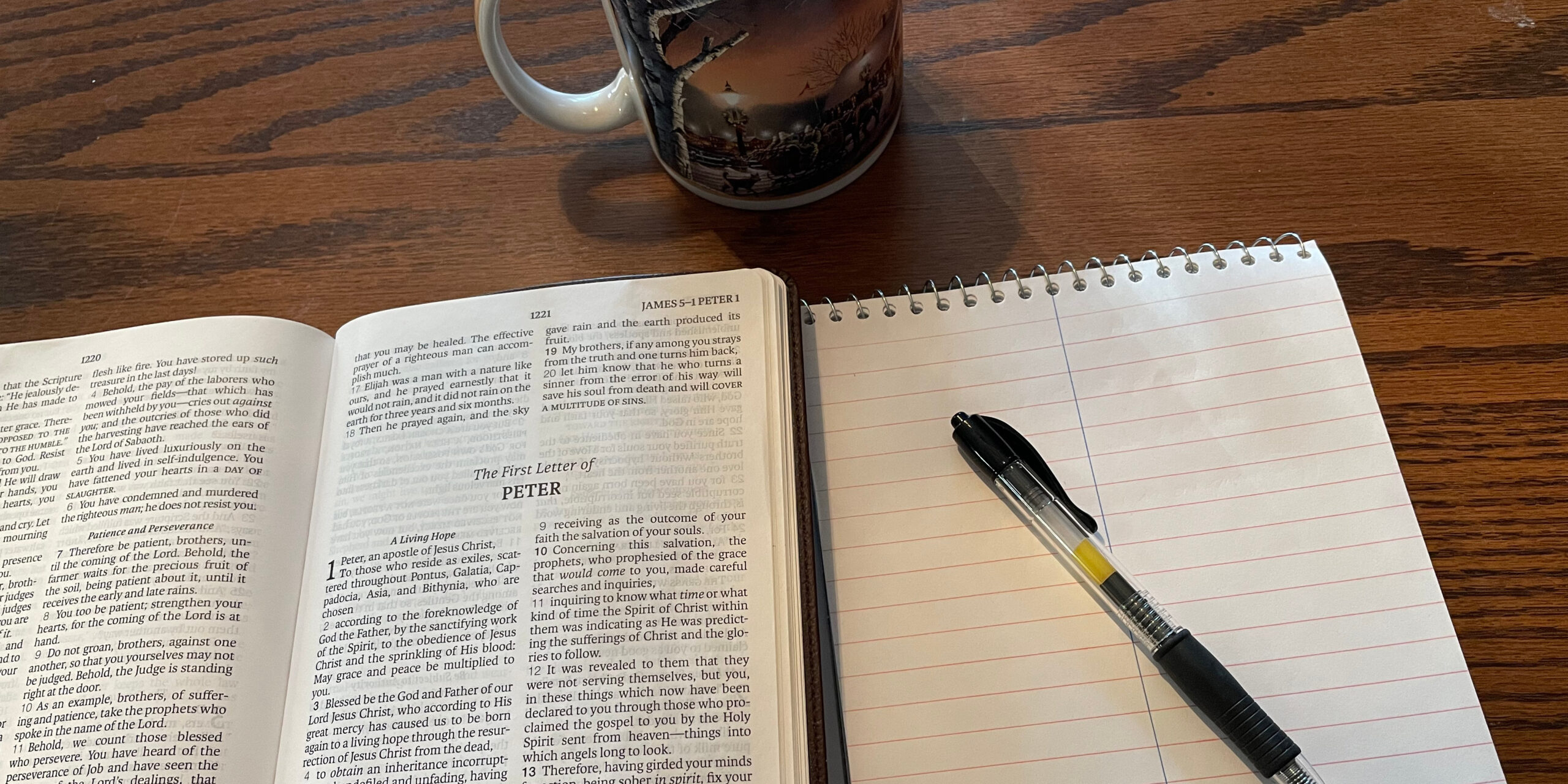
Good Morning! It’s that time again when we take the opportunity to take a few minutes to meditate on God’s Word. We’re thinking through Peter’s encouraging message to those who are scattered throughout their known world. Today I want us to think about the first part of 1 Peter 1:8.
“And though you have not seen Him, you love Him.” That’s true of us too, isn’t it? We haven’t seen Him. Why would we love someone we have never seen?
Peter, of course, saw Jesus and spent three years with Him. He knew Him well. Probably Peter could say what John said, “What was from the beginning, what we have heard, what we have seen with our eyes, what we beheld and touched with our hands, concerning the Word of Life” (1 John 1:1). The things Peter could share with the people he ministered to are many, and because we have the entire New Testament, we know some of these same things even though we have never seen Christ or met Peter:
Jesus loved Peter even though he had betrayed Him, and He made sure Peter knew it. Remember, “Simon … do you love Me?” (John 21:15-21).
Peter saw that Jesus “went about doing good, and healing all that were oppressed,” and he testified to that in his preaching (Acts 10:38).
He knew personally that Jesus was “meek and lowly” and offered rest (Matt. 11:29).
He could testify about Jesus’ death and resurrection (John 20:4).
He could tell people firsthand about the transfiguration (2 Peter 2:16-18).
He could share about the miraculous catch of fish (Luke 5)
Out of love and compassion, Jesus healed Peter’s own mother-in-law (Mark 1:29-31).
He saw Jesus’ ascension and heard the promise of His return (Acts 1:11).
… and so much more.
Can you imagine what it would have been like to hear Peter share these personal experiences? What excitement and certainty we would have heard in his voice! Peter was able to tell people that even though they had not seen what he saw, he could assure them that they could experience this same Christ by faith. We hear this excitement in the letter he has written, and through the generations this same message has come down to us. As a result, we can love the same Lord Peter loved even though we have not seen Him in person.
Last time we thought about 1 Peter 1:6. My intention had been to put verse 7 with it, but that made it a longer read than I really wanted. It’s like eating. Sometimes we need to take smaller bites and chew them longer.
Peter reminded us to rejoice because of the tremendous promises of God even when we are faced with difficult trials. Those trials are often necessary because God uses them to trim and prune us into greater godliness.
Verse 7 says, “so that the proof of your faith, being more precious than gold which is perishable, even though tested by fire, may be found to result in praise and glory and honor at the revelation of Jesus Christ.”
The “so that” at the beginning of verse 7 tells us there is a reason for the trials. The trials and testing we go through are the proof, the genuineness, the trial of our faith. Those three words are from three different translations. The Greek word behind them is similar to our word documentation. The trials and difficulties document the genuiness and reality of our faith. Just like a metal is tested by fire to make sure it is actually gold and not some counterfeit material, our faith is tested by trials. And the metal, even though it might be genuine gold is still perishable, whereas true faith is not.
As our faith gets tested, we ourselves have some clue as to how we are doing. If we don’t do well on one of life’s tests, we know where we need God’s work in our lives to make our faith stronger. After Jesus gave the disciples some instruction in Luke 17, the disciples replied, “Increase our faith!” That’s the request we need to make often in life.
The end of 1 Peter 1:7 tells us that this documentation of our faith will result in praise and glory and honor when Jesus Christ is revealed. The kind of documented transformation of a man or woman that remakes us and renews us into Christ’s image is only something that Jesus Christ Himself can accomplish as He works through us. The praise, honor, and glory goes to Him on that day!
We’ve been working our way through Genesis, and then we made what might have seemed like a big jump over to the book of Hebrews. The reason for that is tied directly to Genesis 2.
Genesis 2 begins with God resting on the seventh day. And the author of Hebrews picks up that truth and uses it to explain something deeper—what the believer’s true rest is. So that’s why we went there, and that’s what we’re continuing to look at.
The author of Hebrews is drawing from Psalm 95, where David reflects back on the wilderness generation. Those people had the opportunity to enter God’s rest, but they didn’t. They were disobedient. They didn’t believe. And so they missed it.
Then David says in Psalm 95, “Today, don’t harden your hearts like they did.” And Hebrews takes that and brings it right into the present—into our lives.
The Weight of “Today”
That word “today” keeps coming up, and it matters more than we usually think.
We tend to live either in the past or in the future. We think about what we wish we had done, or we worry about what might happen next week. But the reality is, all we ever actually have is today.
If tomorrow comes, it will be “today” when it gets here.
That’s true in everyday life. If someone says, “Someday I want to learn something,” that “someday” has to become today at some point, or it never happens. It’s the same with simple things—we tell ourselves we’ll get to it later, but what really matters is whether we do it now.
And the writer of Hebrews presses that same point spiritually. Today is the day not to harden our hearts. Today is the day to enter God’s rest.
The Problem: Hearing Without Believing
Hebrews says something that can be a little uncomfortable. It says the people in the wilderness had good news proclaimed to them, just like we do—but it didn’t profit them.
Why not?
Because they didn’t unite it with faith.
You can hear the Word of God, sit under teaching, listen to a message—and it may not benefit you at all. Not because the message wasn’t true, but because it wasn’t believed.
Belief and obedience go together. If I really believe what God says, it shows up in how I live. It’s not just agreeing with facts. It’s responding to what God has said.
God’s Rest and Finished Work
Hebrews then brings us back to creation:
“God rested on the seventh day from all his works.”
Why did He rest? Because the work was finished. There was nothing left to do. He didn’t take a break so He could get back at it the next day. He was done.
That becomes the pattern.
God rested because His work was complete. And now we’re told that there is a rest for us—and that entering that rest somehow means resting from our works the same way God rested from His.
That’s where the question comes in: what works are we supposed to stop?
What Are “Dead Works”?
To understand that, we have to look at what the same writer calls “dead works.”
Hebrews 9 talks about being cleansed from dead works. And I’m convinced those works include more than just trying to earn salvation. We know we can’t earn salvation. But there’s another kind of work we fall into—especially as Christians. It’s when we try, out of ourselves, to produce something for God. We try to be better, to be more acceptable, to be more pleasing—coming from the wrong place within us.
Even as believers, we can operate that way.
Isaiah says that “all our righteousnesses are as filthy rags.” That means there is a kind of righteousness we can produce that still isn’t what God is after.
So the issue isn’t just whether we’re doing the right things. It’s where those things are coming from.
The Subtle Shift in Motivation
I’ve seen this in my own life, and I’ve heard others describe it too. You can be doing all the same outward things—living a clean life, making good decisions—but something underneath changes. The motivation shifts.
You might be doing it for approval, or out of habit, or because that’s what you’ve always done. And from the outside, nothing looks different. But inside, something is off.
That’s the difference we’re trying to get at. And it’s not always easy to identify. It’s something you have to discern before the Lord.
Are We Perfected by the Flesh?
Galatians presses this even further.
“Having begun by the Spirit, are you now being perfected by the flesh?”
We understand that salvation is by faith. But then we can slip into thinking that our growth—our sanctification—comes by our own effort. The passage pushes back on that.
Just as we began by faith, we continue by faith. That doesn’t mean we do nothing. But it does mean that what we do is not coming from our own strength in the way we often assume.
God Working Within Us
Philippians brings balance to this.
“Work out your own salvation with fear and trembling… for it is God who is at work in you, both to will and to do of His good pleasure.”
That’s a striking statement. Even the desire to do what is right—the will itself—is something God is working in us. And the doing flows from that. So when I find myself wanting to do what is right in a genuine way, that didn’t originate with me. That’s God at work.
No Confidence in the Flesh
And then there’s this:
“We… worship in the Spirit of God… and put no confidence in the flesh.”
But we tend to do the opposite. We hear what we’re supposed to do, and our instinct is, “I can do this.” There’s a kind of determination that sounds right but is rooted in the wrong place. And that’s the line that’s hard to see.
Seeing Sin More Clearly
At one point, this became very personal for me.
For a long time, I thought of my daily failures as a handful of small things—maybe two or three I needed to confess at the end of the day.
But then I started thinking about what Jesus actually said: love God with all your heart, soul, mind, and strength, and love your neighbor as yourself.
If that’s the standard, then how often do I fall short? Not a few times a day, but constantly.
And when I realized that, it changed how I saw forgiveness. It wasn’t that I had a few minor things to clean up. It was that the whole day fell short of God’s standard, and yet all of those failures and sins were all forgiven.
The Limits of Our Effort
We can try to improve. We can raise the level a little. But the gap between where we are and God’s standard is still enormous. So when we respond by saying, “I’m going to do better,” we’re still operating in that same framework of self-effort. And that’s where the frustration comes in.
We sing things like giving everything to God, putting it all on the altar—but it doesn’t stay there. It jumps off of the altar almost immediately. That’s been my experience over and over again.
Resting in Christ Instead
What this passage is pointing us toward is something different. Not a life of trying harder from the same place, but a life of resting in Christ—trusting what has already been finished.
God finished His work in creation.
Christ finished His work on the cross.
And the invitation is to rest in that.
To live out of that reality—not striving to reach some standard so that God will accept us more, but living as those who are already accepted.
And from there, to live, to love, to serve—not perfectly, but from a different place.
That’s the rest that is being offered.
May every one of us find that place of rest each day of our lives so that we can serve God faithfully and from a true heart of faith.
We are meditating our way through First Peter. Today we are going to think through 1 Peter 1:6-7.
“In this you greatly rejoice, even though now for a little while, if necessary, you have been grieved by various trials so that the proof of your faith, being more precious than gold which is perishable, even though tested by fire, may be found to result in praise and glory and honor at the revelation of Jesus Christ.”
We learned in the previous few verses that our inheritance is reserved and guarded for us in heaven, and we ourselves are protected by the power of God through faith. These are the strong and encouraging promises that cause the joy he writes about in verse 6. But it’s interesting to note that this joy is present even though they are going through difficult trials.
We too are not immune to the trials of life. Some are just hardships that are embedded in life itself, and some may be coming because we are Christians and carry His reproach with us. In spite of the hardships, wherever they come from, we can still rejoice because the promises are so tremendously great.
You might be thinking, “my troubles are so difficult that I have a hard time rejoicing even though God’s promises are powerful and encouraging.” Discouragement is one of the fiery darts of the devil and the defense against those is the shield of faith. The author of a devotional I’ve been reading lately says that we must pick up our shield and use it. What that means to me is that I need to talk to myself as David recorded in Psalm 42, “Why are you cast down, O my soul? And why are you disquieted within me?” Put your faith to work by grabbing the promises of God, meditating on them, and then claiming them once again for yourself. Take the promises in verses 3-5 and dwell on them until your heart begins to rejoice in the surety of God’s power to protect both our inheritance and ourselves until the final day.
In the devotional today I want to move us a little further in our meditation on 1 Peter, this time focusing on verse 5. Here are the key parts of verses 3-4 along with verse 5.
Blessed be the God and Father of our Lord Jesus Christ, who according to His abundant mercy has begotten us again … to an inheritance incorruptible and undefiled and that does not fade away, reserved in heaven for you, who are kept by the power of God through faith for salvation ready to be revealed in the last time.
Last time we learned that a Christian has been born again to an inheritance that is kept and reserved in heaven for us. But we stopped before the end of the sentence. Verse 5 goes on to let us know that not only is our inheritance kept in heaven, but we are kept and protected by the power of God.
We need to stop and think about how much power we’re talking about here. We say God is all-powerful, omnipotent. It is that almighty power that protects us. Do you think there is anything that can overpower God so that our protection would be at risk? I don’t think so!!
How are we protected? Our passage tells us: we are protected* through faith. But it is not a faith in faith. It is faith in the unfailing promises of God who has called us and saved us. The protection through God’s power has a goal, a target. It is for a salvation that is prepared and ready to be revealed. When? In the last time. We don’t know how far away that last time is, but we do know that our salvation, just like our inheritance, is protected and guarded until that day when it is fully revealed when Christ returns.
These are promises that each one of us should take hold of by faith. They bring assurance resulting in our present joy.
*When I think of God’s protection, I think of these words from the hymn Day by Day: “The protection of His child and treasure is a charge that on Himself He laid.” Someone has to protect us and God took that responsibility upon Himself.
How would you react if you found out that someone had left a very large inheritance for you in a safe deposit box at a nearby bank? No one else can get to it but you.
That’s the scenario that is pictured for us in 1 Peter 1:4-5. Last week we saw that God has caused us to be born again to a living hope through the resurrection of Jesus Christ. I mentioned that it is a real hope, not a hope-so hope. The sentence continues into the next couple of verses. We have this hope, but there is a target for it. The hope God gives is leading us somewhere.
Verse 4 tells us that it is leading to an inheritance that is incorruptible, undefiled, and unfading, already set aside in heaven for us. First of all, this inheritance is incorruptible or imperishable. The inheritance cannot rust or rot or spoil. It remains whole and intact. Secondly, it is undefiled, pure, untainted with any impurities or pollutants. It has no faults in it. And third, it doesn’t fade away. It doesn’t just melt away like the snow that’s been around our house for more than a month. Let your mind ponder those three words that describe the surety of the inheritance God has provided for us through Christ.
Finally, the Bible says it is reserved in heaven for us. The word is a very strong word like “guarded” or “protected,” and it is written in a verb tense that means the guard and protection has already been placed on this inheritance and that protection is still in place to this day. In other words, when we get to heaven, someone isn’t going to have to look around and see if he can find it under a bed somewhere. The inheritance is in the vault, and it is being guarded 24/7 from the moment it was placed there. May God strengthen and encourage your heart this morning as you consider these amazing descriptions of God’s provision for our eternal salvation.
This is one of the most important lessons I’ve learned in my life. And it’s not easy to apply. That’s part of why I keep coming back to it. Grace means a great deal to me, and I see many Christians struggling right here.
What I’m arguing is this: the Sabbath rest of God after creation is a picture—a type—of the kind of rest God is offering you and me today.
And I want to be clear about something right from the beginning. We’re not talking about death. We’re not talking about heaven. We’re talking about a rest that is available right now. Today is a day we can be entering God’s rest. And when tomorrow comes, it will be today again—and the same offer will still be there.
What Do We Mean by “Rest”?
Before we go further, it helps to slow down and ask what we mean by rest.
When we think of rest, we think of things like ceasing activity, relaxing, being restored, letting go of pressure. There’s even a kind of surrender involved. When you lie down for a nap, you’re letting something go. The pressure is off.
That idea—the pressure being off—is important. Because what we’re going to see is that God is offering something deeper than physical rest. He’s offering a rest that reaches into the heart.
The Warning from the Past
The passage we’re working through brings us into Hebrews 3, where the author quotes Psalm 95. And in that psalm, God is looking back to Israel in the wilderness. Those people had seen His works for forty years. And yet God says of them:
“They always go astray in their heart… As I swore in my wrath, they shall not enter my rest.”
The key issue wasn’t just outward behavior. It was the heart. And specifically, it was unbelief. The author of Hebrews presses that point. He warns:
“Take care… that there not be in any one of you an evil, unbelieving heart that falls away from the living God.”
Notice how those words are tied together—evil and unbelieving. Disobedience and unbelief are not really separate things. They go together. At the root, the sin-issue is that we don’t believe what God has said.
Encouraging One Another—Today
Because of that danger, we’re told to encourage one another.
“Encourage one another day after day, as long as it is still called ‘Today.’”
That word “today” keeps coming up. It’s not abstract. It’s immediate. When should we encourage one another? Today. And when tomorrow comes? It will be today again.
This isn’t something we put off. The reason we encourage each other now is so that none of us will be hardened by the deceitfulness of sin. There is a real danger, even for believers, of a kind of hardening that comes from not believing God.
And God uses both His Spirit and His people to keep us. Our security isn’t some detached guarantee. It’s something God actively sustains—through His Word and through one another.
The Problem: Hearing Without Believing
The Israelites had good news proclaimed to them. God promised to meet their needs. He promised provision in the wilderness. But the word they heard did not profit them.
Why?
Because it wasn’t united with faith. They heard it—but they didn’t believe it.
And that’s where this becomes very close to home. God says, “I will meet your needs.” But we find ourselves thinking, “I’m not sure He will—not in this situation.” God says He gives peace. And yet we say, “I don’t have peace.” If God gave it and we don’t have it, where did it go? At some point, that raises a question: do we really believe Him?
If we truly believed that God has given peace, then we would live in that peace. The issue comes back again to belief.
Entering the Rest by Faith
The writer of Hebrews makes a remarkable statement:
“We who have believed enter that rest.” Not will enter. Enter. This is present reality. This rest is something believers are meant to experience now. And to help us understand it, the passage reaches all the way back to creation:
“And God rested on the seventh day from all His works.”
That rest of God becomes the model. The author connects it with the rest Israel failed to enter—and then says that rest is still available. How do we know it’s still available? Because the word “today” is still being spoken.
The door has not closed.
There Remains a Rest
This leads to one of the most important statements in the passage: “So there remains a Sabbath rest for the people of God.”
There remains a rest—for you, right now. Not next week. Not someday. Today.
And this rest is more than stopping activity. It’s something deeper than that. It touches the heart, the inner striving, the pressure we carry.
Resting from Our Works
The passage brings us to this final idea:
“The one who has entered His rest has himself also rested from his works, as God did from His.”
That’s the picture. God finished His work—and He rested.
And we are told that there is a way for us, in Christ, to enter into that same kind of rest. Not by ceasing all activity—we still live, work, make decisions, raise families—but by ceasing the inner striving, especially the inner striving to prove yourself to God somehow. The grace of God forgives all sins and declares us righteous. The striving for perfection is over!
Ceasing the pressure.
Ceasing the sense that everything depends on us.
What That Looks Like in Real Life
I’ve been trying to think through what this actually looks like.
You go through your day—running errands, making decisions, dealing with responsibilities. Nothing outward necessarily changes. But inwardly, something is different. You are at rest. You’re no longer carrying everything. You’re no longer striving in the same way. The pressure has been lifted.
That’s not easy. I can tell you from experience—it’s not easy. You face real situations, real concerns, real stress. And there’s something in you that wants to hold on—to keep worrying, to keep managing, to keep carrying it. And yet God says, in effect, “Trust Me.”
And we respond, “But if I don’t carry this, who will?” And the answer is—He will.
There’s that verse about casting your cares on Him. And I’ve come to read it this way: not just that He cares about me, but that He does the caring for me. He carries what I’ve been trying to carry.
That’s the rest being offered.
God finished His work. And in Christ, we are invited into that same kind of rest—to say, in the middle of life, “It’s in His hands.”
And the question that remains is whether we will believe Him enough to enter into it.
*Some articles on this publication or website are adapted from my recorded Bible teaching. I use transcription and editing tools (including AI-assisted editing) to convert spoken lectures into readable written form. The ideas, interpretations, and theological conclusions are my own and come directly from my teaching.
We’re still in Genesis chapter 1—five weeks in now. It’s been a little slow going, but I wanted to make sure we didn’t rush past the end of the chapter, especially beginning in verse 29, which we didn’t get to last time.
What God Gave for Food
At the end of Genesis 1, we’re told what God provided for food. He says:
“Behold, I have given you every plant yielding seed that is on the surface of all the earth, and every tree which has fruit yielding seed; it shall be food for you.”
So what did Adam receive? Plants. Trees. Fruit. Herbs. Everything growing from the ground. And notably—no animals. We’re not even at the stage of clean versus unclean animals. There simply are no animals given for food at all. Both man and animals were plant-eaters. Verse 30 tells us that every beast and bird was also given green plants for food. That’s hard for us to picture. Lions eating vegetation. No predation. No death in that sense.And this is before the fall, so none of the frustrations we’re used to were present. No weeds. No disease. No fungus ruining crops. No worms in the fruit. Everything worked exactly as it was supposed to.
“Very Good”
Then we come to verse 31:
“God saw all that He had made, and behold, it was very good.”
Up to this point, God repeatedly said things were “good.” But here, at the completion of creation—especially after the creation of man—He says it is “very good.” The Hebrew intensifies it. Not just good—but fully, completely good. Everything is exactly as He intended. important. Creation wasn’t partial. It wasn’t unfinished. It wasn’t “good enough for now.” It was complete, and it pleased Him.
The Seventh Day: What God Did
As we move into Genesis 2:1–3, we’re really still finishing the creation account.
There are four things God does on the seventh day:
He finished His work
He rested
He blessed the day
He sanctified it
That sequence matters.
God Finished
When God finished, He didn’t stop because He ran out of time or energy. He stopped because there was nothing left to do. He had done everything that was necessary to complete His goals.
That’s different from how we experience work. We might stop working at the end of the day, but most of the time it’s not because everything is truly finished. There’s always more to do tomorrow. But when God finished, it was complete. Exactly as He intended. Nothing lacking. Nothing needing revision.
That’s how God works. He finishes what He starts.
God Rested
God rested—not because He was tired—but because the work was complete.
This rest is not inactivity. Later, Jesus makes it clear that God is still working. But He is at rest in the sense that His creative work is finished and fully sufficient.
God Blessed the Day
When God blesses something, He places His approval on it. It’s not a casual acknowledgment—it’s a full affirmation. He sets this day apart as something good for His creation.
God Sanctified It
To sanctify means to make holy—to set apart as special. So the seventh day becomes distinct. Not just another day, but one marked off by God Himself. Later, Jesus would tell us that the Sabbath was made for man and not the other way around. Unlike the pagan nations that would eventually live in the surrounding territories, God’s people are distinct. They understand that man should not work sunrise to sunset seven days a week.
“Hosts”: Everything Under His Command
Genesis 2:1 says the heavens and the earth were completed “and all their hosts.”
That word “hosts” is important. It can mean armies, but more broadly it refers to everything under God’s command. The stars, the heavens, all creation—everything exists under His authority. Nothing operates independently. Everything answers to Him.
The Sabbath in Israel
When we move forward to Exodus 20, the Sabbath becomes a command.
“Remember the Sabbath day, to keep it holy.”
Why? Because God already made it holy. Now Israel is commanded to treat it that way.
They were to rest completely:
No work
No labor from servants
No work from animals
The entire rhythm of life stopped.
And the reason given is creation itself—God rested, so they were to rest. In addition, God told them to keep the Sabbath because they had been a slave in Egypt. There again it pointed to the fact that His people were set apart, different.
Later, in Exodus 31, the Sabbath is described as a sign of the covenant between God and Israel. It wasn’t just a helpful practice—it was part of their covenant relationship with Him.
Before the Law: The Manna
Even before the Ten Commandments, we see a preview of Sabbath in Exodus 16 with the manna. They were to gather daily—but not hoard it. If they tried to store it, it spoiled. Except on the sixth day. On that day, they were to gather double, because no manna would come on the seventh day.
God was already teaching them a rhythm of trust and rest before formally giving the law. God would always make sure that they had enough.
What Happened by the Time of Jesus
By the time we get to the Gospels, the Sabbath had become something very different. The Pharisees had developed extensive rules—thirty-nine categories of prohibited work, each expanded into detailed restrictions. Simple actions—like picking grain, tying knots, carrying small items, or even writing a couple of letters—could be considered violations. The focus had shifted from the meaning of the Sabbath to the regulation of behavior.
Jesus and the Sabbath
In Mark 2, Jesus’ disciples pick grain on the Sabbath, and the Pharisees object.
Jesus responds with two key statements:
“The Sabbath was made for man, and not man for the Sabbath.”
“The Son of Man is Lord even of the Sabbath.”
That reframes everything. The Sabbath exists for human good—not as a burden. And Jesus, as Lord of the Sabbath, has authority over how it is understood and applied.In another instance (Mark 3), Jesus heals a man on the Sabbath and confronts the question directly:
“Is it lawful to do good or to do harm on the Sabbath?”
The issue is no longer technical compliance—it’s the heart and purpose behind the command.
The New Testament Perspective
When we come to Romans 14, Paul addresses how believers treat days.
“One person regards one day above another, another regards every day alike. Each person must be fully convinced in his own mind.”
This is a shift. Under the new covenant, Sabbath-keeping as a legal requirement is no longer binding in the same way it was for Israel. Some believers set aside a particular day with special focus on the Lord. Others treat all days alike. Both can be done in a way that honors God.
The Meaning That Remains
Even though the commandment structure changes, the meaning of the Sabbath does not disappear.
God rested.
And He invites us into that rest.
That’s the deeper reality.
Not merely setting aside a day—but entering into a way of living where we trust God, where we are not constantly striving, where we rest in His completed work. That doesn’t mean inactivity. God Himself is still working. But it does mean confidence. Peace. Trust. And that’s something we struggle with.
We go through seasons where life feels like constant striving—pressure, confusion, responsibility. And in the middle of that, God says: enter My rest.
That’s not easy. It’s something we have to learn.
As Scripture says, we are to “strive to enter that rest.”
There’s effort involved—not in working more, but in learning how to rest in Him.
Living It Out
Even practically, there is wisdom in stepping back. Not as a legal requirement—but as something good for us.
We don’t need to live seven days a week at full speed. There is value in setting time aside—time focused on God, time that is not driven by work.
Some treat Sunday that way very intentionally. Others don’t structure it the same way. But the principle remains: we were not made for endless striving. We were made to rest in God.
And learning how to do that—really do that—is something we grow into over time.
Blessed be the God and Father of our Lord Jesus Christ, who according to His abundant mercy has begotten us again to a living hope through the resurrection of Jesus Christ from the dead, to an inheritance incorruptible and undefiled and that does not fade away, reserved in heaven for you, who are kept by the power of God through faith for salvation ready to be revealed in the last time.”
Let’s start out with this — Blessed be the God and Father. What does it mean that God is blessed? Certainly, there is nothing we can do that adds to God’s situation to make Him happier, better off or more complete. That might be what it means when we are blessed by God, but God is totally complete in and of himself. I think this phrase is a way we human beings can express our praise and adoration and thankfulness for who God is and for all He has done. When we say, “Bless God!” we are thanking and praising God.
Father of our Lord Jesus Christ — I find that sometimes I read right over a phrase like this, wanting to get to the “meat” of the passage, but it is important to think about what Peter is saying here. He is making sure we understand who Jesus is. Remember, Peter is the guy who denied that he even knew Jesus. Now he is acknowledging that Jesus is the Son of God. Jesus is Lord, and His father is the God who is actually who we are actually praying to. He is the one who accomplishes all that the rest of this passage promises. And remember, this is the same Father we pray to when we pray, “Our Father who is in heaven….” That makes us brothers of Christ because the scripture says, “He is not ashamed to call them brothers” (Hebrews 2:11).
I think we’ll wrap this short devotional at this point. There really is a lot to meditate on this section. Sometimes we just need to slow down and pay attention.
For the next weeks I would like to draw some meditations from the book of First Peter. I have decided to use the books that Peter wrote to help me deepen my understanding of Jesus and the gospel since Peter followed Jesus around for so many years. These posts will give you the opportunity to think about Peter’s message along with me over the next several months.
Today let’s look at 1 Peter 1:1-2: “Peter, an apostle of Jesus Christ, to the pilgrims of the Dispersion in Pontus, Galatia, Cappadocia, Asia, and Bithynia, elect according to the foreknowledge of God the Father, in sanctification of the Spirit, for obedience and sprinkling of the blood of Jesus Christ: Grace to you and peace be multiplied.”
Let me just give you a few quick thoughts to whet your appetite to study the passage more thoroughly:
My first thought is to remember who wrote this. It was Jesus’s disciple Peter who had a habit of putting his foot in his mouth, often speaking before thinking. But now he is a leader in the church and reaching out to scattered Christians all throughout Asia Minor.
Notice that Peter refers to these people, along with all other believers as chosen by God long ago according to the foreknowledge of God the Father. My purpose here is not to get into a big debate about how all of this works, but it is interesting that God the Father, who is all-wise and all-knowing, chose us to serve and follow Him. Whatever this means, and however it works, it is an amazing thought! But the next section is where I really want us to focus. All of this takes place through the sanctifying work of the Spirit of God for obedience and sprinkling of the blood of Jesus Christ.
What does sanctification of the Spirit mean? It means that the Spirit of God sets us apart for God’s glory and His service. We once were part of the world system and walked according to the prince of the power of the air (Ephesians 2). But now, we have been set apart for God’s glory by the Holy Spirit. That’s an amazing thought to me.
The second half of the phrase tells us the purpose of this setting apart: It is for obedience and sprinkling of the blood of Jesus Christ. That means that God’s intention and goal is to make us obedient followers who have been cleansed and forgiven through the blood of Jesus. Putting this all together, you could say the Holy Spirit sets us apart to be cleansed by Jesus’s blood resulting in an obedient life. This is what the Christian life is all about. “If anyone is in Christ, he is a new creation; old things have passed away; behold, all things have become new” (2 Corinthians 5:17). Paul, in Romans 16, speaks of the mystery “made known to all nations, according to the commandment of the everlasting God, for obedience to the faith (Rom 16:25-26). That’s God’s goal, isn’t it? Obedient followers?