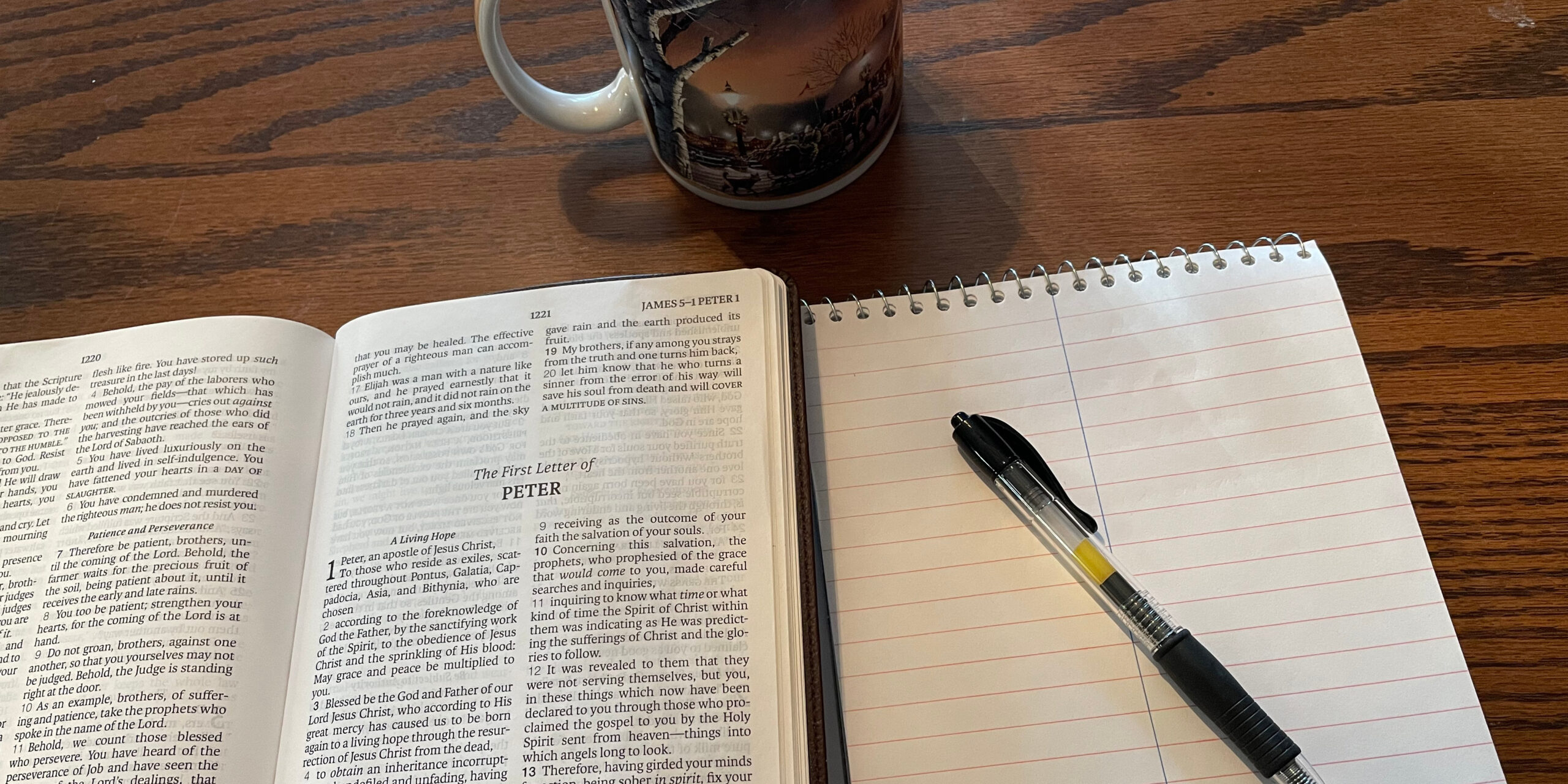
Good Morning. Let’s continue meditating on what Peter wants us to know and understand. This morning we are still thinking through First Peter 1:20-21.
“He [Christ] was foreordained before the foundation of the world, but was manifest in these last times for you who through Him believe in God, who raised Him from the dead and gave Him glory, so that your faith and hope are in God.”
Last time we looked at the first part of this passage. Today let’s focus on “who through Him believe in God.”
The core truth I want us to grasp today is that it is Jesus Christ who brings us to God. You might think, “Well, yes, of course. It’s so obvious, why are we even talking about it?” Sometimes it’s the obvious things that we take for granted and don’t think about. Jesus said, “No man comes to the Father but by me” (John 14:8). Our faith in God comes through Christ. He is the mediator between God and man, and it is through Him we come to know the Father. Jesus said, “All things have been delivered to Me by My Father, and no one knows the Son except the Father. Nor does anyone know the Father except the Son, and the one to whom the Son wills to reveal Him” (Matthew 11:27). Jesus is the revealer of the Father. In fact, Jesus said, “…He who has seen Me has seen the Father” (John 14:9). It is through Jesus that we believe in God.
There is a sequence to this series of verses. Our passage ends with the phrase, “so that your faith and hope are in God.” That statement gives you the purpose of the truth Peter is explaining to us.
Perhaps we could look at the flow of this passage like this:
Before the world began, God planned to send Christ.
God revealed Him in history “at the right time.”
God raised and glorified Christ.
People come to believe in God through Christ.
Resulting in believers placing their faith and hope in God.
The following post was written in commemoration of Memorial Day 2026. It was part of my series on First Peter because of Peter’s reflection on the death of Christ on our behalf.
The Apostle Paul wrote the following words in Romans 5:7-8: “For one will hardly die for a righteous man, though perhaps for the good man someone would dare even to die. But God demonstrates His own love toward us, in that while we were yet sinners, Christ died for us.”
Memorial Day was set aside as a day to remember — to remember those who sacrificed their lives for us and for our freedom. Jesus said, “Greater love has no one than this, than to lay down one’s life for his friends.” This is what Jesus Himself did for us, isn’t it? While we were still sinners, Christ died for us!
The Apostle Peter wrote: “…knowing that you were not redeemed with corruptible things like silver or gold, … but with the precious blood, as of a lamb unblemished and spotless, the blood of Christ.” In this passage, Peter reminds us that Jesus did this for our redemption. We human beings came into this world lost and without God and without hope. We don’t keep God’s commandments, and most of the time, we don’t even try. But even when we were in that condition of rebellion, Jesus redeemed us for Himself. He bought us back and offers us full pardon and reconciliation with Himself. He simply asks us to believe it, and accept the pardon. John wrote, “And we have known and believed the love that God has or us” (1 John 4:16).
As you celebrate Memorial Day and remember those who gave their lives that we might live in freedom, don’t forget The One who died for you and rose again to save you from eternal damnation. Believe His promise and believe the love He has for you. There is no greater love than this!
We’ve been working our way through Genesis, and then we made what might have seemed like a big jump over to the book of Hebrews. The reason for that is tied directly to Genesis 2.
Genesis 2 begins with God resting on the seventh day. And the author of Hebrews picks up that truth and uses it to explain something deeper—what the believer’s true rest is. So that’s why we went there, and that’s what we’re continuing to look at.
The author of Hebrews is drawing from Psalm 95, where David reflects back on the wilderness generation. Those people had the opportunity to enter God’s rest, but they didn’t. They were disobedient. They didn’t believe. And so they missed it.
Then David says in Psalm 95, “Today, don’t harden your hearts like they did.” And Hebrews takes that and brings it right into the present—into our lives.
The Weight of “Today”
That word “today” keeps coming up, and it matters more than we usually think.
We tend to live either in the past or in the future. We think about what we wish we had done, or we worry about what might happen next week. But the reality is, all we ever actually have is today.
If tomorrow comes, it will be “today” when it gets here.
That’s true in everyday life. If someone says, “Someday I want to learn something,” that “someday” has to become today at some point, or it never happens. It’s the same with simple things—we tell ourselves we’ll get to it later, but what really matters is whether we do it now.
And the writer of Hebrews presses that same point spiritually. Today is the day not to harden our hearts. Today is the day to enter God’s rest.
The Problem: Hearing Without Believing
Hebrews says something that can be a little uncomfortable. It says the people in the wilderness had good news proclaimed to them, just like we do—but it didn’t profit them.
Why not?
Because they didn’t unite it with faith.
You can hear the Word of God, sit under teaching, listen to a message—and it may not benefit you at all. Not because the message wasn’t true, but because it wasn’t believed.
Belief and obedience go together. If I really believe what God says, it shows up in how I live. It’s not just agreeing with facts. It’s responding to what God has said.
God’s Rest and Finished Work
Hebrews then brings us back to creation:
“God rested on the seventh day from all his works.”
Why did He rest? Because the work was finished. There was nothing left to do. He didn’t take a break so He could get back at it the next day. He was done.
That becomes the pattern.
God rested because His work was complete. And now we’re told that there is a rest for us—and that entering that rest somehow means resting from our works the same way God rested from His.
That’s where the question comes in: what works are we supposed to stop?
What Are “Dead Works”?
To understand that, we have to look at what the same writer calls “dead works.”
Hebrews 9 talks about being cleansed from dead works. And I’m convinced those works include more than just trying to earn salvation. We know we can’t earn salvation. But there’s another kind of work we fall into—especially as Christians. It’s when we try, out of ourselves, to produce something for God. We try to be better, to be more acceptable, to be more pleasing—coming from the wrong place within us.
Even as believers, we can operate that way.
Isaiah says that “all our righteousnesses are as filthy rags.” That means there is a kind of righteousness we can produce that still isn’t what God is after.
So the issue isn’t just whether we’re doing the right things. It’s where those things are coming from.
The Subtle Shift in Motivation
I’ve seen this in my own life, and I’ve heard others describe it too. You can be doing all the same outward things—living a clean life, making good decisions—but something underneath changes. The motivation shifts.
You might be doing it for approval, or out of habit, or because that’s what you’ve always done. And from the outside, nothing looks different. But inside, something is off.
That’s the difference we’re trying to get at. And it’s not always easy to identify. It’s something you have to discern before the Lord.
Are We Perfected by the Flesh?
Galatians presses this even further.
“Having begun by the Spirit, are you now being perfected by the flesh?”
We understand that salvation is by faith. But then we can slip into thinking that our growth—our sanctification—comes by our own effort. The passage pushes back on that.
Just as we began by faith, we continue by faith. That doesn’t mean we do nothing. But it does mean that what we do is not coming from our own strength in the way we often assume.
God Working Within Us
Philippians brings balance to this.
“Work out your own salvation with fear and trembling… for it is God who is at work in you, both to will and to do of His good pleasure.”
That’s a striking statement. Even the desire to do what is right—the will itself—is something God is working in us. And the doing flows from that. So when I find myself wanting to do what is right in a genuine way, that didn’t originate with me. That’s God at work.
No Confidence in the Flesh
And then there’s this:
“We… worship in the Spirit of God… and put no confidence in the flesh.”
But we tend to do the opposite. We hear what we’re supposed to do, and our instinct is, “I can do this.” There’s a kind of determination that sounds right but is rooted in the wrong place. And that’s the line that’s hard to see.
Seeing Sin More Clearly
At one point, this became very personal for me.
For a long time, I thought of my daily failures as a handful of small things—maybe two or three I needed to confess at the end of the day.
But then I started thinking about what Jesus actually said: love God with all your heart, soul, mind, and strength, and love your neighbor as yourself.
If that’s the standard, then how often do I fall short? Not a few times a day, but constantly.
And when I realized that, it changed how I saw forgiveness. It wasn’t that I had a few minor things to clean up. It was that the whole day fell short of God’s standard, and yet all of those failures and sins were all forgiven.
The Limits of Our Effort
We can try to improve. We can raise the level a little. But the gap between where we are and God’s standard is still enormous. So when we respond by saying, “I’m going to do better,” we’re still operating in that same framework of self-effort. And that’s where the frustration comes in.
We sing things like giving everything to God, putting it all on the altar—but it doesn’t stay there. It jumps off of the altar almost immediately. That’s been my experience over and over again.
Resting in Christ Instead
What this passage is pointing us toward is something different. Not a life of trying harder from the same place, but a life of resting in Christ—trusting what has already been finished.
God finished His work in creation.
Christ finished His work on the cross.
And the invitation is to rest in that.
To live out of that reality—not striving to reach some standard so that God will accept us more, but living as those who are already accepted.
And from there, to live, to love, to serve—not perfectly, but from a different place.
That’s the rest that is being offered.
May every one of us find that place of rest each day of our lives so that we can serve God faithfully and from a true heart of faith.
For the next weeks I would like to draw some meditations from the book of First Peter. I have decided to use the books that Peter wrote to help me deepen my understanding of Jesus and the gospel since Peter followed Jesus around for so many years. These posts will give you the opportunity to think about Peter’s message along with me over the next several months.
Today let’s look at 1 Peter 1:1-2: “Peter, an apostle of Jesus Christ, to the pilgrims of the Dispersion in Pontus, Galatia, Cappadocia, Asia, and Bithynia, elect according to the foreknowledge of God the Father, in sanctification of the Spirit, for obedience and sprinkling of the blood of Jesus Christ: Grace to you and peace be multiplied.”
Let me just give you a few quick thoughts to whet your appetite to study the passage more thoroughly:
My first thought is to remember who wrote this. It was Jesus’s disciple Peter who had a habit of putting his foot in his mouth, often speaking before thinking. But now he is a leader in the church and reaching out to scattered Christians all throughout Asia Minor.
Notice that Peter refers to these people, along with all other believers as chosen by God long ago according to the foreknowledge of God the Father. My purpose here is not to get into a big debate about how all of this works, but it is interesting that God the Father, who is all-wise and all-knowing, chose us to serve and follow Him. Whatever this means, and however it works, it is an amazing thought! But the next section is where I really want us to focus. All of this takes place through the sanctifying work of the Spirit of God for obedience and sprinkling of the blood of Jesus Christ.
What does sanctification of the Spirit mean? It means that the Spirit of God sets us apart for God’s glory and His service. We once were part of the world system and walked according to the prince of the power of the air (Ephesians 2). But now, we have been set apart for God’s glory by the Holy Spirit. That’s an amazing thought to me.
The second half of the phrase tells us the purpose of this setting apart: It is for obedience and sprinkling of the blood of Jesus Christ. That means that God’s intention and goal is to make us obedient followers who have been cleansed and forgiven through the blood of Jesus. Putting this all together, you could say the Holy Spirit sets us apart to be cleansed by Jesus’s blood resulting in an obedient life. This is what the Christian life is all about. “If anyone is in Christ, he is a new creation; old things have passed away; behold, all things have become new” (2 Corinthians 5:17). Paul, in Romans 16, speaks of the mystery “made known to all nations, according to the commandment of the everlasting God, for obedience to the faith (Rom 16:25-26). That’s God’s goal, isn’t it? Obedient followers?
As I have studied the Bible over the years, I sometimes want to go back and think about the beginning. We who have been raised in the church know a lot about the Old Testament through the Bible stories that were read to us as children. But I don’t think that we take enough time to really take in what the Bible says about the relationship and interaction of the True God with His creation. I’m going to take time over the next weeks and months to do that for myself to better inform my thinking and teaching.
The Bible starts out with the statement, “In the beginning God created the heavens and the earth.” My mind then wanders to questions like, “What was going on before time?” and “Why did God decide to create the universe at that particular place and time?”
Time itself deserves some attention. Time did not begin until God created it at the beginning. According to 2 Timothy 1:9, God’s purpose and grace were given to us “before time began.” With God there is no “before” or “after.” He just is. He is outside of time. I believe that when God speaks to us in terms of time, such as “before” or “after,” He is accommodating the fact that we as humans live in time.
Colossians 1:7 speaks of Jesus Christ like this: “He is before all things.” I think we would expect the word “was” in that context. Apparently, God is not just present everywhere in the location sense, He is present everywhere in time. That doesn’t just mean that God has always been present. It means that He is present right now at all times. He is as much present with Abraham, Isaac, and Jacob now as He is with us. We don’t understand that of course, but the Bible seems to be pretty clear about that. At the time Jesus was walking the streets of the Holy Land with His disciples, He said, “Truly, truly, I say to you, before Abraham was, I am” (John 8:58).
Isaiah tells us that God inhabits eternity (Isaiah 57:15). Isaiah also quotes God as saying, “Even from eternity I am He” (Isaiah 43:13). Revelation 4:8 explains that Jesus is the one who “was, is, and is to come.” For God, a day is no different than a 1000 years (2 Peter 3:8; Psalm 90:4).
But, in my own feeble way, I still want to know what was going on before time began – before “In the beginning”? The Bible does give us some clues. In John 17:24, Jesus acknowledges that God loved Him before the foundation of the world. This means that love existed before there were any people. There was love between the Father and the Son. In Proverbs 8, wisdom is personified and says, “From everlasting I was installed,” and “Before the mountains…I was brought forth” (Proverbs 8:23, 25).
What else was going on “Before”? Titus 1:2 tells us that God promised eternal life before all time. Jesus was foreordained and considered slain before the world was created (1 Peter 1:20, Revelation 13:8). And we know that the kingdom was prepared for God’s people before the foundation of the world (Matthew 25:34).
So in the mind and heart of God, plans were in place to accomplish the complete work of redemption that would be needed to restore a broken world and broken people to Himself. You should never think that God must have a plan B or C depending on how we respond to events and circumstances. God encompasses it all.
I think I’ll wrap up my thoughts about the “Before” at this point. Next time I have a chance, I’ll write some of my thoughts related to the first few verses of Genesis 1.
Scripture tells us that it is God that is at work in us both to will and to do of this good pleasure. Sometimes, when I’m battling with some sinful attitude or practice, it is more a problem with the desire to change than the power to actually make the change. When we pray for God’s help in such times, it seems to me we could start with asking for a change of the will. We need to be willing to be made willing.
18 praying at all times in the Spirit, with all prayer and supplication. To that end, keep alert with all perseverance, making supplication for all the saints,
I started writing a personal commentary on the book of Ephesians a long time ago in order to provide myself a focus for my Bible reading and study. If you look at the dates of my postings, you’ll notice that it didn’t help much with a daily focus. Just like a lot of things in life, this project has been subject to procrastination.
We’ve just about finished with the section on the armor of God and have arrived at verse 18. The verse begins with “praying always.” What this means to me is that prayer should be a regular activity for us as well as on the tip of our tongues, so to speak, so that our communication with God is ongoing. Elsewhere the Bible says “Pray without ceasing (1 Thessalonians 5:17).
The next phrase speaks of praying with “all prayer and supplication.” Supplication seems to be the kind of praying we do the best. Supplication is asking and pleading with God to meet some need. But there are obviously several different kinds of prayer. Sometimes the word “prayer” as in this verse is just a general term for all kinds of different prayers. Prayer can include confession, thanksgiving, and praise. You may be able to think of others.
The verse concludes with the challenge to be watchful. A soldier on the night watch is ordered to be watchful. We need to be alert because the enemy is roaming around looking for someone to devour. We need to be alert to circumstances of life and the needs of our friends and neighbors so that we can bring these things to the God of heaven. And we can be especially alert for the temptation opportunities that the devil puts in front of us because this prayer instruction is given as part of our spiritual warfare.
Our praying is to be with perseverance. We should not give up. Even though we are told not to pray meaningless vain repetitions, we are nevertheless admonished to be persistent in our praying. See Jesus’ teaching on prayer in Luke 18 for example.
Besides perseverance, we are to pray supplication prayers for all saints. According to Paul in 1 Timothy 2:1-2 “Therefore I exhort first of all that supplications, prayers, intercessions, and giving of thanks be made for all men, for kings and all who are in authority.” So, our prayer list probably should be a lot longer than it is. Praying for all the saints we know includes our family, people who go church with us, other friends who are believers, missionaries, etc. Than, as Paul told Timothy, we need to pray for the President and other leaders who are in authority over us.
To be honest, I find praying difficult. The list always seems so long that my endurance in prayer is not what I would like it to be. Paul talks about striving in prayer (Rom 15:30), and that is what it feels like to me much of the time.
Pray for yourself and for your brothers and sisters, that all of us would be able to be more diligent in our praying. This is not a legalistic thing where you check it off your list and say, “I’ve achieved that goal for today. I’m good.” No, it is a matter of communicating with the God who loves us and letting Him know how great He is, what you’re thankful for, and what you need. The throne room is open. We should go in without fear and bring our requests to Him.
(The list of these strategies in chart form can be found here.)
Battle Strategy 12: I have someone with whom I can be brutally honest about my temptations and failures. This person helps keep me accountable.
It is important to have at least one friend with whom you can be honest about your temptations, failures and struggles. Two verses come to mind:
“As iron sharpens iron, So a man sharpens the countenance of his friend.” (Proverbs 27:17, NKJV)
“Confess your trespasses to one another, and pray for one another, that you may be healed. The effective, fervent prayer of a righteous man avails much.” (James 5:16, NKJV)
This person must be someone whom you can trust. You are not going to share much with someone who you think will be talking to others about what you share with him.
This person also must be someone who has the courage to ask you the tough questions. There are not many people like that. One thing that keeps people from asking tough questions is that they know they will be asked the tough questions back. Both parties in an accountability relationship must be able to answer the same questions. Most of us are trying to hide who we really are. We know we fail, and we do not like to let others know that we are not really what we seem to be on the surface.
It often takes time to develop a relationship like this. The relationship will likely start out at a superficial level. But as time progresses and as honest discussions take place, the relationship can deepen to the point of being helpful in the battle against sin in both people’s lives.
In Scripture we read:
“He who covers his sins will not prosper, but whoever confesses and forsakes them will have mercy.” (Proverbs 28:13, NKJV)
Covering sin is not wise or helpful. And so we must be able to share freely with another person in order to keep from covering our sin. On the other hand, it’s not necessary to be confessing our sins publicly in church gatherings, especially if those sins are not publicly known and are not against the church.
Sometimes people will get together with others who are having the same struggles and then confess to one another in that context. If no one in the group is having success at overcoming the particular sin they are dealing with, there is not much hope for improvement. It can turn into a time where everyone admits that there are no solutions, and so rather than seeing improvement and victory, there is a downward spiral that hurts everyone in the group.
What needs to take place is confession of sin with another person who is able to speak truth into your life in such a way so that there can be healing of the damage caused by the sinful behavior. Then the promise of James 5:16 can be realized – healing and help.
Priority Goal 12: I will identify and get together with a Christian friend so that the two of us can have an open and honest accountability relationship.
Battle Strategy 11: I am focused on the grace of God in Christ. There is no condemnation since I’m in Christ. God’s grace is teaching me to deny ungodliness and worldly lusts. I realize that focusing on the law will only increase sin’s power.
It is God’s goodness that leads to repentance (Romans 2:4). When we come to Christ in faith, we are justified so completely that all of our sins have been forgiven and removed by God. In place of those sins, Christ’s righteousness is applied to us. We stand completely justified and there is now no condemnation for them that are in Christ Jesus (Romans 8:1).
Some people interpret this as an excuse to sin. However, God tells us that when His grace is present, it teaches us. If that teaching is not present then the grace is absent as well. Salvation is not just the forgiveness of sin, it is the active working of God in our lives such that teaching occurs. This grace teaches us to deny ungodliness and worldly lusts and to live soberly, righteously and godly lives (Titus 2:12).
Sometimes in the commendable effort to squelch sinful tendencies, we reinsert the law. But the scripture clearly tells us that the law actually strengthens sin.
“The sting of death is sin, and the strength of sin is the law.” (1 Corinthians 15:56, NKJV)
“But sin, taking opportunity by the commandment, produced in me all manner of evil desire. For apart from the law sin was dead. I was alive once without the law, but when the commandment came, sin revived and I died. And the commandment, which was to bring life, I found to bring death. For sin, taking occasion by the commandment, deceived me, and by it killed me.” (Romans 7:8–11, NKJV)
We might conclude from this that the law itself is sinful. Paul’s argument in Romans 7 is that sin is the problem. The law is good. But the nature of law is to arouse sin and show us that it is there. Just think of what happens when you tell a child not to eat the fresh cookies that are cooling on the kitchen counter. You know what happens!
So what we are trying to say in this particular battle plan step is that we need to place more focus on the grace of God, what He has accomplished in Christ, and the fact that in Christ we have been released from the guilt and burden of sin. It might not feel like it, but it is important to know the facts, then believe the facts, and allow our feelings to follow along after.
Many people have that order reversed and rely on feelings for determining facts and truth. The order is this:
Facts first –> Belief of the facts –> Allow the feelings to follow.
Don’t put feelings first!
Priority Goal 11: By faith I will believe and act upon the truth that I have been forgiven of every single sin I have committed or ever will commit because of Christ and His death on the cross in my place.
Strategy 10: I realize that I died with Christ, and I am now a new creation. I am living and ordering my life as a resurrected person, not as the old person I used to be.
This is one of the most important strategies when attempting to win the fight against sin. We can make all sorts of resolutions and put into play all of the self-disciplines that we can muster, but real victory becomes possible when this truth is embraced and put into practice.
In Romans 6:2, Paul asks the question, “How shall we who died to sin, live any longer in it?” He then goes on to explain what he means by this. If you’ve been baptized into Christ – in other words, if you’ve been born again – you were baptized into Christ’s death. What this means is that when God saves us, He so thoroughly unites us with His Son that there is a oneness established that makes Christ’s history our history. For example in Ephesians 2 we read, “But God, who is rich in mercy, because of His great love with which He loved us, even when we were dead in trespasses, made us alive together with Christ (by grace you have been saved), and raised us up together, and made us sit together in the heavenly places in Christ Jesus,” (Ephesians 2:4–6, NKJV).
We see here that God raised us up with Christ and has even seated us with Him in heavenly places in Christ. So Jesus’ death is our death. His resurrection is our resurrection. His ascension is our ascension.
What does that mean, then, when it comes to the battle against sin? It means that just as Jesus, when He died, died to sin, so we also, when we died with Him, died to sin. Jesus didn’t sin before His death, but He was subject to all of the temptations that we go through. His death put an end to that. We are to reckon ourselves dead with Christ to sin and we are to see ourselves on the resurrection side of things. This is the way Paul puts it:
“Likewise you also, reckon yourselves to be dead indeed to sin, but alive to God in Christ Jesus our Lord. Therefore do not let sin reign in your mortal body, that you should obey it in its lusts. And do not present your members as instruments of unrighteousness to sin, but present yourselves to God as being alive from the dead, and your members as instruments of righteousness to God.” (Romans 6:11–13, NKJV)
The key word here is reckon. We are to count it as true because God says it. We died to sin when we died with Christ, and we are to reckon on that being true as we face the many temptations of life. We’ve died and our life is hidden with Christ in God (Colossians 3:3).
He finishes the section in Romans with the words, “For sin shall not have dominion over you, for you are not under law, but under grace.” This is not a command for you not to let sin have dominion. It is a statement of fact. Sin shall not have dominion. Its rule over us has been broken. It has no authority over us even though its power seems awfully strong. We are to believe that and act accordingly.
When temptation comes, even when it is a strong one, you acknowledge the fact that you have died with Christ. You claim the truth that you have been buried and raised with Him, and that this sin has no authority over you. Your heart will tell you that that’s not true, and that you must listen to the temptation and bow to it. But just as our Lord did when He was tempted, you must use scripture to claim your ground on the resurrection side.
Priority Goal 10: Moment by moment I will reckon and consider and claim the fact that I died with Christ, and I am on resurrection ground, and therefore sin does not have any authority or power over me no matter how strong it feels.