
Session 3 – The God Who Creates out of Nothing

It’s good to be back in Genesis. We’ve had a couple interruptions the last few weeks — holidays, a baptism for one grandson, then another baptized on Easter — but now we’re settling back into our study.

My goal as we move through Genesis is to go slowly. Not tediously slow, I hope, but slow enough to see what’s really there. We’ll keep making connections to the New Testament and to truths that help us see the greatness of God more clearly.

Today, I want to begin in the New Testament before returning to Genesis.


“What Is Seen Was Not Made Out of Things Which Are Visible”

Turn to Hebrews 11.

Hebrews 11 is the faith chapter. Let me read the opening verses:

“Now faith is the assurance of things hoped for, the conviction of things not seen. For by it the men of old gained approval. By faith we understand that the worlds were prepared by the word of God, so that what is seen was not made out of things which are visible.” (Hebrews 11:1–3)

That last line is what we’re focusing on: “what is seen was not made out of things which are visible.”

As someone who taught chemistry and physics for 25 years, that verse always meant a lot to me. The more you dig into almost any subject, the more it ends up glorifying God. If you grow flowers, you plant a seed in the same dirt as everything else — potatoes, corn, tomatoes — and yet each plant comes up tasting like what it’s supposed to taste like. That alone is amazing.

But let’s talk about something even smaller.


A Little Science — and a Big God

Everything in the material world is made of atoms. Atoms are too small to see. There are over a hundred elements — iron, copper, zinc, oxygen, hydrogen — but most of what we deal with every day is made from maybe ten or twelve of them.

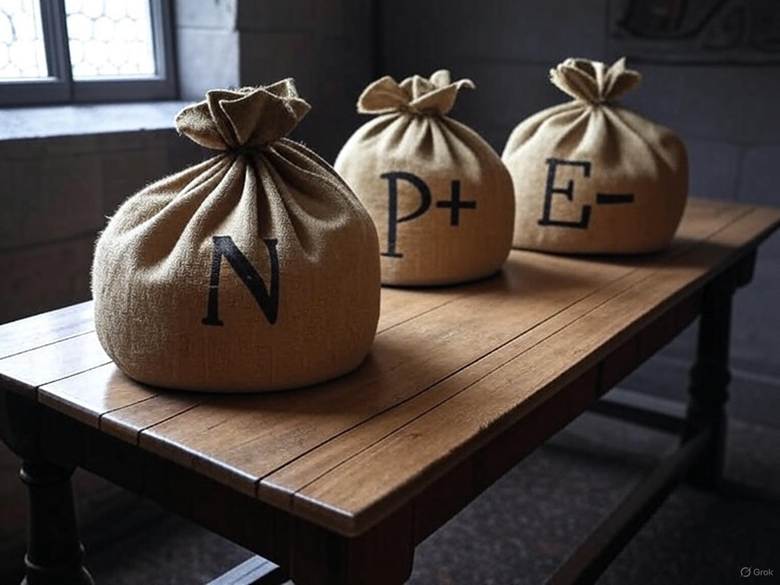
Every atom has three parts: protons, neutrons, and electrons. The sacks in the picture represent the idea that God made everything from those three components. (In actuality, it’s a lot more complicated than that, but I think it gives you a mental picture.)

  • Protons carry a positive charge.
  • Neutrons have no charge.
  • Electrons carry a negative charge and move around the outside of the atom.

Protons and neutrons are packed tightly together in the nucleus. Electrons move around that nucleus. Opposites attract — positive and negative — so the electrons are attracted to the nucleus.

Now here’s where it gets interesting.

Take carbon. Carbon has six protons and six neutrons in its nucleus, and six electrons outside. That’s what carbon is. Graphite in your pencil is carbon. A diamond is carbon.

Add one proton, one neutron, and one electron, and now you have nitrogen — an odorless gas that makes up a large part of our air. And if you were to add three hydrogen atoms, also an orderless gas, to one nitrogen, you have ammonia, which is anything but odorless.

Add another proton, neutron, and electron to nitrogen, you have oxygen — the air we breathe.

It’s the number of protons that makes an element what it is. God, in creating, used these basic building blocks — protons, neutrons, electrons — and from them came everything.


Let’s talk about iron.

Iron has 26 protons and 30 neutrons in its nucleus, with 26 electrons outside. That’s iron.

If you hold a common nail in your hand — mostly iron — that nail contains 26 billion billion atoms.

Now stretch your mind a little.

If we could expand one iron atom so that its nucleus was the size of a ping pong ball, the nearest electrons would be about 26 feet away. The outermost electrons would be about a third of a mile away.

And between the nucleus and those electrons?

Nothing.

Empty space. Not air, because air is made of atoms and there are no atoms within other atoms.

That means an atom of iron — something that seems solid and hard — is mostly nothing. The next atom would be another third of a mile beyond that.

So this nail, which holds buildings together and will hurt if you drive it into your finger, is mostly empty space. It’s made of things you cannot see — and most of it is nothing.

When you hit a nail with a hammer, the atoms of the hammer never actually touch the atoms of the nail. The electrons around each atom repel one another. It’s like magnets pushing away from each other. Forces are involved, but nothing truly “touches.”

And God did that.

The God you worship designed matter that way. The God who made you made a world where solid iron is mostly empty space held together by forces we cannot see.

That’s what Hebrews 11:3 means in part: “what is seen was not made out of things which are visible.”


Now go back to Genesis 1.

“In the beginning God created the heavens and the earth.”
“The earth was without form and void… and darkness was over the surface of the deep… and the Spirit of God was hovering over the surface of the waters.”
“Then God said, ‘Let there be light’; and there was light.”

Before God spoke, there was no light.

He commanded something that did not exist to exist.

That’s not magic. That’s authority. He spoke to what did not exist and said, “Light, exist.” And light obeyed.

Paul picks this up in 2 Corinthians 4:6:

“For God, who said, ‘Light shall shine out of darkness,’ is the One who has shone in our hearts to give the light of the knowledge of the glory of God in the face of Jesus Christ.”

The saving work of Christ is like creation. God says, “Let there be light,” and light shines in a dark heart. He creates spiritual life just as He created physical light.

Romans 4:17 says He is the One who “calls into being that which does not exist.”

That’s what God does.


Separations, Naming, and Order

As we move through Genesis 1, notice what God does.

After creating the heavens and the earth and bringing light into existence, much of what follows is separation and ordering.

  • He separates light from darkness.
  • He names the light “day” and the darkness “night.”
  • There was evening and there was morning, day one.

On the second day, He creates the expanse — the firmament — to separate waters from waters. He calls the expanse “heaven.”

The Hebrew word for that expanse, raqia, comes from a word meaning to beat out metal into a thin sheet. Ancient people looked up and saw what appeared to be a solid dome. That’s the language being used.

God separates waters above from waters below. Then He gathers the waters below so dry land appears.

Up to this point, after the initial creation and the creation of light, He hasn’t created new materials. He has been separating and ordering what He already brought into existence.

Light and darkness. Waters above and below. Sea and dry land.

He is dividing, naming, structuring.


The Sovereign God Who Does It All

Let me close with Isaiah 45.

God speaks to Cyrus, a pagan king. Cyrus did not know Him. Yet God says:

“I am the one who forms light and creates darkness, producing peace and creating calamity; I am the LORD who does all these things.” (Isaiah 45:7)

There is no other.

He forms light. He creates darkness. He produces peace. He creates calamity. He raises up kings. He brings down kings.

This is the God who created iron atoms that are mostly empty space. This is the God who spoke light into existence. This is the God who shines light into human hearts.

And this same God gave us a Savior.

He could have judged us all. We have all rebelled against Him. But He desired to save. He desired to glorify Himself in mercy. So He sent Christ. The God who calls things into existence that do not exist called us into spiritual life.

That’s the God we’re studying in Genesis. And that’s the God we worship.

Genesis 1: In the Beginning*

Last week we spent a little time thinking about time itself, and I hope it didn’t fry anyone’s circuits too badly. Before time even began, God the Father, God the Son, and God the Holy Spirit were already there. They existed before He made the heavens and the earth, and in perfect unity they determined how everything would unfold. We get a small glimpse of that divine conversation when God says, “Let us make man in our image.”

Today we’re going to look at the opening verses of Genesis 1 and start unpacking them.

The Text

“In the beginning God created the heavens and the earth. The earth was without form and void, and darkness was on the face of the deep. And the Spirit of God was hovering over the face of the waters. Then God said, ‘Let there be light’; and there was light.”

We touched on this briefly last time, but now let’s slow down and ask some real questions.

Who Was the Original Audience?

Even though the Holy Spirit inspired Scripture for every generation—including us—the first people to hear or read these words were the Israelites. Moses wrote this account for the people of Israel, the Jewish people of that time.

When we read the Bible, it helps to remember that different parts belong to different genres. The Psalms, for example, are largely poetry—not the rhyming kind we’re used to in English, but Hebrew poetry. Genesis is true history, yet it’s written in a way that carries a poetic rhythm and style natural to the Hebrew language. The original hearers would have picked up certain nuances that we sometimes miss. That doesn’t mean we’re misunderstanding the text; it just means we can gain helpful perspective by imagining how they heard it.

The Name “God” – Elohim

The very first word for God in Genesis 1:1 is Elohim. You’ve probably heard that term before. It’s grammatically plural, yet it’s used here with singular verbs to refer to the one true God we worship. Elohim is actually a more generic word for deity. When Aaron made the golden calf, he pointed to it and said, “This is your Elohim who brought you out of Egypt.” Foreign idols and false gods were also called elohim (lowercase in our English translations to show the distinction).

Hebrew didn’t use upper- and lowercase letters, so context carried the weight. We do something similar in English when we say “the gods of the Egyptians” versus “the God of Israel.”

That plural form of Elohim—combined with phrases like “Let us make man in our image”—offers a quiet hint of the Trinity. It’s not a full explanation, but the plurality is there.

Later in chapter 2 we’ll meet another name: Yahweh (often rendered “LORD” in all capital letters in our English Bibles). That’s the personal, covenant name God gave to Moses—“I AM.” Many of us grew up saying “Jehovah,” but the more accurate pronunciation scholars use today is Yahweh. Personally, I prefer using the name when Scripture does. Saying “the LORD says” feels a little like stepping back into third-person distance, while “Yahweh says” keeps the directness of the text.

The Word That Creates – Connecting to John 1

Genesis 1:1 begins, “In the beginning God created…” John 1:1 picks up the same phrase: “In the beginning was the Word, and the Word was with God, and the Word was God.”

The Greek word logos means far more than a single spoken word. For the Greeks it carried the sense of wisdom, logic, reason, order—the organizing principle of the universe. John is telling us that this logos—this wisdom and commanding speech—was there in the beginning. When God said, “Let there be light,” that was the logos in action.

Later John says the Word became flesh and dwelt among us. So the one through whom God creates is none other than Jesus, the second person of the Trinity.

Psalm 33 echoes the same truth: “By the word of the LORD the heavens were made, and all the host of them by the breath of his mouth… For he spoke, and it was done; he commanded, and it stood fast.”

Why That Should Fill Us with Awe

Think about it. We can’t speak physical reality into existence. I can’t say, “Let there be a chair,” and have one appear. But God speaks, and entire realms come into being. That same word holds everything together right now. Colossians tells us that in Christ all things hold together. If He stopped sustaining creation for even an instant, it would unravel.

A being with that kind of power and reach ought to inspire both awe and a healthy fear. We were made to worship Him. When we grasp—even a little—that He can call things into existence from nothing and can just as easily call them out of existence, respect and wonder are the only right responses.

The Earth Was Without Form and Void – To hu va-bohu

Genesis 1:2 says the earth was tohu va-bohu—without form and void. Those Hebrew words roll off the tongue in a memorable way. Tohu appears far more often than bohu in Scripture, and Isaiah uses it more than anyone else.

Tohu gets translated in various places as:

  • wasteland
  • wilderness
  • empty space
  • confusion
  • empty things
  • nowhere

Put together, the picture is a chaotic, empty, desolate, unfinished wilderness—a dark, watery, formless expanse.

Isaiah 45:18 says God “did not create [the earth] in vain [tohu]; He formed it to be inhabited.” So the original state wasn’t the final goal. He didn’t make a permanent mess. Something was underway.

Other passages that use tohu and bohu describe places under God’s judgment—Edom turned to burning pitch and desolation (Isaiah 34), or the land shaken and emptied because of the Lord’s fierce anger (Jeremiah 4). In both cases the language echoes Genesis 1:2.

Three Ways People Have Understood This

  1. A blank canvas / unshaped clay God created the raw material in a formless, void state—like a potter’s lump of clay or an empty page—and then over the six days He shaped it into the ordered, inhabited world. Nothing wrong with that view.
  2. A result of judgment Some suggest a catastrophe happened between verses 1 and 2—perhaps tied to Satan’s fall and being cast to the earth—leaving the creation in chaos. God then reshaped it.
  3. A pre-Adamic world judged An older view (popularized by Scofield) proposed an entire earlier creation—animals, perhaps even people—that God judged, leaving fossils and a tohu va-bohu earth before the six-day work began. Many today (including Ken Ham) push back on that because it would place death before Adam’s sin.

We don’t have a definitive answer. What we do know is that God makes no mistakes and has no Plan B. He doesn’t say, “Oops, that didn’t work; let me try again.” Everything unfolds according to His eternal purpose.

The Spirit Hovering / Brooding

Genesis 1:2 ends with the Spirit of God “hovering” over the face of the waters. The Hebrew word carries the sense of brooding, fluttering, protecting—like a bird over its nest, wings moving, eyes focused, single-mindedly watching and guarding.

The Spirit wasn’t abandoning this dark, watery chaos. He was present, actively involved, poised for what came next. When God said, “Let there be light,” the work began.

That’s where we’ll pick up next time.

Lord willing, we’ll keep moving slowly through the chapter. There’s depth here worth taking our time with.

* Some articles on this publication or website are adapted from my recorded Bible teaching. I use transcription and editing tools (including AI-assisted editing) to convert spoken lectures into readable written form. The ideas, interpretations, and theological conclusions are my own and come directly from my teaching.

Back to the Beginning – Session 1

What Was God Doing Before “In the Beginning”?

 Several months ago in our adult Bible class, We began a series called “Back to the Beginning.” I chose that name because I think we need to return to the opening pages of the Bible. Genesis gives us the foundation of our Christian faith and a great deal of the thinking that shaped Western culture. We’re going to look at the text more carefully than most people do when they remember the stories from childhood.

Let’s start actually before the beginning.

Genesis 1:1 says, “In the beginning, God created the heavens and the earth.” My immediate question is: the beginning of what? The creation of the earth. Creation itself. Time. The beginning of everything.

Before we walk into verse 1, I want us to consider what Scripture says about what was happening before time began. The Bible does speak about a “before time began,” and it’s worth asking: what was God doing before He started creation?

Fellowship in the Trinity Before Anything Existed

The Father, the Son, and the Holy Spirit existed in perfect fellowship before time began. There was communication and love among the three Persons of the Godhead long before any creature was made.

Look with me at a few passages.

2 Timothy 1:8–9 “…according to the power of God, who has saved us and called us with a holy calling, not according to our works, but according to his own purpose and grace, which was given to us in Christ Jesus before time began.”

Before time began, God already had a purpose and grace in place for us in Christ Jesus. The plan of salvation wasn’t an emergency response; it was already settled.

Titus 1:2 “…in hope of eternal life, which God, who cannot lie, promised before the world began.”

God promised eternal life before the world existed. There was no one yet to receive the promise, but He made it anyway.

Ephesians 1:4 “…he chose us in him before the foundation of the world, that we should be holy and without blame before him in love.”

Something concerning us and Christ’s saving work was already determined before the world was founded.

John 17:24 (Jesus’ high priestly prayer) “Father, I desire that they also, whom you have given me, may be with me where I am, to behold my glory that you have given me, because you loved me before the foundation of the world.”

The Father loved the Son before anything was created. There was love, glory, and relationship within the Trinity.

1 Peter 1:20 “He was foreknown before the foundation of the world but was made manifest in the last times for the sake of you…”

Christ was foreordained before the foundation of the world.

From these passages we see that before time began, God had a structured plan. Some call it a covenant between the Father and the Son (with the Spirit’s involvement) to accomplish our salvation. Jesus speaks of doing only what pleases the Father and of not losing any whom the Father has given Him. That plan was agreed upon before time started.

God Did Not Need to Create

This matters when we think about why God created at all.

Unlike what some teachings say about Allah—that he created because he was alone and needed fellowship—the true God is Triune. There was already perfect fellowship between Father, Son, and Holy Spirit. God had no need, no lack, no missing piece. He doesn’t need anything.

So why create? He wanted to. He desired to display His glory, to receive praise from creatures—angels and people. He wanted to show mercy and grace, which are part of His character. But even that wasn’t a need; it was something He freely chose to do.

He didn’t need glory—He already had it in the Trinity. He didn’t need needy people to be merciful toward—He simply wanted to demonstrate who He is.

Time Itself Had a Beginning

Time started when God created the heavens and the earth. Before that, there was no time.

Even people who hold to the Big Bang (and who don’t believe in God) say there was no time before that event. On this point, they agree with the Bible: time had a beginning.

That means there was no “Thursday” on which God suddenly decided, “Today I’ll create the universe.” There were no days, no sun, no moon to mark time. Asking why God “suddenly” created at a particular moment is a question that doesn’t make sense in eternity.

God never changes His mind. He never learns anything new. Nothing ever surprises Him. Adam and Eve’s sin was not a derailment that forced a backup plan. Christ was foreordained as Savior before the foundation of the world—before Adam and Eve were ever made.

When the Bible speaks of “before” or “after” or “the fullness of time” (Galatians 4:4) or “when the day of Pentecost had fully come” (Acts 2:1), it uses language we can understand. God accommodates our experience of time. But with Him there is no before or after. He simply is. He exists outside of time.

I sometimes picture it like a parade. If you’re standing on the sidewalk, you experience one float at a time. The beginning passes you, then the middle, then Santa at the end. But if you’re high above, you can see the whole parade at once—the start, the middle, the finish—all in view together. God is like that, only perfectly so. He sees every moment of history simultaneously. When He promises to be with you tomorrow, He is already there. You just haven’t arrived yet.

Scripture keeps saying the same thing:

  • James 1:17 — no variation or shadow due to change
  • Colossians 1:17 — Christ is before all things, and in Him all things hold together
  • Exodus 3:14 & John 8:58 — “I AM”
  • Psalm 90:4 — a thousand years are like yesterday
  • Hebrews 13:8 — Jesus Christ is the same yesterday, today, and forever
  • Malachi 3:6 — “I the LORD do not change”
  • Revelation 4:8 — “who was and is and is to come”
  • Isaiah 57:15 — “I inhabit eternity”

He fills eternity the way He fills the earth.

Eternity in Our Hearts—and the Sin Problem

Ecclesiastes 3:11 says God has put eternity in our hearts, yet no one can find out the work that God does from beginning to end. We sense there is something bigger than ourselves. We make plans, we have aspirations, we think in terms of lifetimes. Romans 1 tells us everyone knows there is a God and understands something of His eternal power and divine nature. But we don’t want to bow to Him. That’s the root sin: we suppress the truth and worship the creature rather than the Creator.

That suppression leads to a downward spiral. You see it in culture, in history, in current events—wars, injustice, rebellion. It all flows from refusing to acknowledge who God is and what we owe Him.

Not Religion—Reality

A lot of religion is about jumping through hoops: read your Bible—check; pray—check; go to church—check. That’s how people often treat pagan gods: do the right things, appease the deity, and maybe he’ll leave you alone.

That’s not Christianity.

Christianity is about the real God who exists, who is exactly as we’ve been describing. He doesn’t need to be appeased by our performance. He has already provided propitiation—appeasement—through Jesus Christ. God Himself came as a man, died on the cross, and paid the actual penalty for our sins. Not symbolically. Not religiously. Actually. The debt is paid. There is nothing left to do to make God accept us.

Because of that, we’re free. And in that freedom we bow, we worship, we give thanks. It’s not obligation anymore; it’s opportunity. We get to serve Him because of His grace and kindness toward us.

A Quick Look at Genesis 1

Next time we’ll pick up right here: “In the beginning, God created the heavens and the earth.”

For now, listen to the opening verses and notice a few things.

The earth was without form and void, darkness over the deep, and the Spirit of God was hovering over the face of the waters. Picture that.

Then God said, “Let there be light,” and there was light. In Hebrew it’s more like a command: “Light—be.” He spoke to something that didn’t exist, and it obeyed instantly.

God saw the light, and it was good. He divided light from darkness, called light “day” and darkness “night.” Evening and morning—the first day.

He made a firmament to separate waters above from waters below, called it heaven. And it was so.

Notice how much God does in this chapter. I’ve asked people to list every action: God said, God saw, God made, God called, God separated. It’s striking.

Also notice: God created light on day one, but the sun, moon, and stars don’t appear until day four. Light existed before anything to hold or emit it.

There’s a lot of separating—light from darkness, waters above from waters below, sea from land. Much of the work is division rather than making something out of nothing.

Read Genesis 1 yourself this week. Jot down everything God does: “God created;” “God saw;” “God made;” etc. It will give you a different perspective of God’s creative work.

* Some articles on this publication or website are adapted from my recorded Bible teaching. I use transcription and editing tools (including AI-assisted editing) to convert spoken lectures into readable written form. The ideas, interpretations, and theological conclusions are my own and come directly from my teaching.