Blog Session 8 – Entering God’s Rest—Today

This is one of the most important lessons I’ve learned in my life. And it’s not easy to apply. That’s part of why I keep coming back to it. Grace means a great deal to me, and I see many Christians struggling right here.

What I’m arguing is this: the Sabbath rest of God after creation is a picture—a type—of the kind of rest God is offering you and me today.

And I want to be clear about something right from the beginning. We’re not talking about death. We’re not talking about heaven. We’re talking about a rest that is available right now. Today is a day we can be entering God’s rest. And when tomorrow comes, it will be today again—and the same offer will still be there.

What Do We Mean by “Rest”?

Before we go further, it helps to slow down and ask what we mean by rest.

When we think of rest, we think of things like ceasing activity, relaxing, being restored, letting go of pressure. There’s even a kind of surrender involved. When you lie down for a nap, you’re letting something go. The pressure is off.

That idea—the pressure being off—is important. Because what we’re going to see is that God is offering something deeper than physical rest. He’s offering a rest that reaches into the heart.

The Warning from the Past

The passage we’re working through brings us into Hebrews 3, where the author quotes Psalm 95. And in that psalm, God is looking back to Israel in the wilderness. Those people had seen His works for forty years. And yet God says of them:

“They always go astray in their heart… As I swore in my wrath, they shall not enter my rest.”

The key issue wasn’t just outward behavior. It was the heart. And specifically, it was unbelief. The author of Hebrews presses that point. He warns:

“Take care… that there not be in any one of you an evil, unbelieving heart that falls away from the living God.”

Notice how those words are tied together—evil and unbelieving. Disobedience and unbelief are not really separate things. They go together. At the root, the sin-issue is that we don’t believe what God has said.

Encouraging One Another—Today

Because of that danger, we’re told to encourage one another.

“Encourage one another day after day, as long as it is still called ‘Today.’”

That word “today” keeps coming up. It’s not abstract. It’s immediate. When should we encourage one another? Today. And when tomorrow comes? It will be today again.

This isn’t something we put off. The reason we encourage each other now is so that none of us will be hardened by the deceitfulness of sin. There is a real danger, even for believers, of a kind of hardening that comes from not believing God.

And God uses both His Spirit and His people to keep us. Our security isn’t some detached guarantee. It’s something God actively sustains—through His Word and through one another.

The Problem: Hearing Without Believing

The Israelites had good news proclaimed to them. God promised to meet their needs. He promised provision in the wilderness. But the word they heard did not profit them.

Why?

Because it wasn’t united with faith. They heard it—but they didn’t believe it.

And that’s where this becomes very close to home. God says, “I will meet your needs.” But we find ourselves thinking, “I’m not sure He will—not in this situation.” God says He gives peace. And yet we say, “I don’t have peace.” If God gave it and we don’t have it, where did it go? At some point, that raises a question: do we really believe Him?

If we truly believed that God has given peace, then we would live in that peace. The issue comes back again to belief.

Entering the Rest by Faith

The writer of Hebrews makes a remarkable statement:

“We who have believed enter that rest.” Not will enter. Enter. This is present reality. This rest is something believers are meant to experience now. And to help us understand it, the passage reaches all the way back to creation:

“And God rested on the seventh day from all His works.”

That rest of God becomes the model. The author connects it with the rest Israel failed to enter—and then says that rest is still available. How do we know it’s still available? Because the word “today” is still being spoken.

The door has not closed.

There Remains a Rest

This leads to one of the most important statements in the passage: “So there remains a Sabbath rest for the people of God.”

There remains a rest—for you, right now. Not next week. Not someday. Today.

And this rest is more than stopping activity. It’s something deeper than that. It touches the heart, the inner striving, the pressure we carry.

Resting from Our Works

The passage brings us to this final idea:

“The one who has entered His rest has himself also rested from his works, as God did from His.”

That’s the picture. God finished His work—and He rested.

And we are told that there is a way for us, in Christ, to enter into that same kind of rest. Not by ceasing all activity—we still live, work, make decisions, raise families—but by ceasing the inner striving, especially the inner striving to prove yourself to God somehow. The grace of God forgives all sins and declares us righteous. The striving for perfection is over!

Ceasing the pressure.

Ceasing the sense that everything depends on us.

What That Looks Like in Real Life

I’ve been trying to think through what this actually looks like.

You go through your day—running errands, making decisions, dealing with responsibilities. Nothing outward necessarily changes. But inwardly, something is different. You are at rest. You’re no longer carrying everything. You’re no longer striving in the same way. The pressure has been lifted.

That’s not easy. I can tell you from experience—it’s not easy. You face real situations, real concerns, real stress. And there’s something in you that wants to hold on—to keep worrying, to keep managing, to keep carrying it. And yet God says, in effect, “Trust Me.”

And we respond, “But if I don’t carry this, who will?” And the answer is—He will.

There’s that verse about casting your cares on Him. And I’ve come to read it this way: not just that He cares about me, but that He does the caring for me. He carries what I’ve been trying to carry.

That’s the rest being offered.

God finished His work. And in Christ, we are invited into that same kind of rest—to say, in the middle of life, “It’s in His hands.”

And the question that remains is whether we will believe Him enough to enter into it.

*Some articles on this publication or website are adapted from my recorded Bible teaching. I use transcription and editing tools (including AI-assisted editing) to convert spoken lectures into readable written form. The ideas, interpretations, and theological conclusions are my own and come directly from my teaching.

Session 3 – The God Who Creates out of Nothing

It’s good to be back in Genesis. We’ve had a couple interruptions the last few weeks — holidays, a baptism for one grandson, then another baptized on Easter — but now we’re settling back into our study.

My goal as we move through Genesis is to go slowly. Not tediously slow, I hope, but slow enough to see what’s really there. We’ll keep making connections to the New Testament and to truths that help us see the greatness of God more clearly.

Today, I want to begin in the New Testament before returning to Genesis.


“What Is Seen Was Not Made Out of Things Which Are Visible”

Turn to Hebrews 11.

Hebrews 11 is the faith chapter. Let me read the opening verses:

“Now faith is the assurance of things hoped for, the conviction of things not seen. For by it the men of old gained approval. By faith we understand that the worlds were prepared by the word of God, so that what is seen was not made out of things which are visible.” (Hebrews 11:1–3)

That last line is what we’re focusing on: “what is seen was not made out of things which are visible.”

As someone who taught chemistry and physics for 25 years, that verse always meant a lot to me. The more you dig into almost any subject, the more it ends up glorifying God. If you grow flowers, you plant a seed in the same dirt as everything else — potatoes, corn, tomatoes — and yet each plant comes up tasting like what it’s supposed to taste like. That alone is amazing.

But let’s talk about something even smaller.


A Little Science — and a Big God

Everything in the material world is made of atoms. Atoms are too small to see. There are over a hundred elements — iron, copper, zinc, oxygen, hydrogen — but most of what we deal with every day is made from maybe ten or twelve of them.

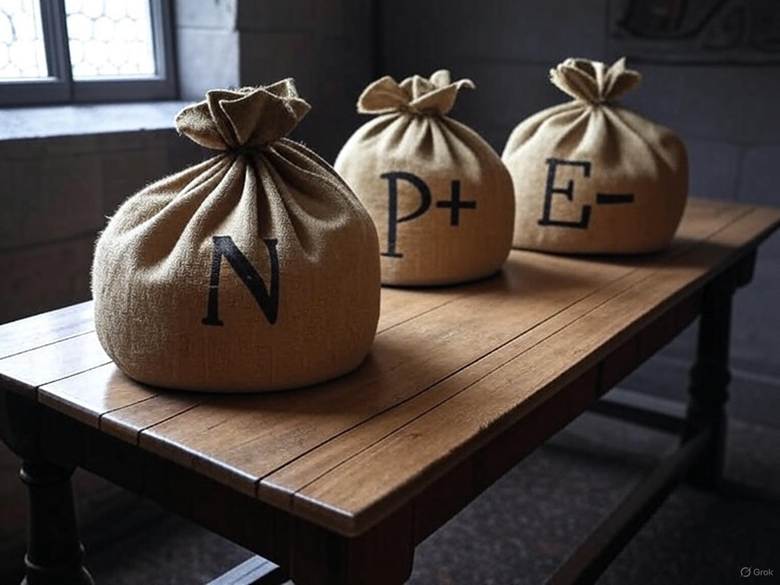
Every atom has three parts: protons, neutrons, and electrons. The sacks in the picture represent the idea that God made everything from those three components. (In actuality, it’s a lot more complicated than that, but I think it gives you a mental picture.)

  • Protons carry a positive charge.
  • Neutrons have no charge.
  • Electrons carry a negative charge and move around the outside of the atom.

Protons and neutrons are packed tightly together in the nucleus. Electrons move around that nucleus. Opposites attract — positive and negative — so the electrons are attracted to the nucleus.

Now here’s where it gets interesting.

Take carbon. Carbon has six protons and six neutrons in its nucleus, and six electrons outside. That’s what carbon is. Graphite in your pencil is carbon. A diamond is carbon.

Add one proton, one neutron, and one electron, and now you have nitrogen — an odorless gas that makes up a large part of our air. And if you were to add three hydrogen atoms, also an orderless gas, to one nitrogen, you have ammonia, which is anything but odorless.

Add another proton, neutron, and electron to nitrogen, you have oxygen — the air we breathe.

It’s the number of protons that makes an element what it is. God, in creating, used these basic building blocks — protons, neutrons, electrons — and from them came everything.


Let’s talk about iron.

Iron has 26 protons and 30 neutrons in its nucleus, with 26 electrons outside. That’s iron.

If you hold a common nail in your hand — mostly iron — that nail contains 26 billion billion atoms.

Now stretch your mind a little.

If we could expand one iron atom so that its nucleus was the size of a ping pong ball, the nearest electrons would be about 26 feet away. The outermost electrons would be about a third of a mile away.

And between the nucleus and those electrons?

Nothing.

Empty space. Not air, because air is made of atoms and there are no atoms within other atoms.

That means an atom of iron — something that seems solid and hard — is mostly nothing. The next atom would be another third of a mile beyond that.

So this nail, which holds buildings together and will hurt if you drive it into your finger, is mostly empty space. It’s made of things you cannot see — and most of it is nothing.

When you hit a nail with a hammer, the atoms of the hammer never actually touch the atoms of the nail. The electrons around each atom repel one another. It’s like magnets pushing away from each other. Forces are involved, but nothing truly “touches.”

And God did that.

The God you worship designed matter that way. The God who made you made a world where solid iron is mostly empty space held together by forces we cannot see.

That’s what Hebrews 11:3 means in part: “what is seen was not made out of things which are visible.”


Now go back to Genesis 1.

“In the beginning God created the heavens and the earth.”
“The earth was without form and void… and darkness was over the surface of the deep… and the Spirit of God was hovering over the surface of the waters.”
“Then God said, ‘Let there be light’; and there was light.”

Before God spoke, there was no light.

He commanded something that did not exist to exist.

That’s not magic. That’s authority. He spoke to what did not exist and said, “Light, exist.” And light obeyed.

Paul picks this up in 2 Corinthians 4:6:

“For God, who said, ‘Light shall shine out of darkness,’ is the One who has shone in our hearts to give the light of the knowledge of the glory of God in the face of Jesus Christ.”

The saving work of Christ is like creation. God says, “Let there be light,” and light shines in a dark heart. He creates spiritual life just as He created physical light.

Romans 4:17 says He is the One who “calls into being that which does not exist.”

That’s what God does.


Separations, Naming, and Order

As we move through Genesis 1, notice what God does.

After creating the heavens and the earth and bringing light into existence, much of what follows is separation and ordering.

  • He separates light from darkness.
  • He names the light “day” and the darkness “night.”
  • There was evening and there was morning, day one.

On the second day, He creates the expanse — the firmament — to separate waters from waters. He calls the expanse “heaven.”

The Hebrew word for that expanse, raqia, comes from a word meaning to beat out metal into a thin sheet. Ancient people looked up and saw what appeared to be a solid dome. That’s the language being used.

God separates waters above from waters below. Then He gathers the waters below so dry land appears.

Up to this point, after the initial creation and the creation of light, He hasn’t created new materials. He has been separating and ordering what He already brought into existence.

Light and darkness. Waters above and below. Sea and dry land.

He is dividing, naming, structuring.


The Sovereign God Who Does It All

Let me close with Isaiah 45.

God speaks to Cyrus, a pagan king. Cyrus did not know Him. Yet God says:

“I am the one who forms light and creates darkness, producing peace and creating calamity; I am the LORD who does all these things.” (Isaiah 45:7)

There is no other.

He forms light. He creates darkness. He produces peace. He creates calamity. He raises up kings. He brings down kings.

This is the God who created iron atoms that are mostly empty space. This is the God who spoke light into existence. This is the God who shines light into human hearts.

And this same God gave us a Savior.

He could have judged us all. We have all rebelled against Him. But He desired to save. He desired to glorify Himself in mercy. So He sent Christ. The God who calls things into existence that do not exist called us into spiritual life.

That’s the God we’re studying in Genesis. And that’s the God we worship.

In the Beginning – Thoughts and Reflections – Part 1

As I have studied the Bible over the years, I sometimes want to go back and think about the beginning. We who have been raised in the church know a lot about the Old Testament through the Bible stories that were read to us as children. But I don’t think that we take enough time to really take in what the Bible says about the relationship and interaction of the True God with His creation. I’m going to take time over the next weeks and months to do that for myself to better inform my thinking and teaching.

The Bible starts out with the statement, “In the beginning God created the heavens and the earth.” My mind then wanders to questions like, “What was going on before time?” and “Why did God decide to create the universe at that particular place and time?”

Time itself deserves some attention. Time did not begin until God created it at the beginning. According to 2 Timothy 1:9, God’s purpose and grace were given to us “before time began.” With God there is no “before” or “after.” He just is. He is outside of time. I believe that when God speaks to us in terms of time, such as “before” or “after,” He is accommodating the fact that we as humans live in time.

Colossians 1:7 speaks of Jesus Christ like this: “He is before all things.” I think we would expect the word “was” in that context. Apparently, God is not just present everywhere in the location sense, He is present everywhere in time. That doesn’t just mean that God has always been present. It means that He is present right now at all times. He is as much present with Abraham, Isaac, and Jacob now as He is with us. We don’t understand that of course, but the Bible seems to be pretty clear about that. At the time Jesus was walking the streets of the Holy Land with His disciples, He said, “Truly, truly, I say to you, before Abraham was, I am” (John 8:58).

Isaiah tells us that God inhabits eternity (Isaiah 57:15). Isaiah also quotes God as saying, “Even from eternity I am He” (Isaiah 43:13). Revelation 4:8 explains that Jesus is the one who “was, is, and is to come.” For God, a day is no different than a 1000 years (2 Peter 3:8; Psalm 90:4).

But, in my own feeble way, I still want to know what was going on before time began – before “In the beginning”? The Bible does give us some clues. In John 17:24, Jesus acknowledges that God loved Him before the foundation of the world. This means that love existed before there were any people. There was love between the Father and the Son. In Proverbs 8, wisdom is personified and says, “From everlasting I was installed,” and “Before the mountains…I was brought forth” (Proverbs 8:23, 25).

What else was going on “Before”? Titus 1:2 tells us that God promised eternal life before all time. Jesus was foreordained and considered slain before the world was created (1 Peter 1:20, Revelation 13:8). And we know that the kingdom was prepared for God’s people before the foundation of the world (Matthew 25:34).

So in the mind and heart of God, plans were in place to accomplish the complete work of redemption that would be needed to restore a broken world and broken people to Himself. You should never think that God must have a plan B or C depending on how we respond to events and circumstances. God encompasses it all.

I think I’ll wrap up my thoughts about the “Before” at this point. Next time I have a chance, I’ll write some of my thoughts related to the first few verses of Genesis 1.