
Christ Died for Us

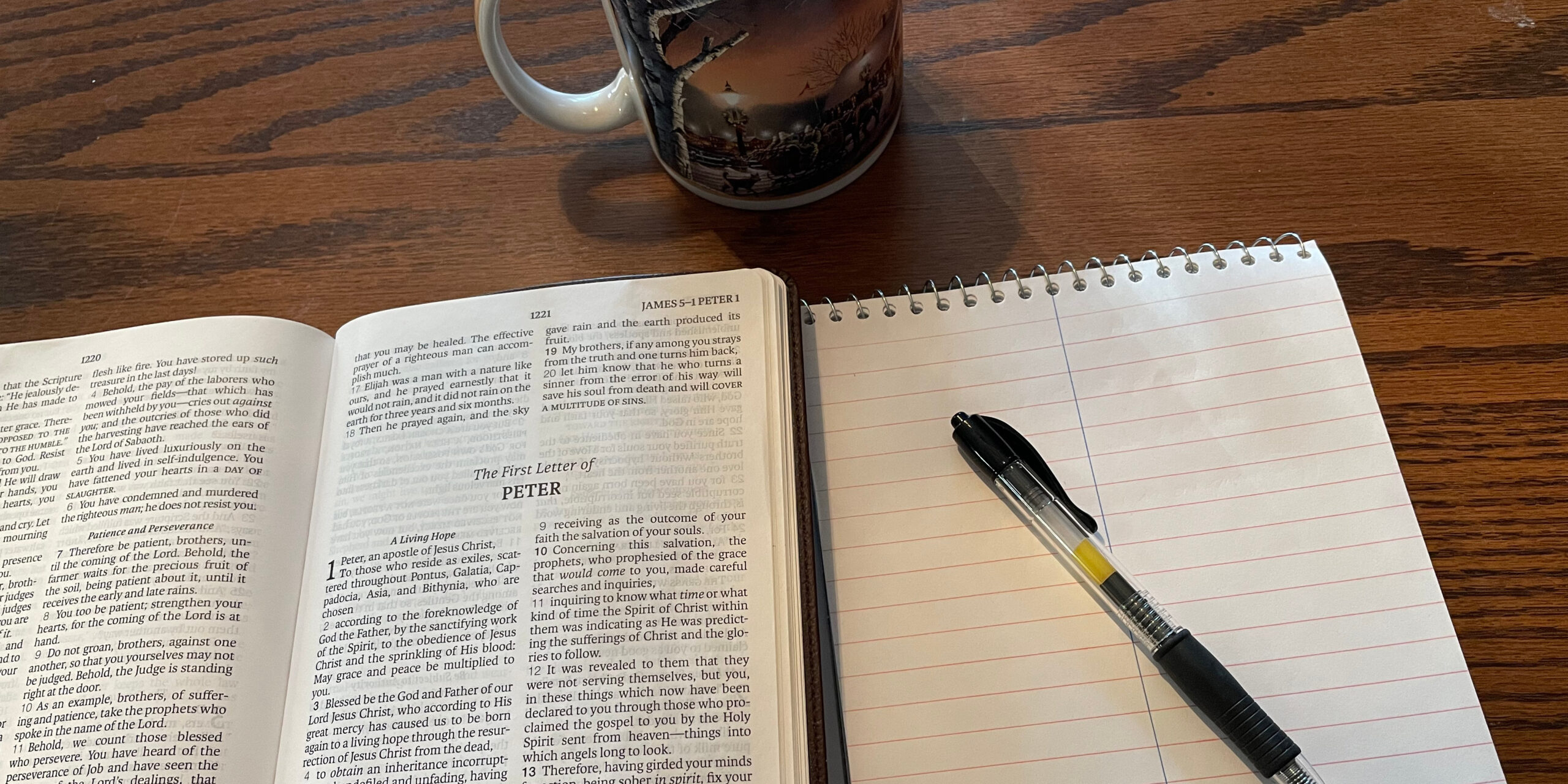
The following post was written in commemoration of Memorial Day 2026. It was part of my series on First Peter because of Peter’s reflection on the death of Christ on our behalf.

The Apostle Paul wrote the following words in Romans 5:7-8: “For one will hardly die for a righteous man, though perhaps for the good man someone would dare even to die. But God demonstrates His own love toward us, in that while we were yet sinners, Christ died for us.”

Memorial Day was set aside as a day to remember — to remember those who sacrificed their lives for us and for our freedom. Jesus said, “Greater love has no one than this, than to lay down one’s life for his friends.” This is what Jesus Himself did for us, isn’t it? While we were still sinners, Christ died for us!

The Apostle Peter wrote: “…knowing that you were not redeemed with corruptible things like silver or gold, … but with the precious blood, as of a lamb unblemished and spotless, the blood of Christ.” In this passage, Peter reminds us that Jesus did this for our redemption. We human beings came into this world lost and without God and without hope. We don’t keep God’s commandments, and most of the time, we don’t even try. But even when we were in that condition of rebellion, Jesus redeemed us for Himself. He bought us back and offers us full pardon and reconciliation with Himself. He simply asks us to believe it, and accept the pardon. John wrote, “And we have known and believed the love that God has or us” (1 John 4:16).

As you celebrate Memorial Day and remember those who gave their lives that we might live in freedom, don’t forget The One who died for you and rose again to save you from eternal damnation. Believe His promise and believe the love He has for you. There is no greater love than this!

Morning Meditations – Thoughts from 1 Peter 1:10-12

So, last time I left you hanging with prophets and angels trying to figure out what the gospel was all about. That’s kind of an interesting picture to me visualizing prophets trying to figure out what they are writing about. But let’s see if there are a couple of things that can encourage us personally today. I’d be interested to hear if you thought of anything.

The first thing for me is that the prophets were writing about our salvation. The text says they realized that it was not for them, but for us. Verse10 mentions prophesies about the grace we would receive. When one reads the Old Testament, the sense is that there is a lot of law there and not too much grace. After Saul was converted and became Paul, he wrote abundantly about grace, and we sometimes wonder if that was something new that he just made up. His background was in the Old Testament law, and so when he was converted, he had new eyes to see the manifold grace of God revealed in the Old Testament by the prophets.

In verse 11 the Bible calls the Holy Spirit the Spirit of Christ. It’s interesting to visualize Jesus’ spirit inside of prophets like Isaiah and Jeremiah pointing out and predicting the sufferings of Christ and the glories that would follow from that. The whole of the Bible is a unified narrative of God at work to accomplish His purposes.

And finally, in verse 12, we find that the gospel that has been proclaimed to us by a pastor, or parent, or someone else, are the very things that the prophets were writing about so long ago. And that gospel that we hear that draws us to Christ was proclaimed by the Holy Spirit. When the gospel is preached, it’s not just another kind of lesson like you might hear a lecture on World War I or how to solve algebra problems. When the Word of God is preached, the Holy Spirit is at work along with the Word He inspired to bring salvation to people. It is a powerful thing that Peter is describing here – something that spans the centuries and millennia of time just to reach you.

Morning Meditation – The Prophets Were Searching

Last time we looked at 1 Peter 1:9 where we discovered that as we love and rejoice in a Savior we have never seen, we are receiving the purpose and goal of faith, the salvation of our souls. Today we are going to begin thinking about verses 10-12. Here is verse 10 of that section:

“Concerning this salvation, the prophets who prophesied about the grace that was to be yours searched and inquired carefully…”

In order to really grasp what Peter is saying here, you should read verses 10-12 several times. I don’t want to go too deeply into this, but I do want to draw several important truths from it. Since I don’t want to make this too long, I’ll give you the gist this week and draw the lessons from it next time.

What Peter is saying here is that the prophets of the Old Testament – people like Isaiah, Jeremiah, Ezekiel, Hosea, etc. – these prophets tried really hard to figure out what kind of salvation they were prophesying about. The Spirit of Christ was inspiring them to write, but they didn’t understand what they were writing about, and so they took out their imaginary magnifying glass and tried to dig deep to understand.

What God revealed to them was that they were not writing about something related to them, but they were writing about the things you and I would be taught centuries later. And at the end of verse 12 we find out that even the angels really wanted to look into this as well to figure out what this teaching about the suffering of Christ was all about.

Lord willing, next week I’ll share a few things that I took away from thinking about this. In the meantime, you read this section many times over the next week and see what thoughts you come up with.

Morning Meditation – The Outcome of Faith

Last time in our meditation on First Peter, we saw that 1 Peter 1:8 focused on the fact that even though we haven’t seen the Lord, we still love Him and are filled with inexpressible joy filled with glory. But of course, the end of verse 8 was not the end of the sentence. Verse 9 goes on to say, “obtaining the outcome of your faith, the salvation of your souls.”

As I think about this, what that short phrase is telling me is that my possession of the faith Peter speaks about in verse 7 – the faith that is more precious than gold – is the evidence of salvation. Here’s what I mean by that: Verse 9 begins with the word “receiving” or “obtaining.” This is a present tense verb. That means that through faith we love one whom we have never seen, and we rejoice in that, and in so doing we are presently receiving the outcome of our faith. That outcome is the salvation of our souls.

“Outcome” is another interesting word. Some translations use the word “end.” The Greek word is telos. A telos is the goal and purpose of something. Our English word “end” is not quite the right word because “end” often means the stopping point. A potter might be working on a lump of clay with the intent of creating a beautiful vase. The telos of his project is a beautiful vase. But the actual end of the project might be when the vase falls from his tongs after it has been fired. A broken vase was not the potter’s telos but it was the end of the vase.

The goal, target, purpose, and outcome of faith is the salvation of our souls. As we have faith in the Christ we have never seen, we rejoice with inexpressible joy. In doing so we are presently receiving the telos of faith which is the salvation of our souls. Take some time this week to let that sink in.

Morning Meditations

Loving Someone We’ve Never Seen

Good Morning! It’s that time again when we take the opportunity to take a few minutes to meditate on God’s Word. We’re thinking through Peter’s encouraging message to those who are scattered throughout their known world. Today I want us to think about the first part of 1 Peter 1:8.

“And though you have not seen Him, you love Him.” That’s true of us too, isn’t it? We haven’t seen Him. Why would we love someone we have never seen?

Peter, of course, saw Jesus and spent three years with Him. He knew Him well. Probably Peter could say what John said, “What was from the beginning, what we have heard, what we have seen with our eyes, what we beheld and touched with our hands, concerning the Word of Life” (1 John 1:1). The things Peter could share with the people he ministered to are many, and because we have the entire New Testament, we know some of these same things even though we have never seen Christ or met Peter:

  • Jesus loved Peter even though he had betrayed Him, and He made sure Peter knew it. Remember, “Simon … do you love Me?” (John 21:15-21).
  • Peter saw that Jesus “went about doing good, and healing all that were oppressed,” and he testified to that in his preaching (Acts 10:38).
  • He knew personally that Jesus was “meek and lowly” and offered rest (Matt. 11:29).
  • He could testify about Jesus’ death and resurrection (John 20:4).
  • He could tell people firsthand about the transfiguration (2 Peter 2:16-18).
  • He could share about the miraculous catch of fish (Luke 5)
  • Out of love and compassion, Jesus healed Peter’s own mother-in-law (Mark 1:29-31).
  • He saw Jesus’ ascension and heard the promise of His return (Acts 1:11).
  • … and so much more.

Can you imagine what it would have been like to hear Peter share these personal experiences? What excitement and certainty we would have heard in his voice! Peter was able to tell people that even though they had not seen what he saw, he could assure them that they could experience this same Christ by faith. We hear this excitement in the letter he has written, and through the generations this same message has come down to us. As a result, we can love the same Lord Peter loved even though we have not seen Him in person.

There’s a lot to think about here!

Morning Meditations

A Faith More Valuable than Gold

Last time we thought about 1 Peter 1:6. My intention had been to put verse 7 with it, but that made it a longer read than I really wanted. It’s like eating. Sometimes we need to take smaller bites and chew them longer.

Peter reminded us to rejoice because of the tremendous promises of God even when we are faced with difficult trials. Those trials are often necessary because God uses them to trim and prune us into greater godliness.

Verse 7 says, “so that the proof of your faith, being more precious than gold which is perishable, even though tested by fire, may be found to result in praise and glory and honor at the revelation of Jesus Christ.”

The “so that” at the beginning of verse 7 tells us there is a reason for the trials. The trials and testing we go through are the proof, the genuineness, the trial of our faith. Those three words are from three different translations. The Greek word behind them is similar to our word documentation. The trials and difficulties document the genuiness and reality of our faith. Just like a metal is tested by fire to make sure it is actually gold and not some counterfeit material, our faith is tested by trials. And the metal, even though it might be genuine gold is still perishable, whereas true faith is not.

As our faith gets tested, we ourselves have some clue as to how we are doing. If we don’t do well on one of life’s tests, we know where we need God’s work in our lives to make our faith stronger. After Jesus gave the disciples some instruction in Luke 17, the disciples replied, “Increase our faith!” That’s the request we need to make often in life.

The end of 1 Peter 1:7 tells us that this documentation of our faith will result in praise and glory and honor when Jesus Christ is revealed. The kind of documented transformation of a man or woman that remakes us and renews us into Christ’s image is only something that Jesus Christ Himself can accomplish as He works through us. The praise, honor, and glory goes to Him on that day!

Morning Meditation

Faith During Trial

We are meditating our way through First Peter. Today we are going to think through 1 Peter 1:6-7.

“In this you greatly rejoice, even though now for a little while, if necessary, you have been grieved by various trials so that the proof of your faith, being more precious than gold which is perishable, even though tested by fire, may be found to result in praise and glory and honor at the revelation of Jesus Christ.”

We learned in the previous few verses that our inheritance is reserved and guarded for us in heaven, and we ourselves are protected by the power of God through faith. These are the strong and encouraging promises that cause the joy he writes about in verse 6. But it’s interesting to note that this joy is present even though they are going through difficult trials.

We too are not immune to the trials of life. Some are just hardships that are embedded in life itself, and some may be coming because we are Christians and carry His reproach with us. In spite of the hardships, wherever they come from, we can still rejoice because the promises are so tremendously great.

You might be thinking, “my troubles are so difficult that I have a hard time rejoicing even though God’s promises are powerful and encouraging.” Discouragement is one of the fiery darts of the devil and the defense against those is the shield of faith. The author of a devotional I’ve been reading lately says that we must pick up our shield and use it. What that means to me is that I need to talk to myself as David recorded in Psalm 42, “Why are you cast down, O my soul? And why are you disquieted within me?” Put your faith to work by grabbing the promises of God, meditating on them, and then claiming them once again for yourself. Take the promises in verses 3-5 and dwell on them until your heart begins to rejoice in the surety of God’s power to protect both our inheritance and ourselves until the final day.

Kept by the Power of God

In the devotional today I want to move us a little further in our meditation on 1 Peter, this time focusing on verse 5. Here are the key parts of verses 3-4 along with verse 5.

Blessed be the God and Father of our Lord Jesus Christ, who according to His abundant mercy has begotten us again … to an inheritance incorruptible and undefiled and that does not fade away, reserved in heaven for you, who are kept by the power of God through faith for salvation ready to be revealed in the last time. 

Last time we learned that a Christian has been born again to an inheritance that is kept and reserved in heaven for us. But we stopped before the end of the sentence. Verse 5 goes on to let us know that not only is our inheritance kept in heaven, but we are kept and protected by the power of God.

We need to stop and think about how much power we’re talking about here. We say God is all-powerful, omnipotent. It is that almighty power that protects us. Do you think there is anything that can overpower God so that our protection would be at risk? I don’t think so!! 

How are we protected? Our passage tells us: we are protected* through faith. But it is not a faith in faith. It is faith in the unfailing promises of God who has called us and saved us. The protection through God’s power has a goal, a target. It is for a salvation that is prepared and ready to be revealed. When? In the last time. We don’t know how far away that last time is, but we do know that our salvation, just like our inheritance, is protected and guarded until that day when it is fully revealed when Christ returns. 

These are promises that each one of us should take hold of by faith. They bring assurance resulting in our present joy. 

*When I think of God’s protection, I think of these words from the hymn Day by Day: “The protection of His child and treasure is a charge that on Himself He laid.” Someone has to protect us and God took that responsibility upon Himself.

A Guarded Inheritance

How would you react if you found out that someone had left a very large inheritance for you in a safe deposit box at a nearby bank? No one else can get to it but you.

That’s the scenario that is pictured for us in 1 Peter 1:4-5. Last week we saw that God has caused us to be born again to a living hope through the resurrection of Jesus Christ. I mentioned that it is a real hope, not a hope-so hope. The sentence continues into the next couple of verses. We have this hope, but there is a target for it. The hope God gives is leading us somewhere.

Verse 4 tells us that it is leading to an inheritance that is incorruptible, undefiled, and unfading, already set aside in heaven for us. First of all, this inheritance is incorruptible or imperishable. The inheritance cannot rust or rot or spoil. It remains whole and intact. Secondly, it is undefiled, pure, untainted with any impurities or pollutants. It has no faults in it. And third, it doesn’t fade away. It doesn’t just melt away like the snow that’s been around our house for more than a month. Let your mind ponder those three words that describe the surety of the inheritance God has provided for us through Christ.

Finally, the Bible says it is reserved in heaven for us. The word is a very strong word like “guarded” or “protected,” and it is written in a verb tense that means the guard and protection has already been placed on this inheritance and that protection is still in place to this day. In other words, when we get to heaven, someone isn’t going to have to look around and see if he can find it under a bed somewhere. The inheritance is in the vault, and it is being guarded 24/7 from the moment it was placed there.  May God strengthen and encourage your heart this morning as you consider these amazing descriptions of God’s provision for our eternal salvation.

Morning Meditations

For the next weeks I would like to draw some meditations from the book of First Peter. I have decided to use the books that Peter wrote to help me deepen my understanding of Jesus and the gospel since Peter followed Jesus around for so many years. These posts will give you the opportunity to think about Peter’s message along with me over the next several months.

Today let’s look at 1 Peter 1:1-2: “Peter, an apostle of Jesus Christ, to the pilgrims of the Dispersion in Pontus, Galatia, Cappadocia, Asia, and Bithynia, elect according to the foreknowledge of God the Father, in sanctification of the Spirit, for obedience and sprinkling of the blood of Jesus Christ: Grace to you and peace be multiplied.”

Let me just give you a few quick thoughts to whet your appetite to study the passage more thoroughly:

My first thought is to remember who wrote this. It was Jesus’s disciple Peter who had a habit of putting his foot in his mouth, often speaking before thinking. But now he is a leader in the church and reaching out to scattered Christians all throughout Asia Minor. 

Notice that Peter refers to these people, along with all other believers as chosen by God long ago according to the foreknowledge of God the Father. My purpose here is not to get into a big debate about how all of this works, but it is interesting that God the Father, who is all-wise and all-knowing, chose us to serve and follow Him. Whatever this means, and however it works, it is an amazing thought! But the next section is where I really want us to focus. All of this takes place through the sanctifying work of the Spirit of God for obedience and sprinkling of the blood of Jesus Christ.

What does sanctification of the Spirit mean? It means that the Spirit of God sets us apart for God’s glory and His service. We once were part of the world system and walked according to the prince of the power of the air (Ephesians 2). But now, we have been set apart for God’s glory by the Holy Spirit. That’s an amazing thought to me.

The second half of the phrase tells us the purpose of this setting apart: It is for obedience and sprinkling of the blood of Jesus Christ. That means that God’s intention and goal is to make us obedient followers who have been cleansed and forgiven through the blood of Jesus. Putting this all together, you could say the Holy Spirit sets us apart to be cleansed by Jesus’s blood resulting in an obedient life. This is what the Christian life is all about. “If anyone is in Christ, he is a new creation; old things have passed away; behold, all things have become new” (2 Corinthians 5:17). Paul, in Romans 16, speaks of the mystery “made known to all nations, according to the commandment of the everlasting God, for obedience to the faith (Rom 16:25-26). That’s God’s goal, isn’t it? Obedient followers?