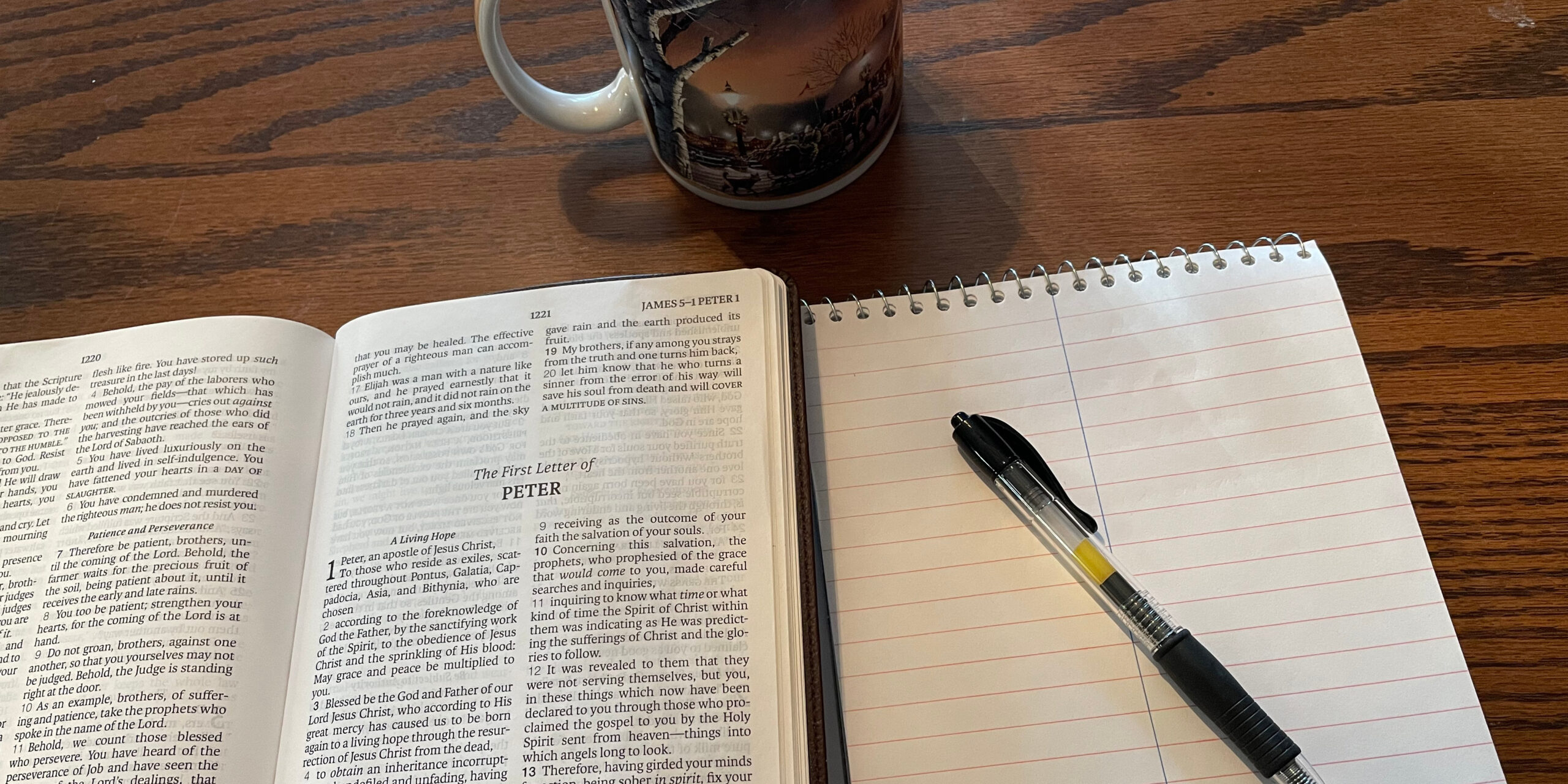
The following post was written in commemoration of Memorial Day 2026. It was part of my series on First Peter because of Peter’s reflection on the death of Christ on our behalf.
The Apostle Paul wrote the following words in Romans 5:7-8: “For one will hardly die for a righteous man, though perhaps for the good man someone would dare even to die. But God demonstrates His own love toward us, in that while we were yet sinners, Christ died for us.”
Memorial Day was set aside as a day to remember — to remember those who sacrificed their lives for us and for our freedom. Jesus said, “Greater love has no one than this, than to lay down one’s life for his friends.” This is what Jesus Himself did for us, isn’t it? While we were still sinners, Christ died for us!
The Apostle Peter wrote: “…knowing that you were not redeemed with corruptible things like silver or gold, … but with the precious blood, as of a lamb unblemished and spotless, the blood of Christ.” In this passage, Peter reminds us that Jesus did this for our redemption. We human beings came into this world lost and without God and without hope. We don’t keep God’s commandments, and most of the time, we don’t even try. But even when we were in that condition of rebellion, Jesus redeemed us for Himself. He bought us back and offers us full pardon and reconciliation with Himself. He simply asks us to believe it, and accept the pardon. John wrote, “And we have known and believed the love that God has or us” (1 John 4:16).
As you celebrate Memorial Day and remember those who gave their lives that we might live in freedom, don’t forget The One who died for you and rose again to save you from eternal damnation. Believe His promise and believe the love He has for you. There is no greater love than this!
We’re in Genesis 2, picking up at verse 8. This is a different angle on creation than Genesis 1. There, we were given the broad account. Here, the focus narrows, especially on man and the place God prepared for him.
“And Yahweh God planted a garden in Eden toward the east, and there He placed the man whom He had formed.”
That word “placed” is worth pausing on. It’s more than just setting someone down somewhere. It carries the idea of settling, even resting. God didn’t just drop Adam into the garden—He settled him there. It was a place for him to be, to belong, to rest in a sense.
Then we’re told what God caused to grow:
“Every tree that is desirable in appearance and good for food.”
That’s an expansive description. Every tree that looks good and is good for food. You start thinking through what that could include—apples, pears, cherries, nuts, things we know—but this is before the fall. Whatever existed then would have been untouched by decay. It’s hard to even imagine the fullness of it.
In the middle of the garden were two specific trees: the tree of life and the tree of the knowledge of good and evil. There was no prohibition given about the tree of life. It seems they could have eaten from it. The restriction was tied only to the other tree.
The Setting of Eden
The passage goes on to describe rivers flowing out of Eden—Pishon, Gihon, Tigris, and Euphrates. That places the region somewhere in what we would now call the Mesopotamian area, around modern-day Iraq.
At the same time, we have to remember the flood changed everything—river courses, land formations, the whole topography. So while we can approximate, we can’t be precise.
There’s also that brief note about gold, bdellium, and onyx. It’s simply stated. No explanation is given. But God included it, so it mattered in some way.
Work Before the Fall
In verse 15, we read:
“Then Yahweh God took the man and set him in the garden of Eden to cultivate it and keep it.”
That’s before sin enters the picture. Adam was given work to do. The word “cultivate” means to work it—to tend the garden. But this wouldn’t have been burdensome work. Later, after the fall, God says that work will come by the sweat of the brow. So this earlier work was different—still effort, but not toil.
“Keep it” means to guard it, to take responsibility for it. There’s even the possibility that part of this involved beautifying it—arranging, tending, shaping what was already there.
This tells me something important: work itself is not a result of sin. Work is good. Even in a perfect environment, man was not meant to sit idle. There was purpose built into his existence.
The Command and the Warning
God then gives a clear command:
“From any tree of the garden you may surely eat; but from the tree of the knowledge of good and evil you shall not eat from it, for in the day that you eat from it you will surely die.”
That phrase “surely die” in Hebrew is expressed by repetition—“dying you shall die.” It’s a way of emphasizing certainty.
Later, when Eve speaks, she adds something God didn’t say—“neither shall you touch it.” Since she wasn’t there when the commandment came down, her response likely came from Adam, passing along the command with an added safeguard. We don’t know for certain, but it would make sense.
When they eventually ate, they didn’t drop dead physically that day. So what did God mean? Some suggest this shows God’s grace—death began, decay began, but it wasn’t immediate physical death. Others say it refers to spiritual death. The text leaves some room there, and we shouldn’t force more precision than it gives.
“Not Good for Man to Be Alone”
Then comes a striking statement:
“It is not good for man to be alone; I will make him a helper suitable for him.”
Everything up to this point has been called good. Now, for the first time, something is “not good.”
The phrase “helper suitable” carries more depth than it might sound like at first. “Helper” can mean assistant, but “suitable” has a range of meaning—corresponding, opposite, even in some sense contrary.
Think of something like a step ladder. One side supports the other, but it does so by being set opposite it. That opposition is what makes the structure stand.
So this helper would be one who supports, corresponds, and at times even stands in a kind of necessary contrast. Not opposition in a hostile sense, but in a way that strengthens. After the fall, that opposing role sometimes takes the form of outright opposition. That then is a sinful twisting of God’s loving design for marriage.
Naming the Animals and Learning the Lack
Before creating the woman, God does something that raises a question.
He brings all the animals to Adam for naming:
“The man gave names to all the cattle, and to the birds of the sky, and to every beast of the field; but for Adam there was not found a helper suitable for him.”
Why do this?
It seems God was showing Adam something. As he named each creature, he would have seen pairs, distinctions, categories. And through that process, he would have come to recognize that none of them corresponded to him.
Naming itself is an act of dominion. To name something is to classify it, to organize understanding. It’s part of ruling over creation. That’s what we humans do all the time. Everything needs a name. A plant for example will have a common name for identification purposes, and a scientist will have a more specific Latin name for the same plant. A young child is constantly pointing at things and asking, “What’s that?”
But all of that activity—purposeful as it was—did not meet his deepest need. There was still no one suitable for him, someone like him but different.
The Formation of the Woman
Then God acts:
“So Yahweh God caused a deep sleep to fall upon the man… and He took one of his ribs… and Yahweh God fashioned the rib… into a woman, and He brought her to the man.”
Adam was formed from the dust. The woman was formed from the man. Neither was created out of nothing.
When Adam sees her, there’s an immediate recognition:
“This one finally is bone of my bones, and flesh of my flesh.”
After all the animals, this is the one who corresponds.
He names her “woman”—in Hebrew, ishah, taken from ish (man). Even in the language, there’s a connection that reflects her origin.
The Foundation of Marriage
The passage then gives us the foundational statement:
“Therefore a man shall leave his father and his mother, and cleave to his wife, and they shall become one flesh.”
This verse is picked up later in the New Testament, but even here, it establishes the pattern—leaving, cleaving, and becoming one flesh.
A Closing Reflection on Design
What we see in all of this is design. Intentional, ordered, purposeful design. Male and female, corresponding to one another, formed in a way that fits together.
When that design is rejected or redefined, it’s not a small shift. It’s a fundamental departure from what God established at the beginning. And when that happens, the results are not neutral. They lead somewhere.
This passage brings us back to the foundation—how God made man, how He made woman, and how He intended them to live together in His created order.
*Some articles on this publication or website are adapted from my recorded Bible teaching. I use transcription and editing tools (including AI-assisted editing) to convert spoken lectures into readable written form. The ideas, interpretations, and theological conclusions are my own and come directly from my teaching.
So, last time I left you hanging with prophets and angels trying to figure out what the gospel was all about. That’s kind of an interesting picture to me visualizing prophets trying to figure out what they are writing about. But let’s see if there are a couple of things that can encourage us personally today. I’d be interested to hear if you thought of anything.
The first thing for me is that the prophets were writing about our salvation. The text says they realized that it was not for them, but for us. Verse10 mentions prophesies about the grace we would receive. When one reads the Old Testament, the sense is that there is a lot of law there and not too much grace. After Saul was converted and became Paul, he wrote abundantly about grace, and we sometimes wonder if that was something new that he just made up. His background was in the Old Testament law, and so when he was converted, he had new eyes to see the manifold grace of God revealed in the Old Testament by the prophets.
In verse 11 the Bible calls the Holy Spirit the Spirit of Christ. It’s interesting to visualize Jesus’ spirit inside of prophets like Isaiah and Jeremiah pointing out and predicting the sufferings of Christ and the glories that would follow from that. The whole of the Bible is a unified narrative of God at work to accomplish His purposes.
And finally, in verse 12, we find that the gospel that has been proclaimed to us by a pastor, or parent, or someone else, are the very things that the prophets were writing about so long ago. And that gospel that we hear that draws us to Christ was proclaimed by the Holy Spirit. When the gospel is preached, it’s not just another kind of lesson like you might hear a lecture on World War I or how to solve algebra problems. When the Word of God is preached, the Holy Spirit is at work along with the Word He inspired to bring salvation to people. It is a powerful thing that Peter is describing here – something that spans the centuries and millennia of time just to reach you.
Last time we looked at 1 Peter 1:9 where we discovered that as we love and rejoice in a Savior we have never seen, we are receiving the purpose and goal of faith, the salvation of our souls. Today we are going to begin thinking about verses 10-12. Here is verse 10 of that section:
“Concerning this salvation, the prophets who prophesied about the grace that was to be yours searched and inquired carefully…”
In order to really grasp what Peter is saying here, you should read verses 10-12 several times. I don’t want to go too deeply into this, but I do want to draw several important truths from it. Since I don’t want to make this too long, I’ll give you the gist this week and draw the lessons from it next time.
What Peter is saying here is that the prophets of the Old Testament – people like Isaiah, Jeremiah, Ezekiel, Hosea, etc. – these prophets tried really hard to figure out what kind of salvation they were prophesying about. The Spirit of Christ was inspiring them to write, but they didn’t understand what they were writing about, and so they took out their imaginary magnifying glass and tried to dig deep to understand.
What God revealed to them was that they were not writing about something related to them, but they were writing about the things you and I would be taught centuries later. And at the end of verse 12 we find out that even the angels really wanted to look into this as well to figure out what this teaching about the suffering of Christ was all about.
Lord willing, next week I’ll share a few things that I took away from thinking about this. In the meantime, you read this section many times over the next week and see what thoughts you come up with.
Last time in our meditation on First Peter, we saw that 1 Peter 1:8 focused on the fact that even though we haven’t seen the Lord, we still love Him and are filled with inexpressible joy filled with glory. But of course, the end of verse 8 was not the end of the sentence. Verse 9 goes on to say, “obtaining the outcome of your faith, the salvation of your souls.”
As I think about this, what that short phrase is telling me is that my possession of the faith Peter speaks about in verse 7 – the faith that is more precious than gold – is the evidence of salvation. Here’s what I mean by that: Verse 9 begins with the word “receiving” or “obtaining.” This is a present tense verb. That means that through faith we love one whom we have never seen, and we rejoice in that, and in so doing we are presently receiving the outcome of our faith. That outcome is the salvation of our souls.
“Outcome” is another interesting word. Some translations use the word “end.” The Greek word is telos. A telos is the goal and purpose of something. Our English word “end” is not quite the right word because “end” often means the stopping point. A potter might be working on a lump of clay with the intent of creating a beautiful vase. The telos of his project is a beautiful vase. But the actual end of the project might be when the vase falls from his tongs after it has been fired. A broken vase was not the potter’s telos but it was the end of the vase.
The goal, target, purpose, and outcome of faith is the salvation of our souls. As we have faith in the Christ we have never seen, we rejoice with inexpressible joy. In doing so we are presently receiving the telos of faith which is the salvation of our souls. Take some time this week to let that sink in.
We’re in Genesis chapter 2, beginning at verse 4. This is where the text says, “These are the generations of the heavens and the earth when they were created, in the day that Yahweh God made earth and heaven.”
As we move into this section, it’s worth noticing right away that the account feels different from Genesis 1. In chapter 1, everything is structured around the sequence of days—day one, day two, day three, and so on. But here, the narrative slows down and looks at the same creation from another angle.
That’s really the best way to understand it. It’s not a contradiction or a different story; it’s the same reality viewed from a different perspective. Just like in everyday life—something can look one way from one angle, and then from another angle you realize there’s more going on than you first thought.
So when verse 5 says, “no shrub of the field was yet in the earth, and no plant of the field had yet grown,” even though plants were created on day three, the writer is not undoing that earlier account. He’s focusing in, narrowing the lens, and telling the story in a way that prepares us for the creation of man.
The “Generations” of Creation
The passage opens with the phrase “these are the generations of the heavens and the earth.” That word “generations” is helpful. It doesn’t just apply to people. It refers to development, to sequence, to stages—how something unfolds.
Creation itself had a kind of progression. God created, He made, He formed, and in many cases, He separated what was already there. In Genesis 1, much of what we saw was God taking what existed and ordering it—separating light from darkness, water from dry land, waters above from waters below.
So when Genesis 2 revisits creation, it’s not starting over. It’s stepping into the process and looking more closely at certain parts of it.
The Introduction of “Yahweh God”
One of the most important shifts in this passage is the introduction of a new name for God. In Genesis 1, the name used is “Elohim.” But here, beginning in verse 4, we see “Yahweh God.”
Many English Bibles render this as “the LORD God,” with “LORD” in all capital letters. That’s not accidental. It’s signaling something specific.
In the Hebrew text, the name is represented by four letters—YHWH. There were no vowels originally written in Hebrew, only consonants. Readers knew how to pronounce the words because the language was passed down orally. But centuries later, when Hebrew was becoming less commonly spoken, scribes added vowel markings to preserve pronunciation.
Interestingly, when it came to this name—YHWH—the Jewish people chose not to pronounce it at all. They remembered the commandment not to take the Lord’s name in vain, and their conclusion was that the safest way to avoid misuse was simply not to say it.
So instead, whenever they came to YHWH in the text, they would say another word: “Adonai,” which means “Lord.”
Later translators followed that same pattern. Rather than writing the name itself, they used “LORD” in all capitals. That’s why your Bible distinguishes between “Lord” and “LORD.” One is a title; the other is standing in for the personal name of God.
At some point, the vowels from “Adonai” were combined with the consonants YHWH, producing the form “Jehovah.” That’s where that familiar name comes from.
God’s Name and Its Meaning
To understand the significance of this name, we have to go to Exodus 3, where God speaks to Moses at the burning bush.
Moses asks a very practical question: “If I go to the sons of Israel and say, ‘The God of your fathers has sent me,’ and they ask, ‘What is His name?’ what shall I say?”
God’s answer is striking: “I am who I am.” And then He says, “Thus you shall say to the sons of Israel, ‘I am has sent me to you.’”
Then He adds, “Yahweh, the God of your fathers… has sent me to you. This is my name forever, and this is my memorial name to all generations.”
That connection matters. The name Yahweh is closely tied to the idea of “I am.” It speaks of God’s eternal, self-existent nature. He simply is. He doesn’t become; He doesn’t depend; He doesn’t derive His being from anything else.
And He calls this His memorial name—His name to be remembered.
That raises an important thought. If God gave His name to be remembered, then replacing it everywhere with a title like “Lord” means we are remembering something different. A title describes Him, but a name identifies Him.
So when Genesis 2 says “Yahweh God,” it’s not just adding information. It’s revealing something personal. The Creator of Genesis 1 is not just a powerful being—He has a name, and He makes Himself known.
The Nature of Language and Translation
All of this also reminds us how complex translation really is. We sometimes assume that moving from one language to another is straightforward, but it isn’t.
Words don’t always map neatly from one language to another. A single word might have multiple meanings depending on context. And sometimes two different translations can both be faithful, even though they express the idea differently.
There are even cases where a sentence could legitimately be translated in more than one way—not contradicting itself, but carrying different shades of meaning. That puts a lot of responsibility on the translator.
And yet, despite those challenges, the Scriptures remain trustworthy. The process isn’t mechanical, but it is careful. God gave His word, and people have labored to preserve and communicate it.
The Creation of Man
Coming back to Genesis 2:7, we’re told that “Yahweh God formed man of the dust from the ground.”
This is different from how other parts of creation are described. Man is not simply spoken into existence in the same way. He is formed. There is a shaping, a fashioning.
And there’s even a wordplay here. The Hebrew word for “man” is closely related to the word for “ground.” So you could say God formed Adam from the adamah—the ground itself.
That tells us something about our nature. We are made from the same material as the earth. The elements that make up our bodies are the same elements found in the ground. And when we die, the body returns to that dust.
But that’s not the whole story.
The Breath of Life
The verse goes on: “and breathed into his nostrils the breath of life; and man became a living being.”
This is what sets man apart. God doesn’t just form the body—He breathes life into it. And the result is a living soul.
That raises the question of what exactly that means. Animals are described elsewhere as having the “breath of life” as well. So there is a similarity at the biological level. But there is also something distinct about man—something tied to being made in the image of God.
The text doesn’t pause here to fully define that difference, but it clearly marks a transition. The dust becomes something more when God breathes into it.
Created from Dust, Yet More Than Dust
So man is both formed from the earth and given life directly from God. Those two truths sit side by side.
We are, in one sense, earthy. As Paul says, “the first man is of the earth, earthy.” Our bodies belong to this world, and they return to it.
But at the same time, we are not merely physical. There is something in us that came from God in a way that distinguishes us from the rest of creation.
That tension runs through the whole Bible. We are made from dust, and yet we bear the breath of life.
Good Morning! It’s that time again when we take the opportunity to take a few minutes to meditate on God’s Word. We’re thinking through Peter’s encouraging message to those who are scattered throughout their known world. Today I want us to think about the first part of 1 Peter 1:8.
“And though you have not seen Him, you love Him.” That’s true of us too, isn’t it? We haven’t seen Him. Why would we love someone we have never seen?
Peter, of course, saw Jesus and spent three years with Him. He knew Him well. Probably Peter could say what John said, “What was from the beginning, what we have heard, what we have seen with our eyes, what we beheld and touched with our hands, concerning the Word of Life” (1 John 1:1). The things Peter could share with the people he ministered to are many, and because we have the entire New Testament, we know some of these same things even though we have never seen Christ or met Peter:
Jesus loved Peter even though he had betrayed Him, and He made sure Peter knew it. Remember, “Simon … do you love Me?” (John 21:15-21).
Peter saw that Jesus “went about doing good, and healing all that were oppressed,” and he testified to that in his preaching (Acts 10:38).
He knew personally that Jesus was “meek and lowly” and offered rest (Matt. 11:29).
He could testify about Jesus’ death and resurrection (John 20:4).
He could tell people firsthand about the transfiguration (2 Peter 2:16-18).
He could share about the miraculous catch of fish (Luke 5)
Out of love and compassion, Jesus healed Peter’s own mother-in-law (Mark 1:29-31).
He saw Jesus’ ascension and heard the promise of His return (Acts 1:11).
… and so much more.
Can you imagine what it would have been like to hear Peter share these personal experiences? What excitement and certainty we would have heard in his voice! Peter was able to tell people that even though they had not seen what he saw, he could assure them that they could experience this same Christ by faith. We hear this excitement in the letter he has written, and through the generations this same message has come down to us. As a result, we can love the same Lord Peter loved even though we have not seen Him in person.