In our study of 1 Peter, I’ve been thinking about 1 Peter 2:4-8. Last time I paraphrased part of this to help us all see more clearly what the passage is saying. I’m not going to tackle the whole thing today, but I want us to get started on it. Let’s start with this:
“Coming to Him as to a living stone, rejected indeed by men, but chosen by God and precious, you also, as living stones, are being built up a spiritual house, a holy priesthood, to offer up spiritual sacrifices acceptable to God through Jesus Christ.”
Peter is saying that when we come to Christ, we are coming to Him as a living stone. Why would he call Jesus a living stone? In thinking about this, I remember that Jesus called Peter a rock. Remember? In Matthew 16:18 Jesus says, “And I also say to you that you are Peter, and on this rock I will build My church, and the gates of Hades shall not prevail against it.”
Both the Matthew passage and the verses we are looking at here in First Peter view the rocks and stones as part of the building process. Specifically, they form the secure foundation for the structure.
When we came to Christ, we came to the right place because Jesus Christ is our rock and our firm foundation. In fact, we learn that Jesus Christ is the main cornerstone of building we call The Church. Not the building where you go to worship, but the body of believers that make up “The Church.” And Jesus is the “living stone” because He is alive! He is not a dead object like a rock. He is the living Savior. Look at what Paul wrote to the Ephesian Christians: “Now, therefore, you are no longer strangers and foreigners, but fellow citizens with the saints and members of the household of God, having been built on the foundation of the apostles and prophets, Jesus Christ Himself being the chief cornerstone” (Ephesians 2:19-20).
If you have come to Christ by faith and trusted in His saving work on the Cross, you have come to the surest foundation of all, Jesus, the chief cornerstone. In addition, you yourself have become part of the structure of the Church itself!
We are studying First Peter together. I’m not just writing a devotional for you to read each week. I am letting you see what I see as I think about this passage in my personal study and meditation (See Joshua 1:8 and Psalm 1:1-3).
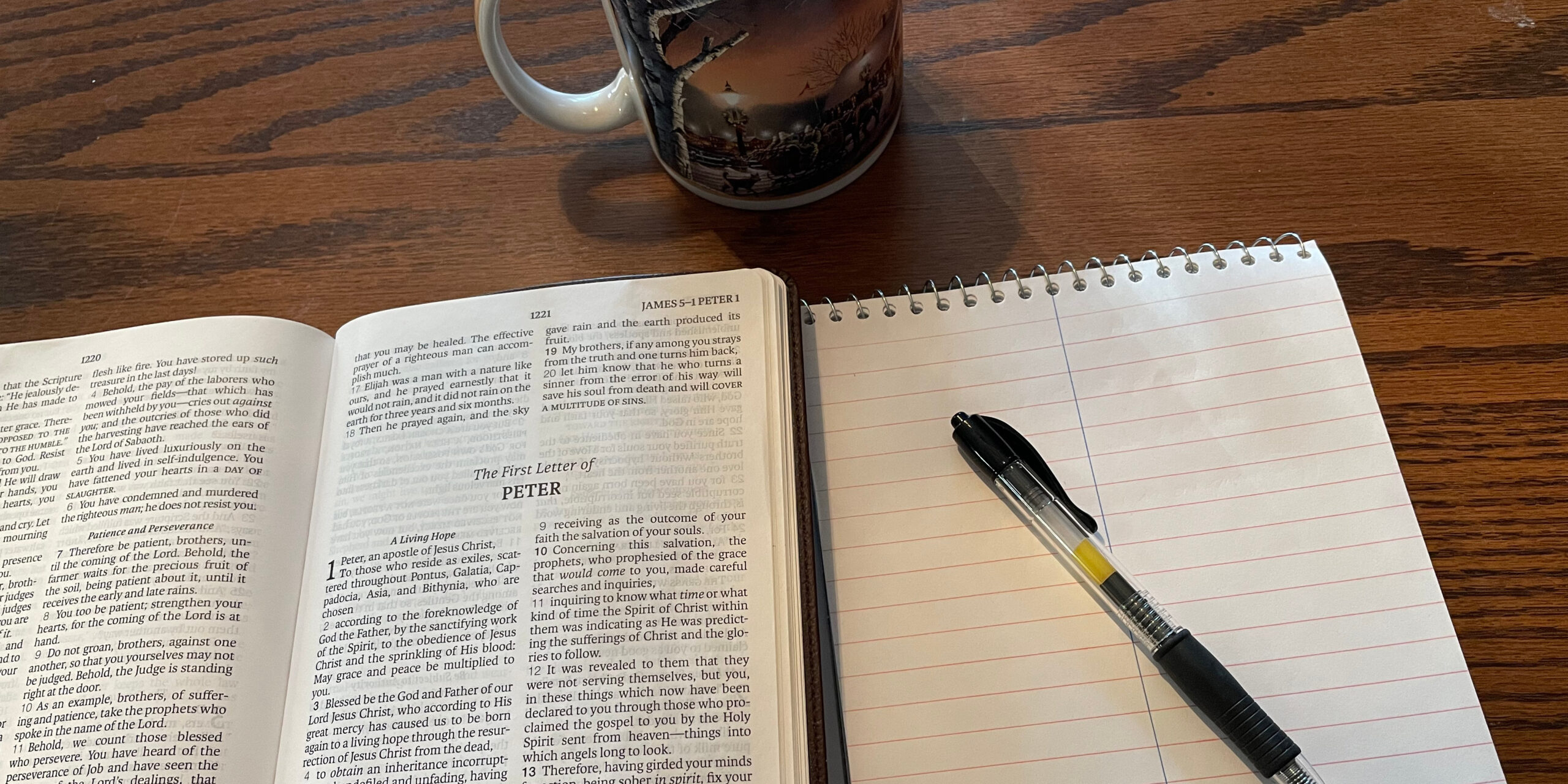
One of the habits the Bible encourages is meditation, which is basically mulling over and pondering God’s Word. I have been doing that with the last part of First Peter chapter 1 and through chapter 2:1-5. What I thought I would do today is to let you see the flow of this section the way I actually grasped it for the first time this week. I’d like to paraphrase the passage and just focus on the main progression of Peter’s thought. I would like you to read the passage as well as what I’ve written below and see if it makes sense to you in the same way. I would also like you to use your imagination to visualize the word pictures: put off, put on, milk, growing up, tasting, living stones, construction of a spiritual house, you as a priest offering sacrifices.
1 Peter 1:25 – 2:5 Paraphrased and summarized:
Since you have been born again through the eternal gospel of God, put away all malice and every other evil way, and, as we learned last week, put on the new self which is created in the likeness of God. You should desire the pure spiritual milk of the Word like a newborn desires physical milk. You need to do this so that you will grow up into salvation like a human baby grows up into adulthood. This should be a natural desire for you since you have already tasted that the Lord is good.
As you come to Jesus, who is a living stone, you yourselves are like living stones that are being built up into a spiritual house which is actually a holy priesthood to God. The purpose is that as holy priests you will offer spiritual sacrifices to God. These sacrifices are always acceptable to Him because they are offered through Jesus Christ.
We talked last time about the covenant God made with Noah in Genesis 9. The promise was simple: there would never again be a universal flood to destroy the earth. That covenant was not just with Noah personally, but with all flesh—with Noah’s descendants and every living creature on the earth.
The sign of that covenant was the bow in the clouds. We call it a rainbow, but the text simply calls it a bow.
There is an interesting detail in that passage that is easy to miss. When the bow appears in the clouds, who is reminded of the covenant? We naturally think of ourselves remembering God’s promise when we see a rainbow. But Genesis 9 says something striking:
“And I will remember my covenant.”
God says that He Himself looks upon the bow and remembers the everlasting covenant between Himself and every living creature on the earth.
The next time you see a rainbow standing on the edge of a thunderstorm, with sunlight breaking through one side of the sky, remember that while you are looking at the bow and remembering God’s promise, God is looking at it too. He says so Himself.
From there we started thinking about covenants in general because the Bible is filled with them. There is the covenant with Abraham, the covenant with David, the covenant connected with Moses and the giving of the law, and then there is a question raised in Hosea 6:7.
Many translations read:
“But like Adam they have transgressed the covenant.”
That raises the question: was there a covenant with Adam?
Genesis never directly uses the word covenant there, but clearly God placed Adam under conditions. Adam was placed in the garden, given responsibility to tend and keep it, and commanded not to eat from the tree in the midst of the garden. It was conditional. Adam broke that covenant arrangement and brought the curse upon the earth.
So even if Genesis does not explicitly use the word covenant, Hosea seems to point us in that direction.
But there is another covenant that is especially important for us, and it is one Christians hear about regularly, often without stopping to think about it deeply. During communion, Jesus spoke of “the new covenant in my blood.”
That new covenant was not invented in the New Testament. It was promised beforehand in the Old Testament.
The Promise of the New Covenant
The two major Old Testament passages describing the new covenant are Jeremiah 31:31–34 and Ezekiel 36:26–27.
Jesus’ conversation with Nicodemus in John 3 helps us understand why these passages matter so much. Jesus told Nicodemus that he must be born again, and Nicodemus did not understand what He meant. Jesus responded almost with surprise:
“You are the teacher of Israel and do not understand these things?”
That statement implies Nicodemus should have understood. But from where? Where in the Old Testament would he have learned about this inward spiritual transformation?
I think the answer is found in these New Covenant passages.
Jeremiah 31 and the Law Written on the Heart
Jeremiah says:
“Behold, days are coming, declares Yahweh, when I will cut a new covenant with the house of Israel and with the house of Judah.”
At first glance, we might think this has nothing to do with us because it explicitly mentions Israel and Judah. But Jesus applied it to His people when He said during communion:
“This is the blood of the new covenant.”
If Jesus had never said that, we would probably never think to apply Jeremiah’s promise to ourselves. But He did say it, and so we understand that somehow we are participants in it.
Jeremiah then contrasts this new covenant with the covenant made when Israel came out of Egypt. That earlier covenant was connected with the law given at Sinai. God told Israel what He required, and Israel agreed to it.
The problem, of course, was that the law demanded perfect obedience.
If you break one point of the law, you are guilty of the whole thing.
That is why the law condemns all of us. We fail continually. We fail in impatience. We fail in trusting God fully. We fail daily, probably hourly. That is why we need a Savior.
But then Jeremiah describes what God will do differently in the new covenant:
“I will put my law within them and on their heart I will write it.”
Under the old covenant, the law was external. It was written on tablets of stone and preserved in written commands. Under the new covenant, God places His law within His people.
That is why Jesus expected Nicodemus to understand the necessity of a new birth. The prophets had already spoken about God doing an inward work.
As believers, we are participants in that covenant. God’s law is not merely outside us commanding us; it is within us.
Jeremiah continues:
“I will be their God, and they shall be my people.”
That means something profoundly personal. God is our God, and we belong to Him.
Then Jeremiah says:
“For I will forgive their iniquity, and their sin I will remember no more.”
There is forgiveness in the new covenant. Sin remembered no more.
The passage also says:
“And they will not teach again each man his neighbor and each man his brother, saying, ‘Know the Lord,’ for they will all know me.”
I do not pretend to fully understand every detail of that statement, but it seems to point ahead to a future great work of God when people come to know the Lord broadly and powerfully through the work of His Spirit.
The Holy Spirit and Spiritual Adulthood
This connects closely with Paul’s teaching in Galatians.
Paul describes the law as a schoolmaster leading us to Christ. Think about how children need external rules. We tell children not to run into traffic, not to stick things into electrical outlets, not to touch a hot stove. Those rules are external because children lack maturity and understanding.
But when maturity comes, those rules become internalized.
Paul applies that idea spiritually. Before Christ came, the people of God were under the law in a kind of spiritual childhood. But when Christ came, something changed fundamentally.
The Holy Spirit now dwells within believers.
David did not experience the permanent indwelling presence of the Holy Spirit in the same way believers do now. Under the new covenant, the Spirit writes God’s law within us.
That is the great difference between the covenants.
Ezekiel 36 and the New Heart
Ezekiel expands this even further.
“I will sprinkle clean water on you and you will be clean.”
“I will give you a new heart and put a new spirit within you.”
“I will remove the heart of stone from your flesh and give you a heart of flesh.”
That is what God has done for His people in the new covenant. He removes the hard, stony heart and replaces it with a living heart responsive to Him.
Then He says:
“I will put my Spirit within you and cause you to walk in my statutes.”
That is an astonishing promise. God does not merely command obedience externally; He works within His people to carry out the obedience that He requires.
That does not mean Christians become sinless. Romans 7 makes that very clear. Paul says that when he wants to do good, evil is present with him. He desires to obey God, yet he still finds sin at work within himself.
But that inward struggle itself is evidence of spiritual life.
A Christian wants to obey God. A Christian grieves over sin. A Christian desires the things of God. Those desires are evidence that the Spirit is at work.
Sin is still present, but believers are called to put it to death—to smother it, stifle it, and let it atrophy rather than feed it.
The presence of that battle is not proof God has abandoned His people. It is evidence of the very work the new covenant promised.
Faith Has Always Been the Issue
All of this ties back to Abraham and Noah.
Abraham believed God, and God counted it to him as righteousness.
Noah also found grace in the eyes of the Lord because he believed what God said. When God told him to build the ark, Noah obeyed.
God’s desire has always been that His people trust Him.
Not merely trust Him for salvation, but trust all of His promises.
That brought us finally to Romans 8:28:
“We know that all things work together for good to those who love God, to those who are called.”
That verse is easy to quote and hard to believe.
“All things” includes sickness, hardship, broken relationships, poor decisions, suffering, financial mistakes, disappointment, and pain.
Even our foolish choices fall under “all things.”
God takes all of it and works it together for good.
That is difficult to believe sometimes. But that has always been the call of God to His people—from Noah to Abraham to us:
Trust God. Believe His promises. And live.
*Some articles on this publication or website are adapted from my recorded Bible teaching. I use transcription and editing tools (including AI-assisted editing) to convert spoken lectures into readable written form. The ideas, interpretations, and theological conclusions are my own and come directly from my teaching.
“Then God remembered Noah… and God caused a wind to pass over the earth, and the water subsided.”
That word wind is an interesting one. In Hebrew, it’s ruach. It’s the same word used back at creation, where the Spirit of God hovered over the waters. All the way through Scripture—Old Testament and New—the words for wind and spirit are closely connected.
Even in English, you can still see traces of it. To inspire is to take in breath. To expire is to breathe out your last. There’s something about breath, wind, and spirit that ties together.
I think about what Jesus said to Nicodemus in John 3. Nicodemus asks how the new birth works, and Jesus says, “The wind blows where it wishes… you hear its sound, but you do not know where it comes from and where it is going.” It almost sounds like, “Does that clear it up?” But that’s the point—that’s how the Spirit works. People are saved here and there. Sometimes in one church, sometimes another, sometimes through a radio broadcast. The Spirit moves, and we aren’t able to control or predict Him.
So here in Genesis 8, you have that same idea again. God sends the wind over the waters, and things begin to settle. It’s like a new beginning, echoing creation itself.
The First Altar and the Soothing Aroma
Noah builds an altar. That’s the first time Scripture explicitly mentions an altar being built. Abel offered a sacrifice earlier, but we’re not told the details about an altar there. Then Noah offers burnt offerings from the clean animals, and the text says:
“And Yahweh smelled the soothing aroma.”
Older translations call it a “sweet savor.” But what does that really mean?
When I think of a smell being soothing, I don’t just think of something pleasant. I think of something that calms, settles, even appeases. If you soothe a wound, you’re trying to bring rest to it.
That word carries the idea of appeasement—of something being settled down.
Think about the context. God has just judged the world. The flood has wiped out humanity except for Noah and his family. There is judgment, wrath, and destruction. And then Noah offers this sacrifice.
The smoke rises. The offering is completely consumed—it’s gone from the earth, given entirely to God. And in response, God speaks to Himself:
“I will never again curse the ground because of man…”
The sacrifice doesn’t just smell good—it represents obedience, faithfulness, total giving. And in that, there is a settling. God’s anger is, in a sense, appeased. There is a calming, a resting.
The Reality of the Human Heart
Right in that same statement, God says something striking:
“For the intent of man’s heart is evil from his youth.”
That hasn’t changed. The flood didn’t fix humanity. The problem is still there. This is the condition we live with until Christ returns. And yet, alongside that reality, God gives a promise:
“While all the days of the earth remain… seedtime and harvest… shall not cease.”
The cycles of the world will continue. Seasons will come and go. There will be planting and harvest, summer and winter, day and night. Whatever disruptions happen here and there, the overall order of creation is sustained by God’s promise.
A Restart: Be Fruitful and Multiply
When we move into Genesis 9, God blesses Noah and his sons and says:
“Be fruitful and multiply, and fill the earth.”
That should sound familiar. It’s the same command given to Adam and Eve. This is a kind of restart. Humanity begins again through Noah’s family.
God also says that the fear of man will be upon the animals. And we see that, don’t we? Most animals don’t calmly let us approach them. They scatter. There’s a built-in awareness, a fear.
At the same time, God says, “Into your hand they are given.” That’s dominion again. Humanity is placed over creation, not to abuse it, but to manage it under God.
A Change in Diet
Then comes something new:
“Every moving thing that is alive shall be food for you.”
Earlier, humans were given plants. Now, animals are included as food. There are no restrictions here—anything living may be eaten. Later, under the covenant with Israel, distinctions between clean and unclean animals will be introduced. But at this point, there are no such limitations. However, there is one clear command:
“You shall not eat flesh with its life, that is, its blood.”
Blood represents life and it must not be consumed. That principle carries forward and becomes very significant later, especially in connection with atonement.
The Seriousness of Life and Blood
God continues:
“Whoever sheds man’s blood, by man his blood shall be shed.”
Here we see the establishment of capital punishment. Human life is sacred because man is made in the image of God.
Even animals are included in this principle. If an animal kills a human, its life is required. That idea shows up later in the law as well.
This is one of the first clear prohibitions given to humanity. Before this, the only direct command had been given to Adam—not to eat from the tree. After that, there were instructions like “be fruitful and multiply,” but not many prohibitions.
And that raises an important theological point.
Sin, Death, and Representation
Between Adam and Moses, people died. But there was very little law given during that time.
Paul explains this in Romans 5. Sin was in the world, but “sin is not imputed when there is no law.” That means sin isn’t counted in the same way when there’s no specific command being broken. And yet people still died.
Why? Because Adam acted as our representative. He made a decision on behalf of the human race. When he sinned, that affected all of us. We are born into that condition.
But here’s the other side of that truth. When someone is in Christ, Christ becomes their representative. And what did Christ do? He obeyed perfectly.
So even though we are not perfect in our daily actions, our representative is. That changes everything about how we are viewed before God.
The Covenant with Noah
God then establishes a covenant:
“I establish my covenant with you… and with every living creature… all flesh shall never again be cut off by the water of the flood.”
This covenant is remarkable because it’s universal. It includes Noah, his descendants, and every living creature. It’s also unconditional. There is nothing required from humanity to maintain it. God simply declares what He will do.
He will never again destroy the earth with a flood.
The Sign of the Bow
God gives a sign of the covenant:
“I set my bow in the cloud.”
We call it a rainbow, but the word used is bow. That raises an interesting thought. A bow can be a decorative bow—or it can be a bow used with arrows. And the shape of a rainbow resembles a bow used for shooting.
Some Jewish teachers reflected on this and noted that the bow is positioned upward. If you picture it that way, the arrow would not be aimed at the earth. The idea is that God has set His weapon aside. The bow is hung up, not aimed at humanity.
Some even suggested that if there were an arrow, it would be aimed upward—meaning that if the covenant were broken, the consequence would fall on God Himself. That’s not stated directly in the text, but it reflects on the certainty and seriousness of God’s promise.
God does not break His promises.
The Certainty of God’s Promises
That same kind of certainty shows up elsewhere. When believers are given the Holy Spirit, it’s described as a down payment—an earnest.
A down payment is a guarantee. If the one making the promise fails to follow through, the deposit is forfeited. There is no way God’s promise will fail because He basically promised to leave the Holy Spirit with us if He doesn’t fulfill His promise. That’s what a down payment means. God gives His Spirit as that guarantee. Not because He might fail, but to show how certain His promise is.
In the same way, the bow in the sky is a visible reminder: God has committed Himself. There will not be another flood to destroy the earth.
And that’s not religious language. That’s reality. God is faithful. He keeps His word.
*Some articles on this publication or website are adapted from my recorded Bible teaching. I use transcription and editing tools (including AI-assisted editing) to convert spoken lectures into readable written form. The ideas, interpretations, and theological conclusions are my own and come directly from my teaching.
We’re still mulling over this passage from First Peter:
“Therefore, laying aside all malice, all deceit, hypocrisy, envy, and all evil speaking, as newborn babes, desire the pure milk of the word, that you may grow thereby, if indeed you have tasted that the Lord is gracious” (1 Peter 2:1-3).
Let’s talk today about the opposite of laying aside. What would that be? We are to lay aside certain things, and we are to put on or take on other things. Getting rid of old thought-patterns and habits without putting something in their place puts us at risk. The Bible usually explains both in the same passage. This concept, too, is worth meditating on in order to help your spiritual growth as a Christian man, no matter your physical age.
Here are a few of those passages for your meditation this week. I’ve summarized them. You should look up the passages and read them in context.
Ephesians 4:22–24 – Put off the old self, corrupted by deceitful desires; be renewed in the spirit of your mind; put on the new self, created after the likeness of God in righteousness and holiness. This one reminds me of the fact that if we are in Christ, we are a new creation (2 Corinthians 5:17.
Colossians 3:5–14 – Paul first tells them to “put to death” what belongs to the earthly nature (sexual immorality, greed, anger, etc.), then to “put off” anger, malice, slander (v. 8), and explicitly: “You have put off the old self with its practices and have put on the new self” (v. 9–10). He then lists the virtues to put on — compassion, kindness, humility, patience, love (v. 12–14).
Romans 13:12–14 – “Let us put cast off the works of darkness and put on the armor of light. Let us walk properly, as in the day, not in lewdness and lust, not in strife and envy. But put on the Lord Jesus Christ and make no provision for the flesh, to fulfill its lusts.”
May I encourage each of you, whether you are a new Christian or have been saved for decades, take time to meditate on these things. They will help strengthen your walk of faith.