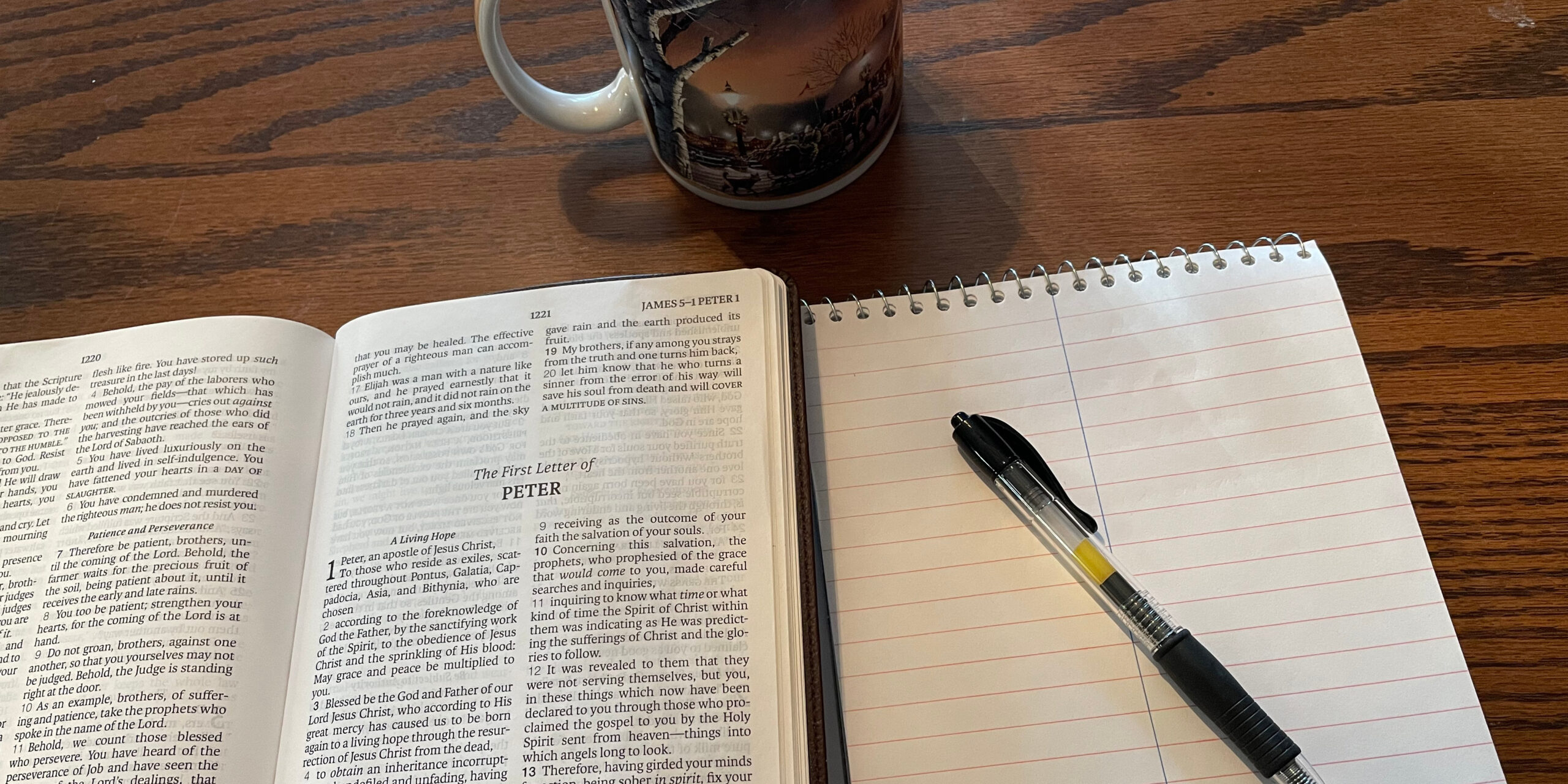
We’re continuing to think through the Apostle Peter’s writings in the book of the Bible we call First Peter. I chose Peter because I spend a lot of my New Testament time studying and thinking through what the Apostle Paul wrote to the various churches. We all need to be in the Word and have a way to be structured in our times of meditation on it. I do a lot of Bible teaching and I study a lot for that, but wanted a personal focus as well, and so I decided on First Peter. I’m using this Monday email to share my thoughts from that study with you. Sometimes my meditations are well-thought-through devotionals, and sometimes they are more random reflections as I work through the meaning for myself. Today feels like one of those to me. Hopefully you will be blessed through what I write this morning.
So now we are at 1 Peter 1:22. Here is what it says:
“Since you have in obedience to the truth purified your souls for a sincere love of the brethren, fervently love one another from the heart, ….” (1 Peter 1:22)
Because he begins with “since you have,” that tells me he assumes his readers have done what the rest of the phrase says. That surprises me because it does not seem obvious that a significant group of Christians he is writing to would have purified their souls in obedience to the truth. But then, perhaps “purified your souls” means believed on Christ for salvation. I say that because in Romans 16:26, Paul speaks of “obedience to the faith.” If that’s what it means then, of course, every Christian will have done that by their faith. What do you think?
The next thing I find interesting is the goal he mentions as the purpose or result of the soul-purification. It is for a “sincere love” of the brethren. God wants an unhypocritical love from us toward others, especially fellow Christians. Just think of how many times in the New Testament love for God and others is the focus of the teaching.
Finally, I notice that this short phrase finishes with the words “fervently love one another from the heart.” Since you’ve purified your soul so that you will have sincere love for other believers, love them well. Fervently means eagerly and earnestly. It also has the idea of continuously, not stopping. That makes me stop and think about how fervently and unceasingly and earnestly I love the brothers and sisters in Christ that are around me. It’s really easy to be self-focused, isn’t it?
May we all focus more this week on loving one another the way God would have us do, and let us pray that such love will be an increasing priority with each of us.
Good Morning. Let’s continue meditating on what Peter wants us to know and understand. This morning we are still thinking through First Peter 1:20-21.
“He [Christ] was foreordained before the foundation of the world, but was manifest in these last times for you who through Him believe in God, who raised Him from the dead and gave Him glory, so that your faith and hope are in God.”
Last time we looked at the first part of this passage. Today let’s focus on “who through Him believe in God.”
The core truth I want us to grasp today is that it is Jesus Christ who brings us to God. You might think, “Well, yes, of course. It’s so obvious, why are we even talking about it?” Sometimes it’s the obvious things that we take for granted and don’t think about. Jesus said, “No man comes to the Father but by me” (John 14:8). Our faith in God comes through Christ. He is the mediator between God and man, and it is through Him we come to know the Father. Jesus said, “All things have been delivered to Me by My Father, and no one knows the Son except the Father. Nor does anyone know the Father except the Son, and the one to whom the Son wills to reveal Him” (Matthew 11:27). Jesus is the revealer of the Father. In fact, Jesus said, “…He who has seen Me has seen the Father” (John 14:9). It is through Jesus that we believe in God.
There is a sequence to this series of verses. Our passage ends with the phrase, “so that your faith and hope are in God.” That statement gives you the purpose of the truth Peter is explaining to us.
Perhaps we could look at the flow of this passage like this:
Before the world began, God planned to send Christ.
God revealed Him in history “at the right time.”
God raised and glorified Christ.
People come to believe in God through Christ.
Resulting in believers placing their faith and hope in God.
Good Morning. It’s time for another Morning Devotional thought from First Peter. This time we’ll think about chapter 1, verses 20 and 21.
“He [Christ] was foreordained before the foundation of the world, but was manifest in these last times for you who through Him believe in God, who raised Him from the dead and gave Him glory, so that your faith and hope are in God.”
To foreordain means to determine, appoint, or decree something in advance. It is a synonym for predestine or predetermine. It means that an event or outcome is unalterable having been decided before it happened.
This is what it means that Christ was foreordained before the foundation of the world. It has always been God’s intention that He would send Christ into the world to be a sacrifice for our sins and those events were unalterable and happened at a time and place of God’s design.
“But when the fullness of the time had come, God sent forth His Son, born of a woman, born under the law, to redeem those who were under the law, that we might receive the adoption as sons” (Galatians 4:4-5).
“…the Lamb slain from the foundation of the world” (Rev 13.8).
“Who has saved us, and called us with a holy calling…according to his own purpose and grace, which was given us in Christ Jesus before the world began” (2 Timothy 1:9).
“According to the eternal purpose which he purposed in Christ Jesus our Lord” (Ephesians 3:11).
It should be encouraging to all of us to know that with God there is no Plan B. Nothing could prevent God’s plan to redeem us through Christ. Even the free decisions of men could not thwart the plan of God occurring at the appointed time and place:
“Him, being delivered by the determined purpose and foreknowledge of God, you have taken by lawless hands, have crucified, and put to death” (Acts 2:23).
The disciples prayed, “For truly against Your holy Servant Jesus, whom You anointed, both Herod and Pontius Pilate, with the Gentiles and the people of Israel, were gathered together to do whatever Your hand and Your purpose determined before to be done” (Acts 4:27-28).
The Bible says there is great success in meditating on the Scriptures (Joshua 1:8; Psalm 1:2-3). Take some time this morning to think about, consider, and meditate on what it means that God purposed and carried out this amazing plan to redeem us from our sins.
The First Adam and the Last Adam – 1 Corinthians 15 and the Resurrection*
We are in 1 Corinthians 15 today. We’ve been studying the Old Testament, but whenever the New Testament directly refers back to Adam, we land there. And here Paul talks about the resurrection. There are some deeply encouraging things in this chapter.
Before moving into the text, I want to briefly revisit where we were last time in Romans 5. There we looked at the comparison between the first Adam and Christ, the last Adam. Adam’s single act of disobedience brought condemnation to all humanity. Christ’s one act of righteousness — his death and resurrection — brought justification.
What struck me again is how Paul emphasizes the “much more.” Adam’s one sin brought judgment. Christ’s one act overcomes not just one sin, but the accumulated weight of many sins. This is not a proportional response — many sins, many punishments — but a divine reversal. Many sins, one tremendous gift of righteousness. That is the superabundance of grace.
Now Paul develops that further in 1 Corinthians 15.
Christ the First Fruits
Verse 20 says:
“But now Christ has been raised from the dead, the first fruits of those who have fallen asleep.”
“First fruits” is Old Testament language. The first part of the harvest was dedicated to the Lord. The firstborn animals, the first portion of crops — they belonged to Him. So when Paul calls Christ the “first fruits,” he is saying Christ is the beginning of a greater harvest to follow.
Others were raised in Scripture — Lazarus, for example — but they died again. Christ is different. His resurrection is the beginning of something permanent.
Verse 21 continues:
“For since by a man came death, by a man also came the resurrection of the dead.”
A man brought the problem into the world. A man had to solve it. That is why it was necessary for God the Son to become truly human. Not a mystical appearance. Not a spirit wandering around. A real man — with bones, blood, hunger, fatigue. Fully man, even while fully God.
Death came by a man. Resurrection also comes by a man.
In Adam or In Christ
Verse 22:
“For as in Adam all die, so also in Christ all will be made alive.”
That sounds sweeping until verse 23 clarifies:
“But each in his own order: Christ the first fruits, after that those who are Christ’s at His coming.”
Every human being is in one of two camps. Either you are in Adam, or you are in Christ.
Adam is the head of a race. Christ is the head of a race.
If you are in Adam, you share in his guilt and death. That is what we call original sin. A child is born already in Adam. He hasn’t done anything yet, but he belongs to that fallen line.
To be saved is to be removed from Adam and placed into Christ. You are transferred from one head to another. From one genealogy to another. From death to life.
Everyone in Adam dies. Everyone in Christ will be made alive.
There is also an order. Christ first. Then those who belong to Him at His coming. Then comes the end.
The End and the Final Enemy
Verse 24 says:
“Then comes the end, when He hands over the kingdom to the God and Father, when He has abolished all rule and all authority and power.”
There is coming a point when every other authority will be abolished. No more subrulers. No more competing powers. All enemies placed under Christ’s feet.
Verse 26 tells us the last enemy to be abolished is death.
That is the final enemy. And it too will be under His feet.
Paul makes an important clarification in verse 27. When he says all things are subjected to Christ, he does not mean the Father is subjected. The One who puts all things under Christ is not Himself put under Christ. The Father remains supreme.
Then in verse 28, when everything is subjected, the Son Himself will be subjected to the Father so that God may be all in all. Christ accomplishes redemption. He completes the work. And when it is fully brought to its end in history, the kingdom is handed over, the purpose fulfilled.
On the cross He said, “It is finished.” In time, that finished work unfolds until all is complete.
What Kind of Body?
Beginning in verse 35, Paul anticipates the question:
“How are the dead raised? And with what kind of body do they come?”
His first answer is blunt:
“You fool!”
In other words, think about it. Look at what God has already made.
He points to seeds. You plant a kernel of corn. You do not plant a full stalk. What you sow is not the body that will be. The seed goes into the ground. It dies. What comes up is different in form, yet connected to what was planted.
Different seeds produce different bodies. Corn produces corn. Lima beans produce lima beans. Each has its own body.
Then he moves to animals — men, beasts, birds, fish — all different. Then to the heavens — sun, moon, stars — each with its own glory.
And then comes the conclusion:
“So also is the resurrection of the dead.”
It is sown a corruptible body. It is raised an incorruptible body.
It is sown in dishonor. It is raised in glory.
It is sown in weakness. It is raised in power.
It is sown a natural body. It is raised a spiritual body.
“Spiritual” does not mean ghostly. It is a real body. Just as real as the natural body, but of a different order.
If there is a natural body — and there is — then there is also a spiritual body.
The First Man and the Last Adam
Now Adam comes back into view.
“The first man, Adam, became a living soul. The last Adam became a life-giving spirit.”
Adam received life. Christ gives life.
However, the spiritual is not first, but the natural; then the spiritual. Adam came first. He was from the earth, made from dust. Earthy. The second man is from heaven.
As is the earthy, so also are those who are earthy. As is the heavenly, so also are those who are heavenly.
Just as surely as we have borne the image of the earthy — and we all have — we will also bear the image of the heavenly.
That is the promise.
We Must Be Changed
Verse 50 makes it clear:
“Flesh and blood cannot inherit the kingdom of God.”
This present body cannot go into that kingdom unchanged.
“Behold, I tell you a mystery; we will not all sleep, but we will all be changed.”
Whether through death and burial or at Christ’s coming, change is required. In a moment, in the twinkling of an eye, at the last trumpet, the dead will be raised incorruptible, and we will be changed.
This corruptible must put on the incorruptible. This mortal must put on immortality.
Then it will be fulfilled:
“Death is swallowed up in victory.”
“O death, where is your victory? O death, where is your sting?”
A Picture That Helped Me See It
The first time this truly settled into my thinking was at my mother’s funeral. At the graveside, the pastor called the children forward and explained this passage to them.
He said, Grandma is like a seed.
When you plant corn, the plant does not come up somewhere else. It comes up where you planted the seed.
So when Grandma is buried here, and the resurrection happens, her new body comes up here — where the seed was planted.
That picture stayed with me. The continuity. The connection. What is sown is what God raises — transformed, glorified, incorruptible.
We were in a desperate situation because of what Adam did. Earthly. Corruptible. Weak.
But we are in a glorious situation because of what Christ has done. Heavenly. Incorruptible. Powerful.
Adam brought earthliness. Christ brings heaven.
And just as surely as we bear the image of the earthy, we will bear the image of the heavenly.
*Some articles on this publication or website are adapted from my recorded Bible teaching. I use transcription and editing tools (including AI-assisted editing) to convert spoken lectures into readable written form. The ideas, interpretations, and theological conclusions are my own and come directly from my teaching.
This session of our Back to the Beginning Bible study series focuses on Romans 5 (especially verses 12–21), a pivotal chapter that explains the doctrine of original sin through Adam and the far greater gift of salvation and righteousness through Christ, the second (or last) Adam. We review how sin and death entered the world through one man and how grace abounds even more through Jesus. Use your Bible (especially Romans 5) and the provided notes to follow along and reflect on these foundational truths. This is material every believer should be able to explain to family or friends when the opportunity arises.
Lesson Objectives
· Understand how sin and death entered the world through one man—Adam—and spread to all. · See Adam as a “type” (pattern or foreshadowing) of Christ, the second Adam. · Grasp the contrast: Adam’s one act brought condemnation and death; Christ’s one act brought justification and life. · Recognize that grace superabounds where sin increased (Romans 5:20). · Reflect on living in the reality of Christ’s finished work rather than striving to earn God’s favor.
Part 1: Sin and Death Entered Through One Man (Romans 5:12–14)
Let’s read Romans 5:12–14: “Therefore, just as through one man sin entered into the world, and death through sin, and so death spread to all men, because all sinned—for until the Law sin was in the world, but sin is not imputed when there is no law. Nevertheless death reigned from Adam until Moses, even over those who had not sinned in the likeness of the offense of Adam, who is a type of Him who was to come.”
Paul makes a clear point: sin and death entered the human race through one man—Adam. His disobedience brought guilt and death to all his descendants. This is not just individual sins; it is original sin—Adam’s sin is imputed to the whole human race because we are all in him by natural descent.
Even before the Law was given (which defined sin more clearly), death still reigned from Adam to Moses. People died even though they did not sin in the exact same way Adam did (breaking a direct command). Death’s reign proves sin’s universal presence and power.
Adam is called a “type” of Christ—the pattern or foreshadowing. Adam’s one act affected everyone under him negatively; Christ’s one act would affect everyone in Him positively.
Reflection Questions
· How does Paul prove that sin was present in the world even before the Law was given? · Why is Adam called a “type” of Christ? What parallels and contrasts do you see?
Part 2: The Gift of Grace Through the Second Adam (Romans 5:15–19)
Let’s read Romans 5:15–19 (key phrases): “But the free gift is not like the transgression. For if by the transgression of the one the many died, much more did the grace of God and the gift by the grace of the one Man, Jesus Christ, abound to the many… For if by the transgression of the one, death reigned through the one, much more those who receive the abundance of grace and of the gift of righteousness will reign in life through the One, Jesus Christ. So then as through one transgression there resulted condemnation to all men, even so through one act of righteousness there resulted justification of life to all men. For as through the one man’s disobedience the many were made sinners, even so through the obedience of the One the many will be made righteous.”
Paul repeatedly contrasts Adam and Christ:
· Adam’s one sin → condemnation and death for all · Christ’s one act of obedience (His death and resurrection) → justification, righteousness, and life for all who receive it
Adam’s trespass brought universal ruin; Christ’s gift brings superabounding grace. The result of Adam’s disobedience: all are constituted sinners. The result of Christ’s obedience: all who are in Him are constituted righteous.
This is not universalism (everyone saved automatically); it is federal headship—Adam represented the human race in sin; Christ represents His people in righteousness. We are “in Adam” by birth; we are “in Christ” by faith.
Reflection Questions
· How is Christ’s gift “much more” abundant than Adam’s trespass? · What does it mean to be “in Adam” by birth and “in Christ” by faith?
Part 3: Grace Abounds More Where Sin Increased (Romans 5:20–21)
Romans 5:20–21: “The Law came in so that the transgression would increase; but where sin increased, grace abounded all the more, so that, as sin reigned in death, even so grace would reign through righteousness to eternal life through Jesus Christ our Lord.”
The Law was added to highlight sin and show its exceeding sinfulness. Sin increased in visibility and guilt, but grace superabounded—overflowed even more.
Sin reigned through death; grace now reigns through righteousness to eternal life in Christ.
Reflection Questions
· Why did the Law come in “so that the transgression would increase”? · How does grace “reign” in the believer’s life today?
Part 4: Living in the Reality of Christ’s Finished Work
This truth is not just theology to memorize—it is life to live. We are no longer under Adam’s condemnation; we are under Christ’s righteousness. Our sins are forgiven—not because we are good enough, but because Christ was perfect in our place.
We should strive to live pleasing to God, not to earn salvation, but because we are already accepted. When we fail (complain, get angry at a red light, etc.), we confess, receive forgiveness, and keep going—resting in Christ’s finished work.
This is not license to sin. It is freedom from the burden of perfectionism. Christ has already met God’s standard perfectly. We live from that reality.
Reflection Questions
· Why is it exhausting to try to be perfect in our own strength? · How does resting in Christ’s righteousness change how we handle daily failures?
Study Exercises
· Read Romans 5:12–21 slowly. Underline every mention of “one man/one act” and “many/all.” · Compare Adam and Christ in a two-column chart: what each did, and the result for others. · Meditate on Romans 5:20–21—write down ways grace has abounded more than your sin. · Explain to yourself (or someone else) in simple terms: “Adam’s sin brought death to all; Christ’s obedience brings life to all who believe.”
Conclusion and Next Steps
Romans 5 shows the devastating effect of Adam’s sin and the far greater triumph of Christ’s obedience. Where sin and death reigned, grace now reigns through righteousness to eternal life. This is the gospel in miniature—something every believer should be able to explain.
*Some articles on this publication or website are adapted from my recorded Bible teaching. I use transcription and editing tools (including AI-assisted editing) to convert spoken lectures into readable written form. The ideas, interpretations, and theological conclusions are my own and come directly from my teaching.