Let me begin where the text itself invites us to begin, with a little review, because the story of Noah does not stand in isolation. It rises out of what has already been unfolding in Genesis. We had looked at Cain and Abel and especially at Cain’s line, and there was something dark about how that line developed. There were achievements, certainly—music, craftsmanship, the beginnings of culture—but morally it was a line in decline. Lamech boasts in an ungodly way , claiming vengeance beyond Cain’s, glorying in violence rather than grieving over it. It is not a line headed toward life.
And then, almost quietly, at the end of Genesis 4, after Seth is born, there is that remarkable statement that men began to call upon the name of the Lord. I have always been intrigued by that. It feels almost like the beginning of a revival, as though among the descendants of Seth something begins to awaken. There is spiritual life stirring in the midst of a darkening world. And that thread carries us eventually to Noah.
When we come into Genesis 6, we come into one of the most solemn passages in all of Scripture. We are told the Lord regretted that He had made man on the earth and that He was grieved in His heart. That is not casual language. That is a staggering statement. We know what regret feels like in our own small human way—those moments when we wish something had never been done. But here is God speaking in those terms. It ought to make us stop and think. Here is the Creator looking at a world ruined by sin and saying, in language we can understand, that He grieves over what man has become.
And then comes that glorious turn in the text: But Noah found grace in the eyes of the Lord.
Everything changes with that word “but.” In the midst of universal corruption, grace appears.
The earth was filled with violence. We talked before about the Hebrew word hamas—violence, ruthless wrong. God says the end of all flesh has come before Him. Judgment is determined. Yet what strikes me in the midst of all that is not only the judgment itself, but the way God deals with Noah. He speaks to him. He tells him what He is going to do.
That always moves me. God is not some distant power issuing decrees from behind a curtain. He talks to Noah. Later He will do something similar with Abraham concerning Sodom and Gomorrah. There is even that sense, almost expressed as divine deliberation, “Shall I hide from Abraham what I am about to do?” What does that tell us? It tells us God is personal. He desires fellowship. He speaks with men.
And it is worth lingering over that, because sometimes we are slow in fellowship with Him, but He is not reluctant toward fellowship with us. He wants His people near. He reveals Himself. Even during moments of judgment, that is true.
Then He commands Noah to build the ark. We talked about the gopher wood—how we do not even know exactly what that was—and about the pitch covering the ark inside and out. That still strikes me as one of those beautiful little details in Scripture that can be easy to rush past. The same word used there for pitch is the word used for atonement. That is no small thing.
What did that covering do for the ark? It protected it from judgment. It covered it. It kept destruction out.
And that is what atonement does.
The ark survived because it was covered.
We survive because we are covered.
That is not reading something foreign into the text. That symbolism is woven into the very word itself.
Again and again in the chapter we are told simply that Noah did what God commanded him. There is something wonderfully unadorned about that testimony. No flourish. No self-display. Just obedience. God spoke. Noah obeyed.
That is faith.
We often separate believing from obeying, but Scripture does not do that. Believing acts. If you truly believe a bridge is out ahead, you stop driving. If you say you believe but keep going, your actions reveal otherwise. Noah believed God, and because he believed, he built. That is why he can be called righteous. Not because he was sinless, but because he believed God, and faith is counted as righteousness. We find that more clearly explained in God’s interaction with Abraham later on in the text.
And there is something beautiful too in the way God provides for Noah in the task. Noah is not out frantically chasing animals around the world. God says they will come to you. Even in the commands, God is providing what obedience requires.
The text is repetitive in describing the animals—birds after their kind, creeping things after their kind, beasts after their kind. It says it over and over. Sometimes we are tempted to hurry past repetition in Scripture, but repetition is emphasis. God is underscoring something. This is comprehensive. This is deliberate. This is concrete history being carefully described.
And when God says, “You alone I have seen righteous before me in this generation,” we are brought again to the matter of faith. Noah believed, and his household entered with him. We talked some about the blessing that rests upon a household under godly influence. Not automatic salvation, no—but covenant blessing, a setting apart, a sphere of mercy. Scripture does speak that way. A child raised in a godly home lives under privileges and protections that are not present in godless homes.
Then the flood comes. And when it comes, it comes with cataclysm. The fountains of the great deep burst open. The floodgates of heaven open. Waters rise from below and descend from above. Everything convulses.
Sometimes people reduce the flood to a children’s story, but Genesis will not allow that. This is cosmic judgment.
And I have often reflected on the impossibility of treating this as merely some local flood. Water high enough to cover mountains does not remain politely confined. There are no walls around a local region to hold it there. Water seeks its own level. It goes where gravity takes it. The very scale described in Scripture demands what Scripture presents—a universal flood.
And then there is the length of time Noah is in the ark, something easy to overlook. A year and ten days. That is no brief emergency. That is a long confinement. Feeding animals, caring for a family, enduring the movement of the ark through all that time. The patience and faith involved in that alone are remarkable.
And when at last they come out, what does Noah do?
He worships. That is the first thing.
He builds an altar. I love that. Deliverance leads to worship. And, by the way, this is the first time in the Bible where someone is said to have built an altar. We assume Abel built an altar as well because he brought a sacrifice from his flock. But the Bible does not explicitly say that he sacrificed on an altar.
He offers sacrifice and then comes that striking statement where the Lord says He will not again curse the ground as He had, because the imagination of man’s heart is evil from his youth.
What a profound reason. Not because man has improved. Because man has not.
The flood did not change human nature. That is still the problem.
Sin lies deeper than circumstances. It lies in us.
And that is where Scripture is so honest. It does not flatter humanity. It tells the truth. From youth, the heart bends away.
I remember noticing this vividly with my son once when he was little in a high chair. He was kicking the footrest, making an irritating racket, and I gently held his legs and told him not to do that. He looked me right in the eye and deliberately kicked once more. It was a small thing, but I remember thinking almost with surprise, there it is. Defiance. There is the sin nature making itself known.
We recognize it because we know it in ourselves.
And that is what Genesis is telling us.
Which is why the answer can never simply be judgment repeated.
There must be another way.
And, of course, there is.
Though the text here has not unfolded it fully yet, we know where this is moving. God will deal with sin another way. Through a Savior. Through the Lamb ordained before the foundation of the world.
Even here, in Noah’s ark and Noah’s altar, those shadows begin to fall.
And when we read this account, I think we miss so much if we only read the surface of it. This is not merely animals entering an ark while floodwaters rise. This is a revelation of the holiness of God, the depth of human corruption, the wonder of grace, the obedience of faith, the shelter of atonement, and the God who speaks personally with those who belong to Him.
These are real people dealing with the real God.
And if we pay attention beneath the surface of the story, there is so much here—not only about Noah, but about ourselves, and about the gracious God who preserves sinners by grace.
*Some articles on this publication or website are adapted from my recorded Bible teaching. I use transcription and editing tools (including AI-assisted editing) to convert spoken lectures into readable written form. The ideas, interpretations, and theological conclusions are my own and come directly from my teaching.
Last time we talked about what it means to lay aside certain sinful activities and characteristics.
This came up because of the following passage from 1 Peter 2:
“Therefore, laying aside all malice, all deceit, hypocrisy, envy, and all evil speaking, as newborn babes, desire the pure milk of the word, that you may grow thereby, if indeed you have tasted that the Lord is gracious” (1 Peter 2:1-3).
We reviewed several passages from Scripture that say the same thing about setting aside or putting off. At the conclusion of last week’s email, I mentioned that it is not only necessary to lay things aside, but also to put things on.
All of this is a very important topic for us guys because we often develop thought-patterns and habits that are not God-honoring, but rather, are sinful and/or harmful to our living as a disciple of Christ.
Today I would like us to focus on the phrase “laying aside.” Perhaps next week we can talk about the putting on.
In the winter, when you go to someone’s house, the host may take your coat and hat or may show you where to put them. You hang them up or lay them aside. It’s actually a pretty simple concept. But, if you are like me, it is not always an easy thing to do. So many sinful habits and practices get pretty entrenched and seem resistant to “laying aside,” and can cause us trouble for years.
Let me share a couple of key principles with you. There’s more that could be said, but I think these three concepts are the most important, at least for me.
1. For the person who has truly trusted Christ for salvation and committed his life as a follower of Jesus the Messiah, there is no condemnation! A complete and full pardon has been granted (Romans 8:1).
2. Even though we are forgiven and have become new creations in Christ, there is a sin principle at work in us that will not go away until we receive our glorified body (Read Romans 7:7-25. Note especially verses 18-25).
3. This third point is the key, especially related to this topic today. Romans 8:14 says, “For sin shall not have dominion over you.” The Bible teaches us that sin’s authority to reign in us has been taken away! This is not a command. It is a truth to be believed! Sin seems powerful, and it is, but it does not have the authority to bully you into submission. You are no longer its slave, even though it may feel like it at times. Read and meditate on Romans 6; … a lot!
There is much, much more that could be written on this subject, but this is not the venue for that.
We’re in First Peter chapter 2 this week. Peter has just finished reminding us of the New Birth brought about by the enduring Word that was preached to us in the gospel.
“Therefore, laying aside all malice, all deceit, hypocrisy, envy, and all evil speaking, as newborn babes, desire the pure milk of the word, that you may grow thereby, if indeed you have tasted that the Lord is gracious” (1 Peter 2:1-3).
My dad used to say, “Whenever you see a therefore, stop and figure out what it is there for.” It’s kind of a silly saying, but a valuable one. Because of the fact that we have been born again by a living word, we should lay aside malice, and so forth. There is a reason for doing what Peter is challenging us to do.
Laying aside various things is a common theme in the epistles. I’ll share some with you for your meditation and study and will continue the thought next week.
Hebrews 12:1 “let us lay aside every weight, and the sin which so easily ensnares us”
James 1:21 “lay aside all filthiness and overflow of wickedness”
Romans 13:12 “let us cast off the works of darkness”
Ephesians 4:22, 25 “put off, concerning your former conduct, the old man” / “putting away lying”
Colossians 3:8-9 “put off all these: anger, wrath, malic, blasphemy, filthy language … since you have put off the old man.”
One important principle that we’ll talk more about next week is that besides “laying aside,” there should always be a “putting on.” Just shedding sins and habits of the old life and not replacing them with new habits and practices doesn’t work and is contrary to God’s whole method of helping us change. We’ll talk more about how that all works next time.
Last time we were reminded that Christians are born again through the living Word of God. The Spirit uses the Word to bring us to new life in Christ. Peter makes a special point to remind us that the seed that brought life was not corruptible. Look again at what the passage says:
“Having been born again, not of corruptible seed but incorruptible, through the word of God which lives and abides forever’ (1 Peter 1:23).
How did Peter know this? Immediately in verse 24-25 he quotes Scripture:
“All flesh is as grass, and all the glory of man as the flower of the grass. The grass withers, and its flower falls away, but the word of the Lord endures forever.”
This is taken from Isaiah 40:6-8. This reminds me that knowing our Bibles is important. The more we are familiar with Scripture and memorize portions of it, the more we will be able to make connections between one part of Scripture and another, and we will be able to make applications to our lives more readily. Yes, Peter was inspired by the Holy Spirit, but I’m thinking that by the time Peter wrote this letter, He knew the Old Testament pretty well and was familiar with this Isaiah passage.
Peter goes on now in verse 25 to tell us that this word was nothing other than the gospel which has been preached to us. As we have sat under the preaching of the gospel throughout our lives, we were hearing that uncorruptible, enduring Word of God. And it is that gospel which the Holy Spirit used to bring life to your soul, and give you a new heart, a new spirit, and God’s Spirit through the fulfillment of the New Covenant that Jesus promised on the night He was betrayed. God commands all people to simply repent and believe the Gospel (Mark 1:15).
Let’s not let this gospel become just religious jargon for us. Let’s remember that it came at the cost of our Savior’s lifeblood because of the great love with which He loved us.
Good Morning. Last time we thought about 1 Peter 1:22, which says, “Since you have purified your souls in obeying the truth through the Spirit in sincere love of the brethren, love one another fervently with a pure heart,”
If you look closely, you’ll notice that the end of the verse is not the end of the sentence. The passage goes on: “… having been born again, not of corruptible seed but incorruptible, through the word of God which lives and abides forever, because ‘All flesh is as grass, and all the glory of man as the flower of the grass. The grass withers, and its flower falls away, but the word of the Lord endures forever.’”
So, if you think about it, Peter is tying his exhortation to love one another fervently with a pure heart to the concept of the new birth. We’re exhorted to love and have the motivation to love because of the fact that we have been born again.
What does it mean to be born again? “Born again” is not a label to be used carelessly as an attachment to the word “Christian.” It is an actual event that takes place in a person’s inner being. In John 3, Jesus told Nicodemus that in order to see the kingdom of God a person had to be born again. Jesus expected Nicodemus to know what this meant, but he didn’t. Jesus told him that all human beings have a natural birth of the flesh, that is of flesh and blood. But a birth of the Spirit is also necessary if he wants to see the kingdom of heaven.
When Nicodemus asked how this could be, Jesus told him that the Spirit moves here and there like the wind. You can’t see the wind, but you can see and feel its effects. In the same way, as the Spirit moves, we see and feel the effects of His work.
In our passage in First Peter, Peter tells us that we are not born again of corruptible seed, but of the Word of God which is incorruptible. Putting these two ideas together, I take it to mean that as the seed of the Word of God is preached it lands on the soil of a person’s heart (See Matthew 13:18-23), and the Spirit works with the Word to regenerate the person.
I think one reason Nicodemus should have known this is because the New Covenant, which Jesus initiated with His blood when He died, promises “I will give you a new heart and put a new spirit within you; I will take the heart of stone out of your flesh and give you a heart of flesh. I will put My Spirit within you and cause you to walk in My statutes, and you will keep My judgments and do them” (Ezekiel 36:26-27). That description of the changes God makes in a person sounds like a description of someone who has been born again.
There is a lot to meditate on there. Hopefully you and I will have time to do that during the days ahead.
As we come to Genesis 4, we arrive at one of the best-known accounts in the Bible—the story of Cain and Abel. Most people remember it as the account of the first murder, but there is much more going on than that. The New Testament sheds additional light on these two brothers, and when we compare Scripture with Scripture, we begin to understand why God accepted one offering while rejecting the other.
Eve’s Remark After Cain’s Birth
Genesis opens the chapter by saying,
“Now the man knew his wife Eve, and she conceived and gave birth to Cain, and she said, ‘I have gotten a man with the help of Yahweh.’ And again she gave birth to his brother Abel.”
Before moving into the story itself, there is an interesting detail in Eve’s statement that is worth noticing.
Most English translations read something like, “I have gotten a man with the help of the Lord,” or “I have gotten a man from the Lord.” Those are reasonable translations, but the Hebrew is actually more difficult than that.
If we translated the words as literally as possible, Eve’s statement would simply read, “I have acquired a man, Yahweh.”
Immediately we wonder what she meant. Did she somehow think she had given birth to Yahweh? That certainly cannot be correct. Was she saying she had received a man from Yahweh? Or that she had obtained a man with Yahweh’s help? Those are exactly the kinds of decisions translators have to make.
It reminds us that translation is not always as straightforward as we sometimes imagine. The original Hebrew contained no capital letters, no punctuation, no commas or periods, no spaces between words, and originally not even written vowels. Translators must study the language carefully and determine how the words fit together in light of the rest of Scripture.
We cannot know with certainty exactly what Eve intended by her statement. Most likely she was expressing gratitude that the Lord had enabled her to bear a son. That seems to fit both the context and the rest of Scripture, even though the Hebrew wording itself leaves us with some unanswered questions.
Two Brothers, Two Occupations
The account then introduces the occupations of the two brothers. Cain became a cultivator of the ground, while Abel became a keeper of flocks.
There is an interesting connection with Adam here. Earlier we learned that Adam’s name is closely related to the Hebrew word for “ground.” Cain’s occupation was literally to work the adamah, the ground. He raised crops while Abel cared for sheep. That connection between Adam and the ground continues to appear throughout the chapter.
Why Did They Bring Offerings?
The story then tells us that, in the course of time, both brothers brought offerings to the Lord.
That raises an important question. Why were they bringing offerings at all?
Genesis never explicitly tells us that God commanded them to do so. Since both brothers brought offerings, it seems reasonable to conclude that God must have instructed them in some way. Yet the passage itself never actually says so, and we should be careful not to claim more than the text tells us.
Cain brought an offering from the fruit of the ground. Unlike the later requirements under the Mosaic Law, Genesis does not say that he brought the firstfruits or the best of his harvest. It simply says that he brought some of the fruit of the ground.
Abel’s offering is described differently. He brought “the firstborn of his flock and of their fat portions.”
Even at this early point in Scripture, we notice that Abel brought the firstborn and the choicest portions. Later in the Old Testament, the fat portions repeatedly represent the best of the sacrifice offered to God.
Still, that alone does not fully explain why God accepted Abel’s offering while rejecting Cain’s. To understand that, we need to let Scripture interpret Scripture.
Scripture Explains Scripture
Whenever we encounter a difficult passage, the best commentary on Scripture is Scripture itself.
The first place we should turn is Hebrews 11.
Hebrews 11:4 says,
“By faith Abel offered to God a better sacrifice than Cain, through which he was approved as being righteous, God approving his gifts.”
Immediately we learn something Genesis has not yet told us. Abel offered his sacrifice by faith.
That detail is significant because Hebrews 11 is the great chapter on faith. Abel believed God. His offering was the expression of genuine faith, and because of that God declared him righteous and accepted his gift.
The passage says nothing similar about Cain.
We are not specifically told that Cain lacked faith, but all of the emphasis falls upon Abel’s faith. Hebrews presents that as the distinguishing difference between the two brothers. Abel was approved as righteous because righteousness comes by faith, and God approved both the man and the offering that proceeded from that faith.
What the New Testament Says About Cain
The New Testament takes us even farther.
In 1 John 3 we read,
“This is the message which you have heard from the beginning, that we should love one another; not as Cain.”
Cain immediately becomes the opposite example of the love believers are to have for one another. John then tells us something we never would have known from Genesis alone.
Cain “was of the wicked one.”
That is a remarkable statement.
Cain certainly believed God existed. God spoke directly with him, and in just a few verses God and Cain will carry on a lengthy conversation. His problem was not that he denied God’s existence. There are many people who honestly believe God exists while never placing genuine faith in Him.
John continues,
“…because his deeds were evil, and his brother’s were righteous.”
According to Scripture, Cain himself was an evil man. It may well be that his evil sprang from unbelief, because elsewhere Scripture speaks of an evil heart of unbelief. A person may perform many outwardly good deeds, care for others, and appear morally upright, yet if that person refuses to believe God, Scripture still describes that heart as evil.
The issue, then, was much deeper than simply bringing vegetables instead of a lamb.
The Way of Cain
Jude reinforces the same picture.
Speaking about ungodly men who had crept into the church, Jude says, “They have gone the way of Cain.” He places Cain alongside Balaam and Korah, two other well-known examples of rebellion against God.
When we put Hebrews 11, 1 John 3, and Jude together, we discover that Cain represents much more than someone who happened to bring the wrong kind of sacrifice. He represents an unbelieving heart that outwardly acknowledged God while inwardly remained opposed to Him.
Abel, on the other hand, stands as an example of genuine faith.
That is the real heart of the story. It explains why God accepted one offering and rejected the other.
God’s Warning to Cain
After God rejected Cain’s offering, Genesis says that Cain became very angry and his countenance fell. That is often what happens when a person is determined to continue in sin. Rather than responding with humility, he becomes angry when confronted.
Just as God questioned Adam after the Fall, He now begins asking Cain questions.
“Why are you angry? And why has your countenance fallen?”
Then God gives Cain a warning: “If you do well, will not your countenance be lifted up? And if you do not do well, sin is lying at the door; and its desire is for you, but you must rule over it.”
The wording is interesting because it echoes the language used earlier in Genesis when God spoke to Adam and Eve. Sin is pictured as something waiting at the door, ready to take control. Its desire is for Cain, but God tells him that he must rule over it.
I cannot help thinking of Paul’s words in Romans that sin shall not have dominion over believers. Under the new covenant, because of Christ’s work, sin has lost its mastery over those who belong to Him. Here, long before that covenant was established, God still calls Cain to master the sin that is pressing against him.
In a sense, God is giving Cain an opportunity. He is warning him before the greater sin takes place. It is much like a parent correcting a child before the situation gets worse. Sometimes the child responds, and the matter is over. Sometimes the child continues to push the line. Cain is not about to listen to God.
The First Murder
Genesis simply says,
“Then Cain spoke to Abel his brother.”
I have always found that statement interesting. We are not told what Cain said. Perhaps the conversation took place before they entered the field. Perhaps he simply persuaded Abel to go with him. We do not know. The text leaves that part of the story unstated.
What we do know is that they ended up together in the field.
Then Cain rose up against his brother Abel and killed him.
The first murder in history was not the result of a momentary disagreement over an offering. It grew out of an unbelieving heart that had already rejected God’s warning. Cain had been confronted, given an opportunity to do what was right, and warned that sin was waiting to master him. Instead of ruling over sin, he yielded to it, and the result was the murder of his own brother.
The Judgment of Cain
After Cain murdered his brother, the Lord came to him once again. Just as God had questioned Adam after the Fall, He now questioned Cain. The questions were not asked because God lacked information. He already knew what had happened. Instead, the questions exposed Cain’s heart and gave him the opportunity to acknowledge his sin.
“Where Is Abel Your Brother?”
The Lord asked, “Where is Abel your brother?”
Cain answered, “I do not know. Am I my brother’s keeper?”
His reply is as revealing as the murder itself. Rather than confessing what he had done, he denied any responsibility for his brother. It is the familiar response of a guilty heart trying to avoid accountability. Someone breaks the vase and immediately says, “I don’t know who did it.” Cain’s answer has that same spirit. “Why should I know where he is? Am I responsible for keeping track of him?”
Instead of admitting his guilt, he attempted to shift the focus away from himself.
The Lord then replied,
“What have you done? The voice of your brother’s blood is crying to Me from the ground.”
That is remarkable language. Abel’s blood is pictured as crying out from the ground itself. The “crying” here is a yelling plea for revenge on the evil that was done. In Scripture when that word is used, God responds. It was a similar cry from the captive Israelites that God responded to with the Passover. The ground had received the blood that Cain had shed, and God speaks of it almost as though the earth itself were bearing witness to the crime.
Cursed from the Ground
The connection between Cain and the ground continues throughout God’s judgment.
Earlier we noticed that Cain’s occupation was to cultivate the adamah, the ground. Now God says,
“Now cursed are you from the ground, which has opened its mouth to receive your brother’s blood from your hand.”
The ground is personified. It is pictured as opening its mouth to receive Abel’s blood.
There is also an obvious parallel with Adam. Adam worked the ground, and after the Fall the ground would yield its produce only through painful labor. Cain now receives an even more severe judgment.
God tells him,
“When you cultivate the ground, it will no longer yield its strength to you.”
The very thing that had been Cain’s occupation would no longer respond to him. The ground he had worked, and from which he had brought his offering, would no longer produce as it once had.
God continues,
“You will be a vagrant and a wanderer on the earth.”
A vagrant is someone who roams from place to place without stability. The idea of a wanderer carries the thought of aimlessness and homelessness. Cain would no longer enjoy the settled life of cultivating his own land. Instead, he would become a restless wanderer with no permanent place to call home.
Cain’s Response
Cain did not argue that he was innocent. Instead, he cried out,
“My punishment is too great for me to bear.”
He understood exactly what God had said.
Then he continued,
“Behold, You have driven me this day from the face of the ground; and from Your face I will be hidden.”
Those words are especially sobering.
Throughout this account, Cain has been speaking directly with Yahweh. He has heard God’s questions, God’s warnings, and now God’s judgment. He realizes those conversations are coming to an end.
“You have driven me…from Your face I will be hidden.”
Cain understands that his fellowship with the Lord has been broken. He accepts God’s declaration that he will become a vagrant and a wanderer because God has said it will be so.
Then another concern enters his mind. “Whoever finds me will kill me.”
I find that interesting.
Cain had just murdered his own brother, yet now he feared that someone else would kill him. It reminds me of how often those who commit acts of violence suddenly become very concerned for their own safety when justice begins to catch up with them. Cain, who had shown no mercy to Abel, now desperately wanted mercy shown to himself.
The Mark of Cain
The Lord answered Cain’s fear with another declaration.
“Therefore whoever kills Cain, vengeance will be taken on him sevenfold.”
In other words, anyone who took Cain’s life would face an even greater judgment from God.
Then Genesis says,
“Yahweh appointed a sign for Cain, so that no one finding him would slay him.”
The text never tells us what that sign was.
Over the years many ideas have been suggested. Some ancient Jewish teachers even proposed that it was some sort of physical mark or horn-like feature. Scripture itself, however, says nothing about the nature of the sign, so we should not go beyond what the Bible reveals.
Whatever the sign was, it identified Cain in such a way that those who encountered him would know he was under God’s protection.
Exactly how that would prevent someone from attacking him, we are not told. Perhaps those who saw the sign also understood its meaning and respected the judgment God had pronounced. The text simply leaves the matter there.
Cain Leaves the Presence of the Lord
The section closes with a brief but solemn statement:
“Then Cain went out from the presence of Yahweh and settled in the land of Nod, east of Eden.”
Earlier, Eden itself had been to the east. Now Cain travels even farther east.
That geographical detail becomes significant as Genesis continues, because later events—including the Tower of Babel—also take place farther east in that same general region. This, of course, is before the Flood, so the geography of rivers and the landscape itself may not have been exactly as we know it today.
More important than the direction Cain traveled is the statement that he went out from the presence of Yahweh.
That is the tragic conclusion to this part of the story. The man who had spoken directly with God, who had received both warning and opportunity to repent, now departs from the Lord’s presence under divine judgment.
Cain’s Descendants and the Growth of Humanity
After recording Cain’s departure from the presence of the Lord, Genesis turns our attention to his descendants. At first glance this genealogy may seem like little more than a list of unfamiliar names, but it helps answer questions that naturally arise as we read the account.
One of the first questions people ask is, “Where did Cain’s wife come from?” The genealogy begins to answer that question by showing that the population of the earth was already growing far beyond Adam, Eve, and their immediate family.
Cain Builds a City
Genesis says,
“Cain knew his wife, and she conceived and gave birth to Enoch; and he built a city, and called the name of the city Enoch, after the name of his son.”
It is worth noticing that Cain himself named the city after his son Enoch.
The fact that Cain built a city immediately tells us there had to be far more people living than just Adam, Eve, Cain, and Seth. It may have been a very small city by our standards, but it was certainly more than a single family living alone. The account itself points to a rapidly increasing population.
The Genealogy of Cain
Genesis then traces Cain’s descendants:
Enoch became the father of Irad, Irad the father of Mehujael, Mehujael the father of Methushael, and Methushael the father of Lamech.
Lamech marks an important point in the genealogy because several details are given about his family.
The text tells us that Lamech took two wives, Adah and Zillah. That alone distinguishes him within the genealogy, since Scripture records him as having two wives rather than one.
Adah gave birth to Jabal, who became the father of those who dwell in tents and have livestock. His brother Jubal became the father of those who play the lyre and the pipe.
Zillah gave birth to Tubal-cain, who forged implements of bronze and iron.
That statement is easy to read past, but it tells us something important about the civilization that existed before the Flood.
Working with bronze and iron is not a simple matter. Iron does not simply appear in usable form. Someone has to mine the ore, build furnaces, smelt the metal, and develop the skills necessary to fashion tools from it. Those industries were already developing long before the Flood.
This was not a primitive society with no technology. It was a developing civilization with craftsmen, herdsmen, musicians, and metalworkers.
Naamah—An Unusual Detail
One more person is mentioned almost in passing:
“The sister of Tubal-cain was Naamah.”
That may not seem significant until we remember that women are rarely named in Old Testament genealogies unless there is some special reason for doing so.
Naamah is named, yet the Bible never explains why.
Some of the ancient Jewish rabbis suggested that she eventually became Noah’s wife. Scripture itself never says that, so we should not present it as fact. It simply remains one of those interesting suggestions that has been made over the years without biblical proof.
Lamech’s Boast
The genealogy pauses briefly to record something Lamech said to his wives:
“Adah and Zillah, listen to my voice… I have killed a man for striking me, and a boy for wounding me. If Cain is avenged sevenfold, then Lamech seventy-sevenfold.”
Lamech speaks of killing both a man and a young man. We will look more carefully at that passage later, but even here we can see his attitude. He appeals to the protection God gave Cain and claims that he deserves even greater protection for himself.
The account introduces themes that will become more important as Genesis continues.
Looking at the Genealogy
In the lesson notes, I included a genealogy chart showing Cain’s descendants.
Seeing the names laid out visually helps us follow the family line from Cain through Enoch, Irad, Mehujael, Methushael, Lamech, and then to Jabal, Jubal, Tubal-cain, and Naamah.
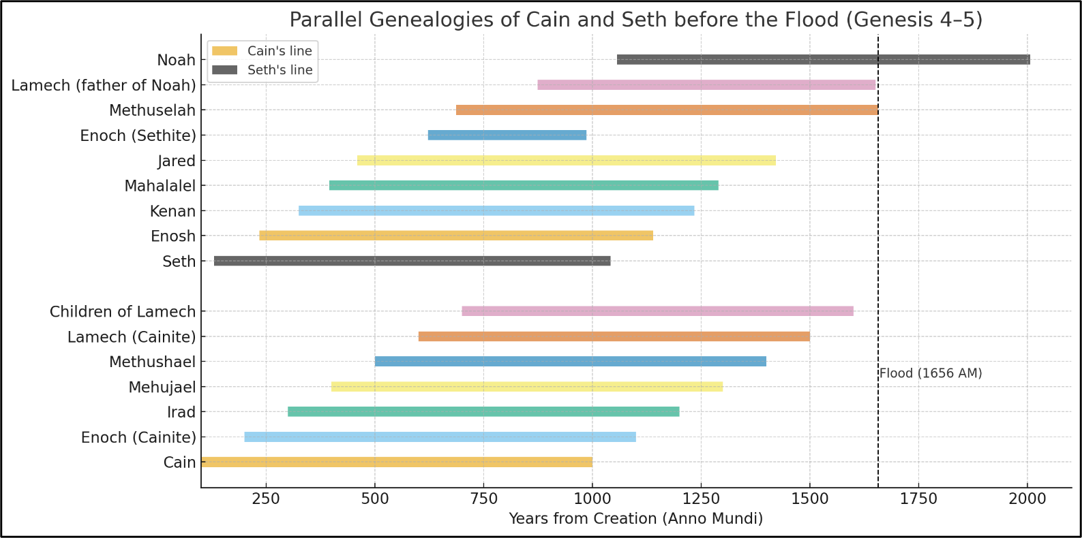
I also included a second chart that raises an interesting question.
I asked an AI program whether Scripture ever tells us how long Cain and his descendants lived. The answer was no. Unlike the genealogy of Seth in the next chapter, Genesis never records the ages of Cain’s family.
The program suggested creating an approximate timeline by assuming that Cain’s descendants generally lived about as long as the descendants of Seth. Since Scripture does not provide those numbers, the chart is only an illustration—not biblical fact.
Still, it provides an interesting way to visualize who may have been living at the same time.
For example, if you draw a vertical line at approximately 750 years after creation, you can see which members of Cain’s family and which members of Seth’s family would likely have been alive simultaneously if their lifespans were generally comparable.
Again, that chart is only an approximation designed to help us picture the chronology. It is not something Scripture itself tells us.
How Many People Were Living?
That naturally leads to another question.
How many people could have been living before the Flood?
Many people picture only a few scattered families, but that probably was not the case.
Organizations such as Answers in Genesis have attempted to estimate population growth by making reasonable assumptions about lifespan, the average number of children per family, and the ages at which people began having children. Those assumptions are then used to model what the world’s population might have looked like before the Flood.
Depending on the assumptions that are made, the population could easily have reached into the millions—or even the billions—by the time of Noah.
Of course, those figures are only estimates. Scripture does not tell us the exact population.
Even so, those possibilities help answer questions like, “Who was Cain afraid of?” or “Who lived in the city he built?” There were likely many more people alive than we often imagine.
That also raises another interesting question. If the population had grown that large, people could not all have been living together in one small settlement. Long before the Flood they would have spread out over large areas. Exactly how far they spread, we simply are not told.
These are interesting things to think about, even though the Bible does not answer every detail. They help us picture the setting in which the events of Genesis took place without going beyond what Scripture actually says.
Looking Ahead
The chapter closes by recording the birth of Seth, whose family line will become the focus of the next section of Genesis.
Before moving there, it is helpful to remember what we have seen in Cain’s account. Genesis has shown us far more than the story of one brother killing another. Through the New Testament we discover that Cain represents an unbelieving heart that outwardly acknowledged God while inwardly opposed Him. His descendants reveal a growing civilization with cities, agriculture, music, and metallurgy, while at the same time setting the stage for the increasing corruption that will eventually lead to the judgment of the Flood. The genealogy of Seth now becomes the line that Genesis will follow as God’s redemptive plan continues.