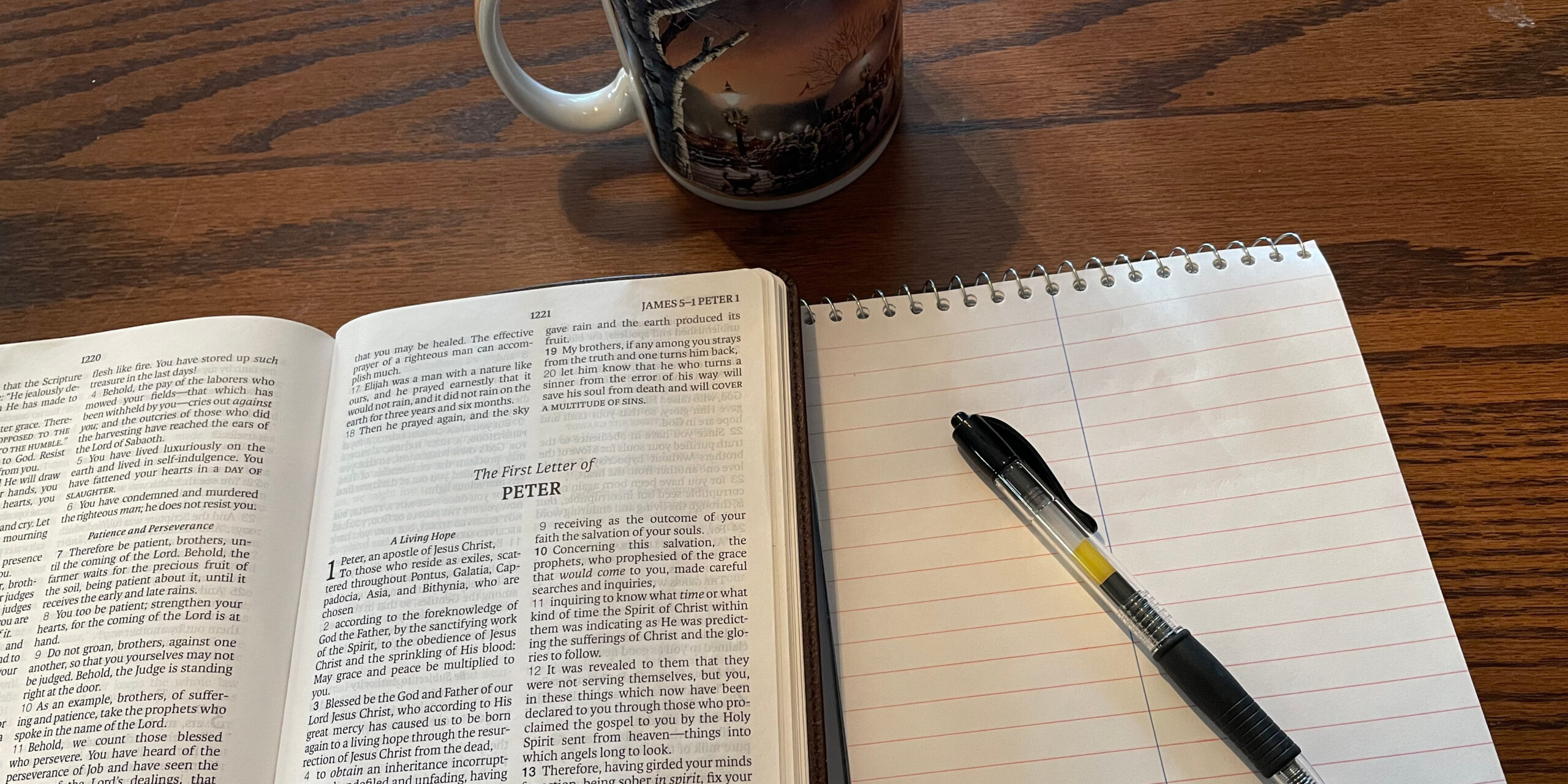
Today and through the next week or two, I would like us to take a look at 1 Peter 1:17-19 “And if you call on the Father, who without partiality judges according to each one’s work, conduct yourselves throughout the time of your stay here in fear; knowing that you were not redeemed with corruptible things, like silver or gold, from your aimless conduct received by tradition from your fathers, but with the precious blood of Christ, as of a lamb without blemish and without spot.”
Today we’ll focus on verse 17. Go back and read it again.
The first thought I had is that this verse speaks of God evaluating our works. But works are not part of the evaluation process for those who are in Christ, are they? Peter goes on to emphasize it even more by telling us to conduct ourselves with fear during our stay here.
The Bible clearly teaches that we are saved by grace and not by works. Romans 8:1 teaches us that there is no condemnation for those who are in Christ Jesus. So Peter is not talking about a salvation issue here.
However, we do know that God is going to evaluate our lives and hand out awards according to the deeds we have done. “For we must all appear before the judgment seat of Christ, that each one may receive the things done in the body, according to what he has done, whether good or bad” 2 Corinthians 5:10. Since we are redeemed by the very valuable and precious blood of Christ, we belong to God. We are not our own. We are here to serve God and not ourselves. It’s reasonable and biblical to recognize that we should be careful how we live for God during our short stay here. There should be some level of fear. This fear is not a terrorizing fear of losing our salvation. But, it is also not a superficial respect for God. Our father is God almighty who rules from heaven, and He knows not only what we do but what our motivation for doing it is. There is coming a day when we will give an account to Him as to how we used the gifts and abilities He has given us, including how we used our time and money. There should be some level of fear even as we face our Heavenly Father who we know loves us.
Let us each ask God to give us the desire to serve Him in a way that pleases Him, realizing that all the blessings of life are ours because of His generous grace.
The passage we are thinking about today is 1 Peter 1:14–16: “As obedient children, not conforming yourselves to the former lusts, as in your ignorance; but as He who called you is holy, you also be holy in all your conduct, because it is written, ‘Be holy, for I am holy.’”
Here are just a couple of thoughts:
Obedient non-conformance is assumed. The opening phrases assume that the readers are children of God, and therefore obedient and non-conforming. To conform means to be shaped by a mold. Everything that goes through the mold comes out looking the same. God does not want us to be shaped by the ways of the natural, unsaved man. Peter mentions the “former lusts.” These believers had once lived as unsaved people before coming to know Christ. We should no longer be shaped by those natural desires that bring so much damage. Later, in chapter 2, Peter urges believers to abstain from fleshly lusts that “war against the soul.” We should not let those desires shape us. This also reminds me of what Paul says in Romans 12:2, that we are not to be conformed to this world. This matters greatly to God.
In contrast, God has called us to be holy as He is holy. Instead of being conformed to the world through worldly desires, we are to be conformed to God. That is what it means to be godly. Sometimes we think of the word “holy” as meaning perfect or righteous. But at its root, the word means separate, distinct, and unique. God is holy because He is unlike anyone or anything else. He is completely different. There are many ways a person can be unique, but from a Christian perspective we are to be different because we are set apart for God and for His glory. We are not to live like those who are serving themselves, seeking recognition, or trying to be the center of attention. Instead, we are to follow the example of Jesus, who came to serve rather than to be served. That kind of life is radically different from what the world values.
So, these three verses present two directions our lives can take. Either we will allow ourselves to be shaped by the world and its desires, or we will seek to be shaped by the character of God. When we are conformed to God’s character, we become distinct in a godless world.
Good Morning. It’s time to get back into our meditation on the book of First Peter. We’re looking at 1:13 this morning. If you have been following closely, you will discover that this post should have been posted before the Memorial Day devotional. I guess my age is catching up with me.
“Therefore, having girded the loins of your minds for action, and being sober-minded, set your hope fully on the grace that will be brought to you at the revelation of Jesus Christ.”
Peter has been writing about the amazing inheritance and salvation that has been secured for us and is reserved and guarded in heaven awaiting our arrival. The prophets who wrote about this in the Old Testament, and even angels were trying to figure out what this salvation was all about. Then he writes, “Therefore.” Because of all that he has written he issues a challenge. The actual command of the challenge is, “Rest (or set) your hope ….” Now if you look back at the verse, you’ll notice that there are a few steps of preparation that come ahead of “setting your hope.” Let’s take a look at those.
First, Peter says, “having girded the loins of your mind.” In New Testament times, men wore long robes. When it came time to run or fight, it was necessary to gather up the robes and tie them in place around the waist so that the man’s legs would be free to run and maneuver. That’s what the expression “gird up your loins” meant in those days. In this passage Peter says to do this with our minds. That means we need to gather our thoughts in place, clear our heads, get focused on what the objectives are so that our minds are ready for action. In this case it’s not necessarily a physical action, although it might be. But our minds need to be ready for mental action, for thinking, understanding, and planning. Along with that we are to be sure our minds are sober-minded. In other words our minds need to be under control so that we don’t have thoughts running all over the place out of control. Our minds need to be controlled and ready for action before we can really be ready for some spiritual work.
The spiritual work here is what Peter tells us to do. With our minds ready for action and in control, we are to set our hope. We are to plant our hope firmly in the ground fixed in a way that it can fully function. What is the ground where we are to set our hope? Set it fully and completely on the grace that is coming our way when Jesus Christ returns. Certainly we are recipients of grace now. But when Christ comes back, that grace will be on full display and fully operational in all aspects of our lives. Because we have the grace of God at work now, we have some experience and understanding of it and we are to fix our hope on the future full revelation of that grace that we now know only in part.
The main point I want to make is that it is not a leisurely, sort of careless unthinking planting of our hope on the promise of future grace. That is the way we often handle spiritual truths. But what Peter is saying here is that it must be done with our minds fully engaged for action. And our minds must be sober and clear-headed. It is a very conscious action that is being called for here. When a man wants to put a stake in the ground in a way and in a place where it will stay, he finds the right spot and then uses a sledge hammer to drive it firmly into the ground so that it won’t move. That’s the picture here. Take hold of your hope and plant it firmly in the ground of the grace that you have received as it will be fully brought into focus when Christ comes back for us. Do it intentionally! And, you might have to do it more than once, because unlike a physical stake, our hope is sometimes uprooted by circumstances and our minds traveling in all sorts of directions because of the cares of life. Plant your hope and do it as often as necessary.
We are continuing our study in Genesis, but one of the things I want to do as we move through the Old Testament is bring the New Testament alongside it. The New Testament frequently reaches back into Genesis, and when it does, it often helps us understand why these early passages are so important.
In Genesis 2 we have just come to the creation of Eve. God caused Adam to fall into a deep sleep, took from his side, and formed a woman for him. Before that, God had brought the animals before Adam and given him the responsibility of naming them.
That matter of naming is significant. We do it all the time. We name our children. We name our inventions. Every time something new is created, we give it a name. Naming reflects responsibility and authority. Adam had been given stewardship over the created world and over the garden, and part of that stewardship was expressed through naming the animals.
Yet among all the creatures there was none corresponding to Adam. None were like him. That is why Adam responds the way he does when God brings Eve to him:
“This one finally is bone of my bones and flesh of my flesh. This one shall be called woman because this one was taken out of man.”
For the first time Adam encounters someone who truly corresponds to him.
A Man Shall Leave His Father and Mother
Genesis then gives us a statement that becomes very important throughout the rest of Scripture:
“Therefore a man shall leave his father and his mother and cleave to his wife, and they shall become one flesh.”
What is interesting is that when this statement appears, there is not yet a father and mother in existence. There are only Adam and Eve.
Because of that, I understand this as Moses, under the inspiration of Scripture, providing an explanatory comment as he records the account. Moses was writing many years later, when marriage, parents, and families already existed. He is connecting the creation account to the institution of marriage as his readers knew it.
Something else has always struck me about the verse. It says the man shall leave his father and mother. It does not say the wife shall leave her father and mother.
I think there is significance there. From the beginning, the man was intended to lead, provide, and take responsibility. The emphasis seems to be on the husband establishing a new primary loyalty. Whatever attachment existed to father and mother must now give way to a new union with his wife.
Different cultures may express that in different ways. In the ancient world families often lived very close together, sometimes even adding living quarters onto an existing family compound. The command does not necessarily require a great geographical separation. But even if families remained close physically, there still had to be a shift in relationship. The man was to cleave to his wife.
That emotional and practical transfer of loyalty appears to be part of what the passage is emphasizing.
Jesus Appeals to Genesis
When we come to Matthew 19, Jesus quotes this very passage while answering a question about divorce.
The Pharisees came to Him and asked:
“Is it lawful for a man to divorce his wife for any reason at all?”
Jesus immediately directed them to Scripture:
“Have you not read…?”
That was His authority. He did the same thing during His temptation. He continually appealed to what God had said.
Jesus answers by going all the way back to creation:
“He who created them from the beginning made them male and female.”
Then He quotes Genesis:
“For this reason a man shall leave his father and mother and be joined to his wife, and the two shall become one flesh.”
Notice what Jesus is doing. He is affirming the authority of Genesis and grounding His teaching in God’s original design.
This is especially important in a culture that increasingly rejects God’s created order. The biblical teaching is straightforward: God made humanity male and female. That is not merely a social arrangement. It is part of God’s design from the beginning.
Jesus continues:
“So they are no longer two, but one flesh. What therefore God has joined together, let no man separate.”
Marriage is not merely a human arrangement. God joins husband and wife together.
The Pharisees responded by asking why Moses allowed divorce. Jesus explained that Moses permitted it because of the hardness of people’s hearts, but that it was not God’s original intention.
From the beginning, God’s design was permanence and faithfulness.
This is not simply an abstract issue. Divorce leaves real wounds. It affects husbands and wives, children and families. God’s design was not casual separation but covenant union.
Paul’s Use of Marriage in Romans
Although we did not turn there, it is worth remembering that Paul also uses marriage imagery in Romans 7.
His purpose there is not primarily to teach about marriage. Instead, he uses marriage as an illustration of the believer’s relationship to the law.
When a spouse dies, the surviving spouse is free from the legal bond of that marriage. Paul uses that principle to explain what has happened to believers in Christ.
All the judgment of the law was carried out on Christ. The law declared that sin deserved death, and Christ died in our place. Because of that, the law has no further jurisdiction over those who are in Him.
The demands of the law have been fully satisfied through Christ’s death.
One Flesh and Sexual Purity
Paul reaches back to Genesis again in 1 Corinthians 6.
The Corinthian church struggled with many moral problems, and Paul addresses sexual immorality directly.
He reminds believers that their bodies are members of Christ.
That is an astonishing truth. Sometimes we speak of the church as the body of Christ almost as a figure of speech, but Paul presses the idea further. Our bodies themselves belong to Christ.
Because of that, Paul asks:
“Shall I then take away the members of Christ and make them members of a prostitute?”
His answer is immediate:
“May it never be.”
Then he quotes Genesis once again:
“The two shall become one flesh.”
Paul applies the language of Genesis to sexual immorality. A physical union creates a one-flesh relationship. That is why sexual sin is so serious. It involves the body that belongs to Christ.
He contrasts this with the believer’s union with Christ:
“The one who joins himself to the Lord is one spirit with Him.”
Our bodies belong to God. We are not our own.
Paul says:
“You were bought with a price.”
Therefore:
“Glorify God in your body.”
Not merely in some inward spiritual sense, but in the actual use of our bodies.
Our eyes belong to Him. Our hands belong to Him. Our feet belong to Him.
When we use our bodies, we are using what belongs to Christ.
That old children’s song comes to mind:
“Be careful little eyes what you see.”
There is more truth in that song than we sometimes realize.
If our bodies are members of Christ, then what we watch, where we go, and what we do with our bodies all matter.
The Great Mystery
The most fascinating use of Genesis 2 may be found in Ephesians 5.
Paul begins with instructions to husbands:
“Husbands, love your wives, just as Christ also loved the church and gave Himself up for her.”
Christ loved the church sacrificially. He gave Himself for her in order to sanctify her and present her to Himself in glory.
Paul then applies that principle to husbands.
A husband should minister to his wife in such a way that she becomes more beautiful spiritually, more mature, more holy, and more Christlike through the years.
He should nourish and cherish her just as Christ does the church.
Then Paul quotes Genesis again:
“For this reason a man shall leave his father and mother and be joined to his wife, and the two shall become one flesh.”
At that point he says something remarkable:
“This mystery is great; but I am speaking with reference to Christ and the church.”
Ultimately, Paul says, Genesis 2 is pointing beyond human marriage.
Marriage is a picture of Christ and the church.
That means every Christian marriage carries with it a testimony. The relationship between husband and wife reflects something about Christ’s relationship with His people.
When a husband loves his wife as Christ loves the church, and when a marriage reflects grace, faithfulness, and commitment, it becomes a picture of the gospel.
On the other hand, when a marriage is characterized by selfishness, bitterness, constant conflict, and disregard for one another, it distorts that picture.
Marriage was designed to point beyond itself.
It was designed to tell the truth about Christ and His church.
Returning to Genesis 3
As we come to Genesis 3, everything changes.
The chapter opens with these words:
“Now the serpent was more crafty than any beast of the field which Yahweh God had made.”
The serpent approaches Eve and asks:
“Indeed, has God said, ‘You shall not eat from any tree of the garden’?”
Why that question?
The answer seems obvious. He is attempting to create doubt. He is questioning God’s word and planting uncertainty in Eve’s mind.
Another question naturally arises. Why did he approach Eve rather than Adam?
Several possibilities come to mind.
Adam had personally received God’s original command. Eve was not yet present when that command was first given. We do not know whether God later repeated it directly to her. Scripture does not tell us.
What we do know is that Adam had heard it firsthand.
Perhaps that is part of the reason the serpent approached Eve.
Whatever the reason, the strategy was clear. The serpent’s first move was not an outright denial. It was a question designed to make God’s word seem uncertain.
As we move into the account of the fall, it is worth reading the passage carefully and thinking through the details. The text invites us to engage with it, to ask questions, and to consider what is taking place as sin enters the human story.
We’re in Genesis 2, picking up at verse 8. This is a different angle on creation than Genesis 1. There, we were given the broad account. Here, the focus narrows, especially on man and the place God prepared for him.
“And Yahweh God planted a garden in Eden toward the east, and there He placed the man whom He had formed.”
That word “placed” is worth pausing on. It’s more than just setting someone down somewhere. It carries the idea of settling, even resting. God didn’t just drop Adam into the garden—He settled him there. It was a place for him to be, to belong, to rest in a sense.
Then we’re told what God caused to grow:
“Every tree that is desirable in appearance and good for food.”
That’s an expansive description. Every tree that looks good and is good for food. You start thinking through what that could include—apples, pears, cherries, nuts, things we know—but this is before the fall. Whatever existed then would have been untouched by decay. It’s hard to even imagine the fullness of it.
In the middle of the garden were two specific trees: the tree of life and the tree of the knowledge of good and evil. There was no prohibition given about the tree of life. It seems they could have eaten from it. The restriction was tied only to the other tree.
The Setting of Eden
The passage goes on to describe rivers flowing out of Eden—Pishon, Gihon, Tigris, and Euphrates. That places the region somewhere in what we would now call the Mesopotamian area, around modern-day Iraq.
At the same time, we have to remember the flood changed everything—river courses, land formations, the whole topography. So while we can approximate, we can’t be precise.
There’s also that brief note about gold, bdellium, and onyx. It’s simply stated. No explanation is given. But God included it, so it mattered in some way.
Work Before the Fall
In verse 15, we read:
“Then Yahweh God took the man and set him in the garden of Eden to cultivate it and keep it.”
That’s before sin enters the picture. Adam was given work to do. The word “cultivate” means to work it—to tend the garden. But this wouldn’t have been burdensome work. Later, after the fall, God says that work will come by the sweat of the brow. So this earlier work was different—still effort, but not toil.
“Keep it” means to guard it, to take responsibility for it. There’s even the possibility that part of this involved beautifying it—arranging, tending, shaping what was already there.
This tells me something important: work itself is not a result of sin. Work is good. Even in a perfect environment, man was not meant to sit idle. There was purpose built into his existence.
The Command and the Warning
God then gives a clear command:
“From any tree of the garden you may surely eat; but from the tree of the knowledge of good and evil you shall not eat from it, for in the day that you eat from it you will surely die.”
That phrase “surely die” in Hebrew is expressed by repetition—“dying you shall die.” It’s a way of emphasizing certainty.
Later, when Eve speaks, she adds something God didn’t say—“neither shall you touch it.” Since she wasn’t there when the commandment came down, her response likely came from Adam, passing along the command with an added safeguard. We don’t know for certain, but it would make sense.
When they eventually ate, they didn’t drop dead physically that day. So what did God mean? Some suggest this shows God’s grace—death began, decay began, but it wasn’t immediate physical death. Others say it refers to spiritual death. The text leaves some room there, and we shouldn’t force more precision than it gives.
“Not Good for Man to Be Alone”
Then comes a striking statement:
“It is not good for man to be alone; I will make him a helper suitable for him.”
Everything up to this point has been called good. Now, for the first time, something is “not good.”
The phrase “helper suitable” carries more depth than it might sound like at first. “Helper” can mean assistant, but “suitable” has a range of meaning—corresponding, opposite, even in some sense contrary.
Think of something like a step ladder. One side supports the other, but it does so by being set opposite it. That opposition is what makes the structure stand.
So this helper would be one who supports, corresponds, and at times even stands in a kind of necessary contrast. Not opposition in a hostile sense, but in a way that strengthens. After the fall, that opposing role sometimes takes the form of outright opposition. That then is a sinful twisting of God’s loving design for marriage.
Naming the Animals and Learning the Lack
Before creating the woman, God does something that raises a question.
He brings all the animals to Adam for naming:
“The man gave names to all the cattle, and to the birds of the sky, and to every beast of the field; but for Adam there was not found a helper suitable for him.”
Why do this?
It seems God was showing Adam something. As he named each creature, he would have seen pairs, distinctions, categories. And through that process, he would have come to recognize that none of them corresponded to him.
Naming itself is an act of dominion. To name something is to classify it, to organize understanding. It’s part of ruling over creation. That’s what we humans do all the time. Everything needs a name. A plant for example will have a common name for identification purposes, and a scientist will have a more specific Latin name for the same plant. A young child is constantly pointing at things and asking, “What’s that?”
But all of that activity—purposeful as it was—did not meet his deepest need. There was still no one suitable for him, someone like him but different.
The Formation of the Woman
Then God acts:
“So Yahweh God caused a deep sleep to fall upon the man… and He took one of his ribs… and Yahweh God fashioned the rib… into a woman, and He brought her to the man.”
Adam was formed from the dust. The woman was formed from the man. Neither was created out of nothing.
When Adam sees her, there’s an immediate recognition:
“This one finally is bone of my bones, and flesh of my flesh.”
After all the animals, this is the one who corresponds.
He names her “woman”—in Hebrew, ishah, taken from ish (man). Even in the language, there’s a connection that reflects her origin.
The Foundation of Marriage
The passage then gives us the foundational statement:
“Therefore a man shall leave his father and his mother, and cleave to his wife, and they shall become one flesh.”
This verse is picked up later in the New Testament, but even here, it establishes the pattern—leaving, cleaving, and becoming one flesh.
A Closing Reflection on Design
What we see in all of this is design. Intentional, ordered, purposeful design. Male and female, corresponding to one another, formed in a way that fits together.
When that design is rejected or redefined, it’s not a small shift. It’s a fundamental departure from what God established at the beginning. And when that happens, the results are not neutral. They lead somewhere.
This passage brings us back to the foundation—how God made man, how He made woman, and how He intended them to live together in His created order.
*Some articles on this publication or website are adapted from my recorded Bible teaching. I use transcription and editing tools (including AI-assisted editing) to convert spoken lectures into readable written form. The ideas, interpretations, and theological conclusions are my own and come directly from my teaching.
We’re in Genesis chapter 2, beginning at verse 4. This is where the text says, “These are the generations of the heavens and the earth when they were created, in the day that Yahweh God made earth and heaven.”
As we move into this section, it’s worth noticing right away that the account feels different from Genesis 1. In chapter 1, everything is structured around the sequence of days—day one, day two, day three, and so on. But here, the narrative slows down and looks at the same creation from another angle.
That’s really the best way to understand it. It’s not a contradiction or a different story; it’s the same reality viewed from a different perspective. Just like in everyday life—something can look one way from one angle, and then from another angle you realize there’s more going on than you first thought.
So when verse 5 says, “no shrub of the field was yet in the earth, and no plant of the field had yet grown,” even though plants were created on day three, the writer is not undoing that earlier account. He’s focusing in, narrowing the lens, and telling the story in a way that prepares us for the creation of man.
The “Generations” of Creation
The passage opens with the phrase “these are the generations of the heavens and the earth.” That word “generations” is helpful. It doesn’t just apply to people. It refers to development, to sequence, to stages—how something unfolds.
Creation itself had a kind of progression. God created, He made, He formed, and in many cases, He separated what was already there. In Genesis 1, much of what we saw was God taking what existed and ordering it—separating light from darkness, water from dry land, waters above from waters below.
So when Genesis 2 revisits creation, it’s not starting over. It’s stepping into the process and looking more closely at certain parts of it.
The Introduction of “Yahweh God”
One of the most important shifts in this passage is the introduction of a new name for God. In Genesis 1, the name used is “Elohim.” But here, beginning in verse 4, we see “Yahweh God.”
Many English Bibles render this as “the LORD God,” with “LORD” in all capital letters. That’s not accidental. It’s signaling something specific.
In the Hebrew text, the name is represented by four letters—YHWH. There were no vowels originally written in Hebrew, only consonants. Readers knew how to pronounce the words because the language was passed down orally. But centuries later, when Hebrew was becoming less commonly spoken, scribes added vowel markings to preserve pronunciation.
Interestingly, when it came to this name—YHWH—the Jewish people chose not to pronounce it at all. They remembered the commandment not to take the Lord’s name in vain, and their conclusion was that the safest way to avoid misuse was simply not to say it.
So instead, whenever they came to YHWH in the text, they would say another word: “Adonai,” which means “Lord.”
Later translators followed that same pattern. Rather than writing the name itself, they used “LORD” in all capitals. That’s why your Bible distinguishes between “Lord” and “LORD.” One is a title; the other is standing in for the personal name of God.
At some point, the vowels from “Adonai” were combined with the consonants YHWH, producing the form “Jehovah.” That’s where that familiar name comes from.
God’s Name and Its Meaning
To understand the significance of this name, we have to go to Exodus 3, where God speaks to Moses at the burning bush.
Moses asks a very practical question: “If I go to the sons of Israel and say, ‘The God of your fathers has sent me,’ and they ask, ‘What is His name?’ what shall I say?”
God’s answer is striking: “I am who I am.” And then He says, “Thus you shall say to the sons of Israel, ‘I am has sent me to you.’”
Then He adds, “Yahweh, the God of your fathers… has sent me to you. This is my name forever, and this is my memorial name to all generations.”
That connection matters. The name Yahweh is closely tied to the idea of “I am.” It speaks of God’s eternal, self-existent nature. He simply is. He doesn’t become; He doesn’t depend; He doesn’t derive His being from anything else.
And He calls this His memorial name—His name to be remembered.
That raises an important thought. If God gave His name to be remembered, then replacing it everywhere with a title like “Lord” means we are remembering something different. A title describes Him, but a name identifies Him.
So when Genesis 2 says “Yahweh God,” it’s not just adding information. It’s revealing something personal. The Creator of Genesis 1 is not just a powerful being—He has a name, and He makes Himself known.
The Nature of Language and Translation
All of this also reminds us how complex translation really is. We sometimes assume that moving from one language to another is straightforward, but it isn’t.
Words don’t always map neatly from one language to another. A single word might have multiple meanings depending on context. And sometimes two different translations can both be faithful, even though they express the idea differently.
There are even cases where a sentence could legitimately be translated in more than one way—not contradicting itself, but carrying different shades of meaning. That puts a lot of responsibility on the translator.
And yet, despite those challenges, the Scriptures remain trustworthy. The process isn’t mechanical, but it is careful. God gave His word, and people have labored to preserve and communicate it.
The Creation of Man
Coming back to Genesis 2:7, we’re told that “Yahweh God formed man of the dust from the ground.”
This is different from how other parts of creation are described. Man is not simply spoken into existence in the same way. He is formed. There is a shaping, a fashioning.
And there’s even a wordplay here. The Hebrew word for “man” is closely related to the word for “ground.” So you could say God formed Adam from the adamah—the ground itself.
That tells us something about our nature. We are made from the same material as the earth. The elements that make up our bodies are the same elements found in the ground. And when we die, the body returns to that dust.
But that’s not the whole story.
The Breath of Life
The verse goes on: “and breathed into his nostrils the breath of life; and man became a living being.”
This is what sets man apart. God doesn’t just form the body—He breathes life into it. And the result is a living soul.
That raises the question of what exactly that means. Animals are described elsewhere as having the “breath of life” as well. So there is a similarity at the biological level. But there is also something distinct about man—something tied to being made in the image of God.
The text doesn’t pause here to fully define that difference, but it clearly marks a transition. The dust becomes something more when God breathes into it.
Created from Dust, Yet More Than Dust
So man is both formed from the earth and given life directly from God. Those two truths sit side by side.
We are, in one sense, earthy. As Paul says, “the first man is of the earth, earthy.” Our bodies belong to this world, and they return to it.
But at the same time, we are not merely physical. There is something in us that came from God in a way that distinguishes us from the rest of creation.
That tension runs through the whole Bible. We are made from dust, and yet we bear the breath of life.
We’ve been moving slowly through these studies, and I hope that doesn’t trouble anyone, because when you really study Scripture, it takes time. Some things can’t be hurried. You have to sit with them, turn them over in your mind, compare passage with passage, meditate, and let the Word teach you.
That’s one reason I leave space in the notes. They’re not meant merely to follow along in class; they’re meant to encourage your own study. We need more than a Sunday lesson and a sermon each week. Those are gifts, but they’re not meant to be the whole of our feeding. I hope you are opening the Bible during the week, tracing references, thinking deeply, learning to linger over truth.
I often think of the Lord’s word to Joshua: “This book of the law shall not depart from your mouth, but you shall meditate on it day and night…then you will make your way prosperous, and you will have good success.” That is not prosperity in the worldly sense. It is prosperity in walking with God. It is spiritual success.
That really has been behind this whole study.
From Creation’s Sabbath to Christ Our Rest
We began in Genesis, but we’ve taken something of a side road into the New Testament, and I’m content to stay on that road as long as the Lord keeps leading us there. The Old Testament gives us pictures and shadows, and the New Testament often opens those shadows and shows us what they meant.
We had been looking at the seven days of creation and especially the seventh day, the Sabbath, which God sanctified and set apart. Later Israel received the Sabbath command formally in the law, but when Christ came, again and again He collided with the Pharisees over Sabbath questions. They had wrapped God’s gift in layer after layer of regulations.
And our Lord said two things that are tremendously important.
First, the Sabbath was made for man, not man for the Sabbath.
Second, He declared Himself Lord of the Sabbath.
That means the One who instituted it has authority over it.
We saw a similar principle when God once declared certain foods unclean, and later said through Peter’s vision, “What God has cleansed, no longer call unclean.” The One who made the rule has authority over the rule.
That matters when we come to the New Testament understanding of Sabbath. The ceremonial regulations concerning special days and feasts and Sabbaths were shadows. They pointed forward. Their substance is found in Christ.
And that led us into Hebrews.
“Today” — Entering Rest Now
One of the great words in Hebrews 3 and 4 is “Today.”
Not someday.
Today.
The writer is not talking about dying and going to heaven. He is speaking of a present reality believers may enter into now.
Hebrews says, “For the one who has entered His rest has himself also rested from his works, as God did from His.”
That takes us all the way back to Genesis.
God ceased from His works, and the believer is called into a corresponding rest.
Now that doesn’t mean inactivity. It doesn’t mean we stop serving. I’m busy myself—even in retirement, maybe busier than I expected. But the issue is not activity versus inactivity. The issue is whether we are operating in self-effort or resting in God.
There is a way of living the Christian life where we are striving in our own strength, trying to produce spirituality, trying to please God through our own energy.
And Hebrews, tied together with other passages, calls those “dead works.”
That phrase has arrested me.
Dead works are not only sinful acts. They can even be religious efforts done in the energy of the flesh.
Even as believers, we know something of what Paul describes in Romans 7. There is that struggle. We desire what is right, yet how often we attempt to do what is right through ourselves rather than by dependence upon the Spirit.
And Isaiah says that “all our righteousnesses are as filthy rags.”
That can be unsettling until you understand what is being exposed. Even good things can be mixed. You can do something outwardly kind and still have the flesh tangled up in it. You might bring cookies to a neighbor, and hidden somewhere in the heart is the thought, “I hope they think well of me.” And then you realize how deeply self can creep into things.
That is why true righteousness has to be something God produces.
Christ Living His Life in Us
Several passages come together here.
Philippians says it is God who works in you both to will and to do of His good pleasure.
Hebrews says He is working in us that which is pleasing in His sight.
Paul says, “Yet not I, but the grace of God which was with me.”
Jesus says, “Apart from Me you can do nothing.”
And Galatians says, “It is no longer I who live, but Christ lives in me.”
Those verses all point in one direction. The Christian life is not mainly imitation. It is participation. It is the life of Christ being expressed through us by the Spirit. That is very different from merely trying harder.
And I want to be careful here, because people can hear that and turn it into a new kind of burden. They start analyzing everything. Was that flesh? Was that Spirit? Was this motive pure enough? And now they are laboring over the very thing meant to bring them rest.
Don’t do that. Trust Christ with this, the way you trusted Him for salvation. Live before Him. Love people. Serve Him. Walk with Him. And rest in the fact that God Himself is at work in you.
That is entering His rest.
God’s Larger Purpose from the Beginning
Step back and look again at creation.
God made a perfect world, rested on the seventh day, and placed Adam and Eve in the garden for fellowship with Himself.
Human beings were created in His image.
Sometimes I stop and think what the earth might have become had sin never entered—an earth filled with image-bearers living in perfect harmony with God and one another.
But sin marred that image. It turned humanity into enemies of God. And much of Scripture is the story of God restoring what was ruined.
Israel was called in a special way to display God’s glory, but failed repeatedly.
Then came the Second Adam. The perfect Man. The exact image of God.
Jesus Christ.
Through His death we are reconciled. And, as Romans 5 says, through His life we are saved. That is not merely something future. There is a present saving activity of Christ in His people. God now has sons and daughters scattered through a hostile world, indwelt by His Spirit.
And our calling is not merely to talk about Christ, though we do witness with words. It is also to be His presence, as it were, wherever He places us. At work. In the neighborhood. In the store. Everyday places. Displaying His character.
The Dwelling Place of God
That brought us into another astonishing truth.
Jesus told the Samaritan woman true worship is not tied to this mountain or that mountain.
Not this location or that location.
True worshipers worship in spirit and truth.
In Eden, God walked with man. Later, under the old covenant, He dwelt in the tabernacle and temple, in the Holy of Holies. But under the new covenant something remarkable has happened.
“We are the temple of the living God.” “Your body is a temple of the Holy Spirit.”
We are being built together into a dwelling place of God in the Spirit.
Those are not just doctrinal statements to memorize. That is reality. God has always desired to dwell among His people. And in Christ, He does.
I said in class—and I mean it quite literally—when you walk through Meijer, you are a walking temple of the living God.
Think of that!
When believers gather together, we are collectively His dwelling place. God in our midst.
That should shape how we think about life.
We carry the presence of the Holy Spirit everywhere we go.
Where we go matters.
What we watch matters.
How we speak matters.
Because we do not go anywhere alone. The Spirit goes with us.
And this, too, reaches back to the beginning and forward to the end. Because what began in Eden and is realized spiritually now will one day be openly and perfectly fulfilled.
“Behold, the tabernacle of God is among men…He will dwell among them, and they shall be His people.” (Revelation 21:3)
Today we’re going to continue to look at 1 Peter 1:3-5. Here are those verses:
Blessed be the God and Father of our Lord Jesus Christ, who according to His abundant mercy has begotten us again to a living hope through the resurrection of Jesus Christ from the dead, to an inheritance incorruptible and undefiled and that does not fade away, reserved in heaven for you, who are kept by the power of God through faith for salvation ready to be revealed in the last time.”
I find this long sentence fascinating. We were talking about this in our men’s Bible study a couple weeks ago and we noticed that it is full of many prepositions. We joked about how we used to diagram sentences in high school. This one would be a fairly complicated sentence to diagram.
Let me break it up a little bit so that we can get at the meaning. There is a lot here. God has begotten us again. That has to do with the new birth that Jesus spoke to Nicodemus about. Look at the verse to see if you can determine the motivation for God giving us a new birth. He did that because of His abundant mercy. God is a God of tremendous mercy. Mercy is receiving something that we don’t deserve, and there is no question that we don’t deserve mercy. We are great sinners — not just before we were saved, but now as well. Sometimes we focus on a few major sins that we don’t commit very often and rate ourselves pretty highly on the obedience side. But just ask yourself, “How many times today have I failed to love God with my whole heart, soul, mind, and strength? Your whole heart. And then how many times today have you failed to love your neighbor as much as you love yourself? At least for me, the numbers are staggeringly high. All of those times we failed at this, we were not acting like God. It is ungodly not to love our neighbor as ourselves. That’s why we need a savior, isn’t it. It’s of the Lord’s mercy that we are not consumed, Lamentations 3:22.
Let’s look at the next little phrase: to a living hope. The whole purpose of God’s giving us the new birth is so that we may have a living hope. There is real hope for the believer. My dad used to say, “It’s not hope-so hope.” Sometimes people ask if we are going to do something and we say, “I hope so.” That kind of hope is tentative and uncertain. This entire passage that we are studying over these weeks gives us rock solid hope, confidence that God is faithful to His promises and has guaranteed the outcome of our faith — the salvation of our souls (1 Peter 1:9).
One of the things that has been on my mind the last couple of weeks is how we handle the promises of God. We read them, we believe them, we might even memorize them—but sometimes they just sit there as facts. True facts, important facts, even encouraging facts—but still somewhat distant.
I’ve been trying to change that in my own thinking.
Instead of simply acknowledging a promise, I’ve been trying to take it in personally. When the Bible says, “God never leaves us nor forsakes us,” I want to stop and think, God never leaves me. Not just generally true—true in my life, right now. When He promises to meet every need, I want to hear that as something directed toward me, not just something I agree with in theory.
As we read Scripture, we’re not just reading religious material. We are reading the word from God. That’s what Paul commended in 1 Thessalonians 2:13—that they received it not as the word of men, but as it is in truth, the word of God. That’s how I want to approach passages like Psalm 33.
Seeing the World Through Psalm 33
In Psalm 33, we read statements that are easy to pass over, but they’re meant to shape the way we see reality.
“The earth is full of the goodness of the Lord.”
Do I actually believe that? Does it look that way to me as I go through the day? Or do I mostly notice what’s wrong—what’s lacking, what’s frustrating, what hasn’t gone the way I wanted?
God says the earth is full—full to the brim—of His goodness.
The psalm goes on to remind us that by the word of the Lord the heavens were made. He spoke, and it was done. He commanded, and it stood fast. And then it says something that I find especially encouraging: He brings the counsel of the nations to nothing.
All the plans, all the discussions, all the decisions that dominate the news—God is not threatened by any of it. He sees it all, and He rules over it all. His counsel stands forever.
That’s meant to steady us.
The Pattern of Creation
As we come back to Genesis 1, it’s helpful to review what we’ve seen. And one of the things that stands out is the structure of the six days of creation.
On day one, God creates light. Then on day four, He creates the sun, moon, and stars to govern that light.
On day two, He separates the waters and forms what the Hebrew calls the raia—the expanse or space. Then on day five, He fills those realms with birds and fish.
On day three, dry land appears, along with vegetation. And on day six, He fills the land with animals and mankind.
There’s a kind of correspondence there—day one with day four, day two with day five, day three with day six. It’s orderly, but there’s also something almost poetic about it. God is not only purposeful in what He creates; there is a structure and beauty to how He does it.
Appointed Times
When God made the sun, moon, and stars, one of their purposes was to mark what the text calls “appointed times.” The Hebrew word is moed—a word used for set meeting times.
This wasn’t just about seasons or agriculture. It also relates to the rhythm of worship—Sabbaths, feasts, gatherings. These heavenly bodies were given, in part, to structure time around meeting with God.
And it’s interesting to note that three days after their creation—on day seven—we arrive at the Sabbath, the appointed day of rest.
“Let Us Make Man”
When we come to the creation of man, we read, “Let us make man in our image, according to our likeness.”
There’s a plurality there—“Let us… our image.” We’re hearing something of the Trinity in that statement.
And then we’re told that man is made in the image of God.
Image and Likeness
The word “image” carries the idea of a figure, a representation—even something like a statue. Not in the sense of a false god, but in the basic sense of a visible representation of something.
God made us as His image—His representatives in creation.
Then there’s the word “likeness,” which has the idea of form or pattern—something modeled after another. So we’re not just general representations; we are shaped in a way that reflects Him.
God is spirit, and we are not. We have physical bodies. But there is something about us—our nature, our capacities—that reflects Him.
The Perfect Image
In the New Testament, we’re told that Christ is the image of the invisible God.
That’s significant. Adam was made in the image of God, but he fell. The image was not lost, but it was marred. There is now sin, weakness, corruption.
Christ, however, is the perfect image. Where Adam failed, Christ did not. He is the true and flawless representation of God.
A Thought on Idols
Something that struck me recently is this: God tells His people not to make graven images. And yet, in a sense, He has already made an image—mankind.
He created the true representation. There’s no need for us to create substitutes and bow down to them. That’s a distortion of what He has already done.
Male and Female
Genesis says, “In the image of God He created him; male and female He created them.”
That’s an important statement. The image of God is reflected in mankind as male and female. Both together are part of that design. We’ll explore that more when we come to Genesis 2, where the creation of Eve is described in more detail.
The First Commands
God then gives mankind their first instructions.
“Be fruitful and multiply; fill the earth.”
The intention is clear: humanity is to spread, to fill the earth. Not to remain confined, but to extend outward.
Then He says, “subdue it.”
That word can sound harsh to us, but this is before the fall. There are no weeds, no chaos in the sense we experience now. So what does it mean?
It has the idea of bringing under order—organizing, shaping, managing what God has made.
There is work to be done, even in a perfect world.
Dominion Under God
God also says that man is to have dominion. That’s a kingly term. It speaks of rule, authority.
But we need to understand this correctly. God is the King. He rules over everything. What He does here is place humanity under Him as sub-rulers—managers, stewards, representatives of His authority in creation.
You might think of it as a kind of structure: God at the top, and under Him, human beings spread across the earth, exercising rule in their appointed places.
A Living Picture
I’ve often thought about this in terms of something very practical.
When a Christian man and woman marry and start a home, they’re not just forming a household. They are establishing a place where God’s design is being lived out. In their neighborhood—maybe just a few houses down—there is now a home that reflects something different.
The way they treat one another, the way they raise their children, the way they live—it becomes a visible expression of what it means to live under God’s rule.
That’s part of what it means to bear His image.
Ordering the World
Even in the beginning, part of man’s role was to bring order.
You can imagine Adam taking what God had made—already good, already beautiful—and arranging it, shaping it, organizing it in new ways. Not correcting something broken, but developing and structuring what was there.
That’s part of subduing the earth.
The Weight of Being an Image Bearer
Every human being is made in the image of God.
Even in a fallen world, that remains true. And that has implications. It affects how we treat people, how we speak about them, how we pursue justice.
We are not free to take vengeance into our own hands. Justice is meant to reflect God’s character, not our impulses.
Learning to Rule
The New Testament tells us that believers will one day rule and reign with Christ.
And that sheds light on something else. In this life, we are learning. Even in the ordinary conflicts of life—disagreements, misunderstandings—we are being trained.
Paul rebukes believers for taking their disputes to court and asks, in effect, “Don’t you know you will judge angels?”
That’s a remarkable statement. It means that what we are doing now is preparation. This is practice.
Creation Calls Us to Praise
We ended by reading Psalm 148, which calls all of creation to praise the Lord.
The sun, the moon, the stars, the weather, the animals, the nations—everything is fulfilling His word.
Even the stormy wind does exactly what He commands.
And when you think about that, even in a world that has been affected by sin, there is still so much beauty. The earth is still full of His goodness.
That ought to move us to praise.
And as we go through our days, whatever our routines may be, the call is to take God’s word as what it truly is—the truth from God—and to live in light of it.
Before moving forward in the creation account, it helps to review where we have been. Last time we walked through the first four days of Genesis 1.
On the first day God created light. “Let there be light.” And there was light.
On the second day God made a separation. He separated the waters below from the waters above and created the expanse between them. Some Bible versions call it an expanse, while older translations use the word firmament. I mentioned the Hebrew word raka last time. Ancient people didn’t think of this simply as empty space. They thought of it as the sky itself—the place where the sun, moon, stars, and planets were set.
Then on day three there was another separation. Nothing entirely new was created at first. God separated the waters from the land so that dry ground appeared. The dry land he called earth, and the gathered waters he called seas.
But something else happened on that third day. God said, “Let the earth sprout,” and plants began to grow. Vegetation appeared with seed in it so that it would reproduce.
That raises the question of kinds. The text says plants reproduce “after their kind.” When we talked about that, I mentioned that I’m comfortable with the idea that “kind” does not necessarily mean every modern species as we categorize them. There may have been one kind of oak or one kind of maple, and over time there was diversity within that kind. When we eventually talk about animals and Noah’s ark, I don’t think Noah necessarily had to bring every kind of dog—cocker spaniels, German shepherds, and so on. There could have been a basic dog kind from which those variations came. I’m comfortable with that understanding, though if someone isn’t, that’s okay too.
Then we came to day four.
The Lights in the Expanse
On the fourth day God placed lights in the expanse of the heavens.
Light itself had already been created on day one. That sometimes makes people stop and think. How do you have light without the sun, moon, or stars? But light itself is a real thing. In the original creation, God first created light, and then later he made the things that would hold or produce that light.
Sometimes when we explain it to children, we say that God made the sun and the stars as containers for light. The light existed, and then God made the things that would bear it.
Genesis says these lights were given several tasks.
First, they were to separate the light from the darkness.
Second, they were given as signs.
Third, they were for seasons, and for days and years.
And finally, they were to give light on the earth.
It’s interesting that giving light on the earth is listed last. When we think about the sun, we usually think that providing light is its main purpose. But in the biblical description, that appears at the end of the list.
The word translated “seasons” is especially important. When we read it, we usually think of the agricultural seasons—spring, summer, autumn, winter. But the Hebrew word carries a deeper meaning. It refers to appointed times.
These are the appointed times for gatherings.
Later in the Old Testament the Hebrew people had their new moons, Sabbaths, and festivals—Passover, the Day of Atonement, and the rest. All of those observances were guided by the positions of the sun and moon. They didn’t have clocks or wall calendars like we do. Nobody could walk over to the kitchen wall and check what day or month it was. They had to keep track of time by watching the sky.
Even today the Jewish calendar is complicated because it is based on the lunar cycle. A lunar month is about twenty-nine and a half days. If every month followed that pattern, eventually the calendar would drift out of sync with the seasons. So they occasionally add a leap month. Not every year, but some years. That keeps the festivals tied to the proper seasons.
At one point in history the wider world had to correct its calendar as well. Things had drifted so far that they suddenly skipped a number of days in order to bring everything back into alignment. People who had birthdays during those missing days simply lost them that year.
All of that helps us see what Genesis is saying. God placed the sun, moon, and stars in the heavens not only to give light and regulate the agricultural seasons, but also to mark the appointed times when his people would gather.
When I read that, it tells me something about God’s interests even in the creation week. In the middle of these seven days, God is already providing for the gatherings of his people. Later in the biblical story there would be Israel with its festivals, and eventually the gatherings of believers who worship the true God. The heavens themselves help mark those appointed times.
So when we read the word seasons, it’s helpful not to limit it in our minds to weather patterns. It also includes those special, appointed times for gathering.
The Fifth Day: Life in Water and Sky
That brings us to the fifth day.
Genesis 1:20 says:
“Then God said, ‘Let the waters swarm with swarms of living creatures and let birds fly above the earth across the face of the expanse of the heavens.’ And God created the great sea monsters and every living creature that moves with which the waters swarmed after their kind and every winged bird after its kind. And God saw that it was good. Then God blessed them saying, ‘Be fruitful and multiply and fill the waters in the seas, and let the birds multiply on the earth.’ And there was evening and there was morning, a fifth day.”
On this day God created the creatures of the sea and the birds of the air.
One phrase that caught my attention in my translation was “great sea monsters.” I hadn’t thought much about that before, so I looked into the Hebrew word used there. It refers to large sea creatures—things we might think of as dragons, crocodiles, whales, and other massive creatures of the deep.
Then you also have the rest of the creatures that swarm in the waters—fish and everything else that lives there.
When you start thinking about the oceans, you realize how much life there is that we have never even seen. There are creatures living at depths we cannot easily reach. My grandson was telling me about organisms that live near volcanic vents on the ocean floor and somehow get their energy from sulfur compounds coming out of those vents. I had never even heard about creatures like that before.
It makes you wonder how many things exist down there that nobody has ever seen. The ocean is deep enough that there may be countless forms of life we still haven’t discovered. God made them all, and I sometimes think he must delight in them.
Someday when human beings discover more of those things, we will probably stand back and say again how remarkable the Creator is. Perhaps when He created them, God thought, “I can’t wait until they first get their eyes on this!”
The Blessing on the Creatures
There is another detail in this passage that is easy to miss.
After creating the creatures of the sea and the birds of the air, verse 22 says, “God blessed them.” He said, “Be fruitful and multiply and fill the waters in the seas, and let the birds multiply on the earth.”
Later we will see God say something very similar to human beings. But humans are rational creatures. We can think about what it means to be fruitful and multiply.
What does it mean when God says that to animals? He is speaking to creatures that don’t reason or reflect the way we do. Yet the text still says he blessed them.
One way to understand that blessing is that God created them with the instinct to reproduce. The blessing guarantees the continuation of their existence. If God had created all these living creatures but withheld that blessing, they would disappear in a single generation.
Instead, the blessing means that one generation follows another. Creatures reproduce after their kind, and life continues.
Some things have gone extinct over time, but in general the pattern remains: life reproduces life after its own kind. The blessing God spoke at creation ensured that the world he made would continue to be filled with living creatures.
And that is exactly what we see.
*Some articles on this publication or website are adapted from my recorded Bible teaching. I use transcription and editing tools (including AI-assisted editing) to convert spoken lectures into readable written form. The ideas, interpretations, and theological conclusions are my own and come directly from my teaching.